
Turning Dong Nai into a dynamic economy by 2030, taking the lead in aviation economics, high-tech industry, science and technology, innovation and digital transformation, is one of the key goals outlined in the draft revised master plan for Dong Nai province for the 2021–2030 period, with a vision to 2050 (Dong Nai Plan). This is also viewed as a strategic effort to shape a new development model for the province in the country’s new era of growth.
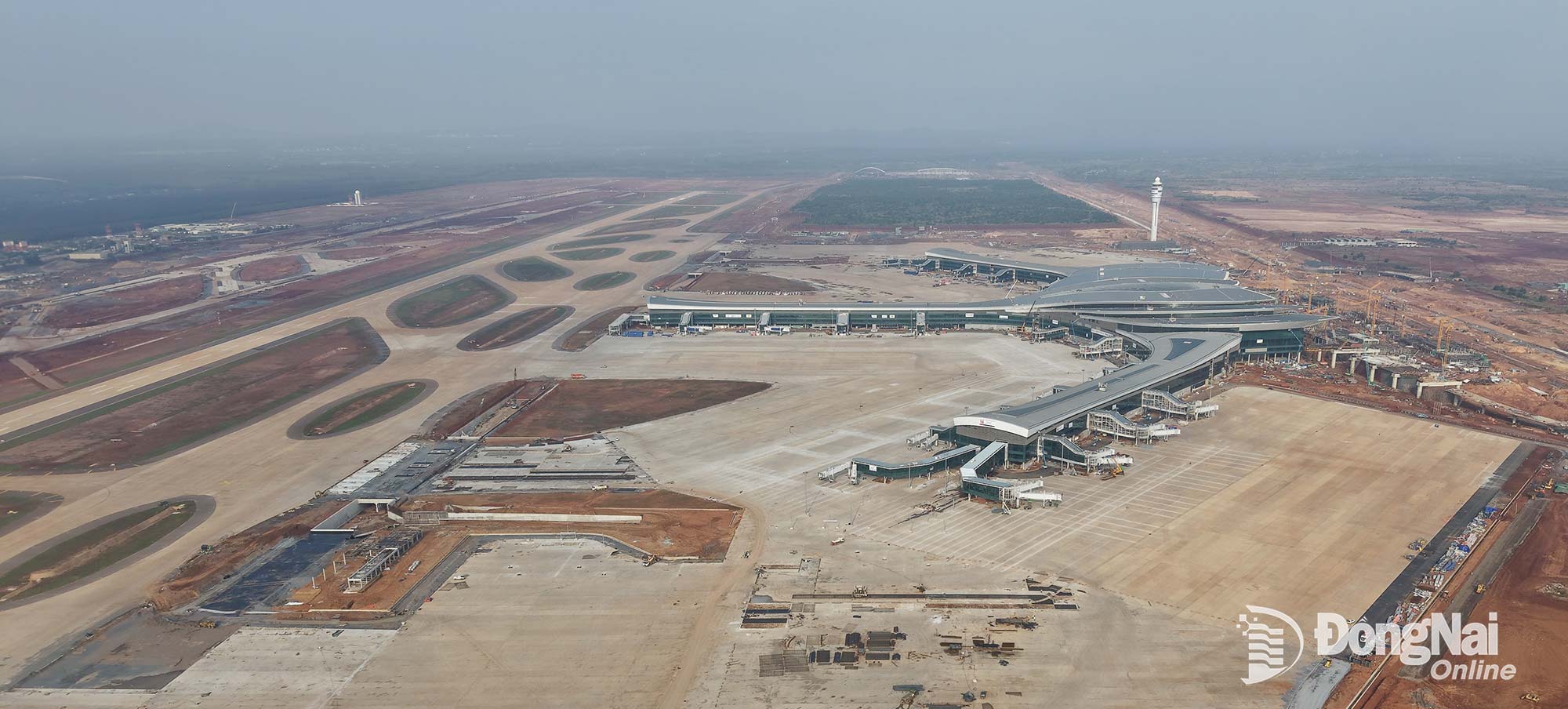 |
| Long Thanh International Airport plays a crucial role in Dong Nai’s development orientation. Photo: Pham Tung |
High and sustainable growth
Following the merger, the new Dong Nai province ranks among the country’s leading localities in terms of economic scale, population and area. In this context, the adjustment of the Dong Nai Plan serves as a foundation to define the locality’s development trajectory in the years ahead.
Member of the Provincial Party Committee (PPC) and Vice Chairman of the Provincial People’s Committee Ho Van Ha stressed that the revised master plan must clearly identify breakthrough orientations, tasks and solutions across key sectors and growth-driving industries. In doing so, Dong Nai will be able to formulate a feasible and high-quality plan capable of meeting its socio-economic development needs.
According to assessments by the consulting consortium comprising The Boston Consulting Group (BCG) and the University of Economics Ho Chi Minh City (UEH), Dong Nai currently possesses numerous strengths and favourable conditions to pursue a new development model aligned with the nation’s new growth era.
Specifically, Dong Nai holds a strategic geo-economic position at the heart of the Southern key economic region, adjacent to Ho Chi Minh City and extending Northwards to border the Kingdom of Cambodia. The province also benefits from multi-modal connectivity through synchronously developed transport infrastructure projects.
In addition, Dong Nai boasts a large economic scale, a diversified and mutually supportive industrial structure, strong investment attraction, and solid fiscal and budgetary capacity. In the new development context, the province also enjoys advantages from a young and abundant workforce capable of rapid adaptation, as well as rich natural resources and strong potential for green economic development.
Notably, within the country’s new growth era, the consulting consortium has proposed a vision of positioning Dong Nai as a new development model driven by advanced and green manufacturing, high-tech agriculture, and an international logistics gateway associated with the operations of Long Thanh International Airport.
According to Assoc. Prof. Dr. Bui Thi Mai Hoai, Director of the Institute for Sustainable Finance under UEH, in order for Dong Nai to develop under the proposed model, the plan must clearly define high technology as an axis to reorganise cross-sectoral and cross-spatial value chains.
Under the roadmap, the revised Dong Nai Plan for the 2021–2030 period, with a vision to 2050, is expected to receive official approval in February 2026.
Three economic pillars
Nguyen Bao Long, Associate Director of BCG, said that based on the proposed development vision for Dong Nai in the new planning period, the consulting consortium has identified three main economic pillars for the province.
Of these, two core sectors, including strategic manufacturing industry (comprising electronics, equipment, components, machinery, new materials; specialised industrial parks and high-tech industrial zones; vocational training centres and high-quality technical human resources) and agro-processing industry — will serve as a group of foundational industries, playing a key role in consolidating Dong Nai’s industrial position within the Southern key economic region. “These sectors will also act as the group of core growth drivers of Dong Nai province,” Nguyen Bao Long noted.
Logistics and transport services, along with high-tech manufacturing, constitute the second growth pillar, enabling Dong Nai to move up the value chain and enhance its attractiveness to international experts and technology enterprises.
Meanwhile, groups of urban services, tourism and green energy industries will form the third economic pillar, ensuring balanced socio-economic and environmental development, steering Dong Nai towards becoming a sustainable, liveable and environmentally friendly province.
According to the consulting consortium’s assessment, under the province’s projected growth and development scenario, the timely completion of strategic national infrastructure projects — particularly Long Thanh International Airport — is considered to have a strong spillover effect on the socio-economic development structure, especially in the 2026–2030 period. Indeed, the airport is expected not only to drive the formation of next-generation processing and manufacturing industries, but also to significantly boost aviation logistics services, trade, tourism and high-end services linked to an international aviation hub.
By Pham Tung – Translated by M.Nguyet, Thu Ha


Thông tin bạn đọc
Đóng Lưu thông tin