
By the end of 2025, Dong Nai province ranked among the top five localities nationwide in attracting foreign direct investment (FDI), with newly registered FDI exceeding 3 billion USD and cumulative FDI reaching nearly 42.9 billion USD.
In recent years, FDI projects in Dong Nai have primarily focused on high-tech industrial manufacturing sectors such as semiconductors, components, electrical equipment, garments, pharmaceuticals, and fabricated metal products. No projects are listed among polluting, labor-intensive industries, ensuring compliance with the province’s criteria for advanced and environmentally friendly technologies.
Unlocking development potential
FDI is regarded as one of the key pillars for achieving double-digit economic growth, as set out by the first Dong Nai Provincial Party Congress for the 2025–2030 term. Previously, this task posed considerable pressure, as industrial parks and clusters in Dong Nai’s central area and Ho Chi Minh City’s economic core had been established for decades and were nearing full occupancy. Meanwhile, newly planned industrial parks required time to complete infrastructure development.
In addition, industrial land rental costs in these central areas remained high, prompting many investors to reassess their strategies and shift toward satellite industrial parks offering more suitable land funds and sufficient space for long-term and sustainable development.
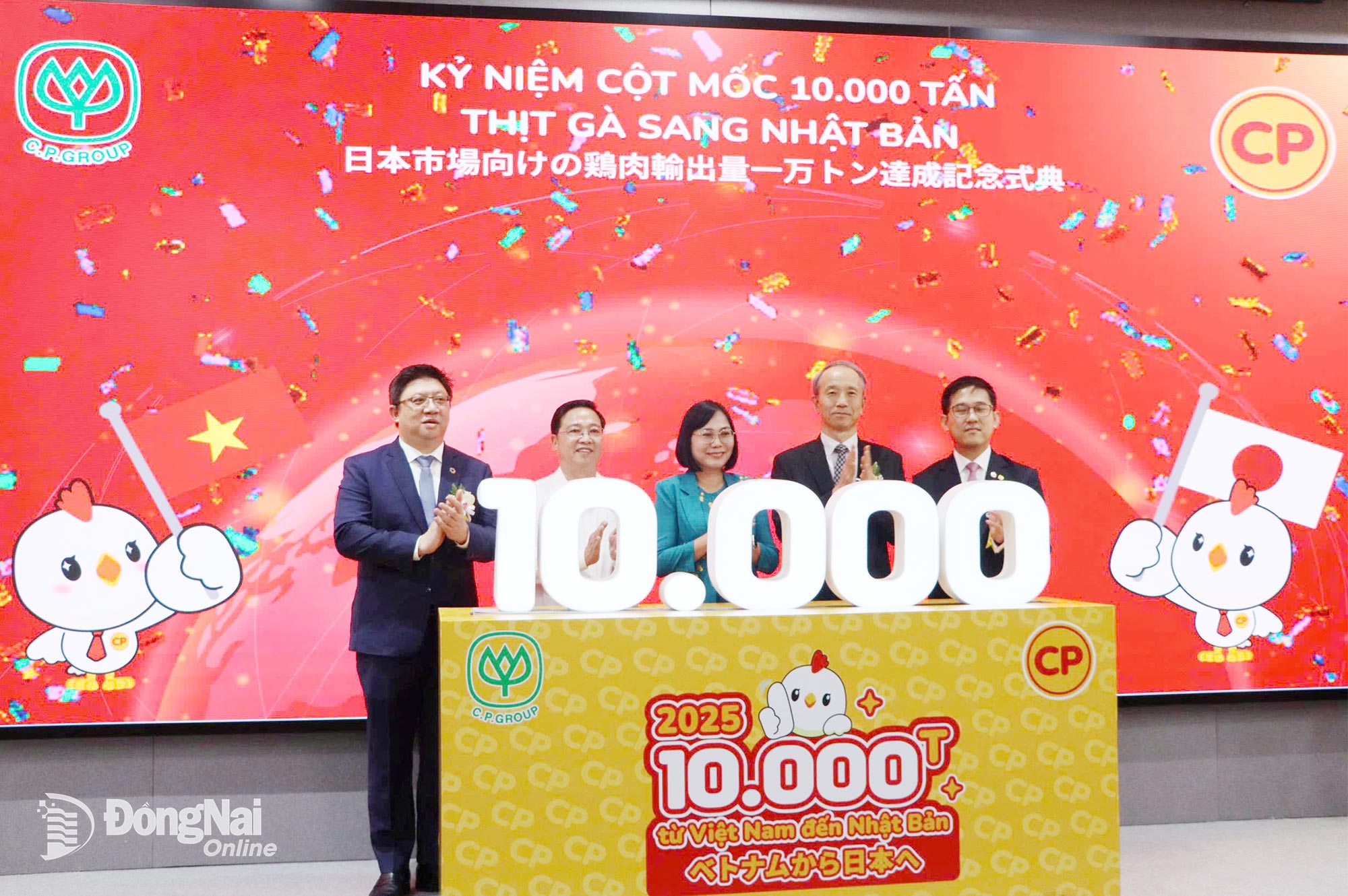 |
| Just five years after commencing operations in Dong Nai, CPV Food Binh Phuoc achieved an impressive export milestone, shipping 10,000 tonnes of processed chicken meat to the Japanese market. Photo: Xuan Tuc |
This challenge became more manageable after July 1, 2025, following administrative unit mergers that created “super-localities” with significantly expanded economic scale, population size, and development space. The newly formed Dong Nai province, based on the merger of the former Dong Nai and Binh Phuoc provinces, now ranks among the country’s leading localities in terms of population, land area, and economic size.
Currently, the Northern area of Dong Nai province (comprising all communes and wards of the former Binh Phuoc province) is considered highly promising due to its vast land reserves. The area hosts 15 industrial parks covering more than 6,000 hectares, along with the Hoa Lu border economic zone spanning over 28,400 hectares, in addition to dozens of industrial clusters with completed infrastructure and transport connectivity. Notably, industrial land rental prices here are significantly lower than in central areas, creating a strong comparative advantage and attracting large-scale, regionally significant investment projects.
Following extensive investment promotion efforts with authorities at all levels, CPV Food Binh Phuoc Co., Ltd. decided in 2020 to invest 250 million USD in the Becamex – Binh Phuoc Industrial Park, located in Chon Thanh ward, Dong Nai province. The complex operates under a fully integrated closed-chain model, encompassing animal feed production, breeding, hatchery operations, broiler farming, slaughtering, processing, and by-product treatment, with a maximum capacity of 52 million industrial chickens and 19,200 tonnes of processed chicken meat annually.
After just five years of operation, CPV Food Binh Phuoc reached a remarkable export milestone by shipping 10,000 tonnes of processed chicken meat to Japan. More recently, the company was granted permission to export processed chicken products to Singapore, one of the world’s most demanding markets with stringent food safety and import regulations. These achievements contributed to cumulative export revenues estimated at over 1.7 trillion VND during the 2021–2025 period, positioning CPV Food Binh Phuoc as one of Vietnam’s leading processed chicken exporters. This is a positive signal for Dong Nai, one of the country’s leading provinces in livestock development, with more than 36 million poultry, primarily chickens, accounting for approximately 33 million heads.
According to Phung Duc Tien, Deputy Minister of Agriculture and Environment, Vietnam’s poultry sector has achieved strong performance in farming, but remains limited in slaughtering and processing facilities at intermediate to advanced levels, with distribution largely confined to the domestic market. Therefore, the establishment of additional poultry processing plants and the expansion into international markets will help address these shortcomings and promote sustainable development of Vietnam’s poultry industry.
Following the success of a major investor in the livestock sector, another industry giant—Shandong Haohua Tire, a subsidiary of China’s HAOHUA Group—has invested 500 million USD in a tire manufacturing plant at the Minh Hung – Sikico Industrial Park in Tan Khai commune, Dong Nai province. The project covers 43 hectares and has a production capacity of 14.4 million tires per year.
In 2025, Dong Nai ranked fourth nationwide in economic scale and remained among the top ten provinces and cities nationwide in investment attraction. Looking ahead, the province is determined to maintain its position among the country’s leading localities in economic growth, targeting double-digit expansion, and to reinforce its role as Vietnam’s “industrial hub.” Accordingly, investors in Dong Nai will receive maximum support throughout the entire project lifecycle, from research and site surveys to implementation and operation. In return, the province requires investors to meet strict criteria regarding financial capacity, modern and clean technologies, and environmental friendliness.
Comrade Nguyen Kim Long, Member of the Provincial Party Standing Committee and Standing Vice Chairman of Dong Nai People’s Committee.
Alongside the completion of phase one, the HAOHUA Group continued its investment at the end of 2024 by allocating an additional 280 million USD to expand the factory by 31 hectares. The expansion phase is expected to achieve a capacity of 10 million tires per year, generating estimated revenues of 322 million USD. Once both phases are completed, the project’s total capacity will reach 24.4 million tires annually, with minimum revenues projected at 1.092 billion USD. With total investment capital raised to 780 million USD, HAOHUA has become the largest tire manufacturer in Vietnam.
A representative of Shandong Haohua Tire stated that since late 2022, the company had surveyed investment opportunities in several countries, including Malaysia, Thailand, Cambodia, and Indonesia. After conducting risk assessments and evaluating investment environments and locations, the company decided to select the Minh Hung – Sikico Industrial Park as its investment destination. The area is known as Vietnam’s “rubber hub,” offering advantages in labor supply, a business-friendly administration, and efficient administrative procedures, aligning well with the company’s investment criteria.
Leveraging the advantages of Southern key economic region
The Political Report presented at the first Dong Nai Provincial Party Congress for the 2025–2030 term affirmed that the province’s future development must be focused and targeted, leveraging the advantages of the southern key economic region while harnessing internal strengths, potential, and competitive advantages. Development must ensure balanced and harmonious growth among localities and regions within the province. The province aims to restructure its development space to create new growth drivers and achieve double-digit economic growth, comprising three main zones: the Southern urban–industrial zone; the Northern industrial–urban zone; and the Northeastern agricultural–ecological–tourism zone.
Dong Nai is currently adjusting its provincial master plan for the 2021–2030 period, with a vision to 2050, to ensure consistency with national socio-economic development strategies and regional and inter-regional spatial planning orientations. The province is also formulating and revising construction, urban, underground space, and sectoral plans to address infrastructure bottlenecks, enhance land-use efficiency, facilitate investment attraction, and mobilize resources more effectively.
In addition, Dong Nai is focusing on new key areas to fully exploit potential and advantages in industry, logistics, trade, services, tourism, agriculture and forestry, and mineral resources. These include the Southern urban–industrial zone linked to Long Thanh International Airport, Phuoc An Port, and the urban areas of Tran Bien, Long Thanh, and Nhon Trach; the Northern industrial–urban zone associated with the Hoa Lu border economic zone, Hoang Dieu border gate, and the urban centers of Binh Phuoc, Dong Xoai, Chon Thanh, and Binh Long; as well as economic zones along rivers and reservoirs, high-tech agricultural areas, large-scale modern livestock farming, and green eco-tourism development. The province focuses on building and refining its development institutions in a synchronized, transparent and feasible manner, aligned with development requirements.
Based on these planning zones, Dong Nai will implement comprehensive solutions to advance two key growth drivers with industrial development as the core, focusing on attracting next-generation strategic investors, filling existing industrial parks, and continuing to draw investment into high-potential parks, prioritizing high-tech industries, green industries, and supporting industries.
By Ngoc Lien, Xuan Tuc – Translated by M.Nguyet, Thu Ha




Thông tin bạn đọc
Đóng Lưu thông tin