
Green production is an inevitable requirement for all economic sectors, especially as global markets become increasingly demanding. This trend requires enterprises and production facilities to innovate proactively.
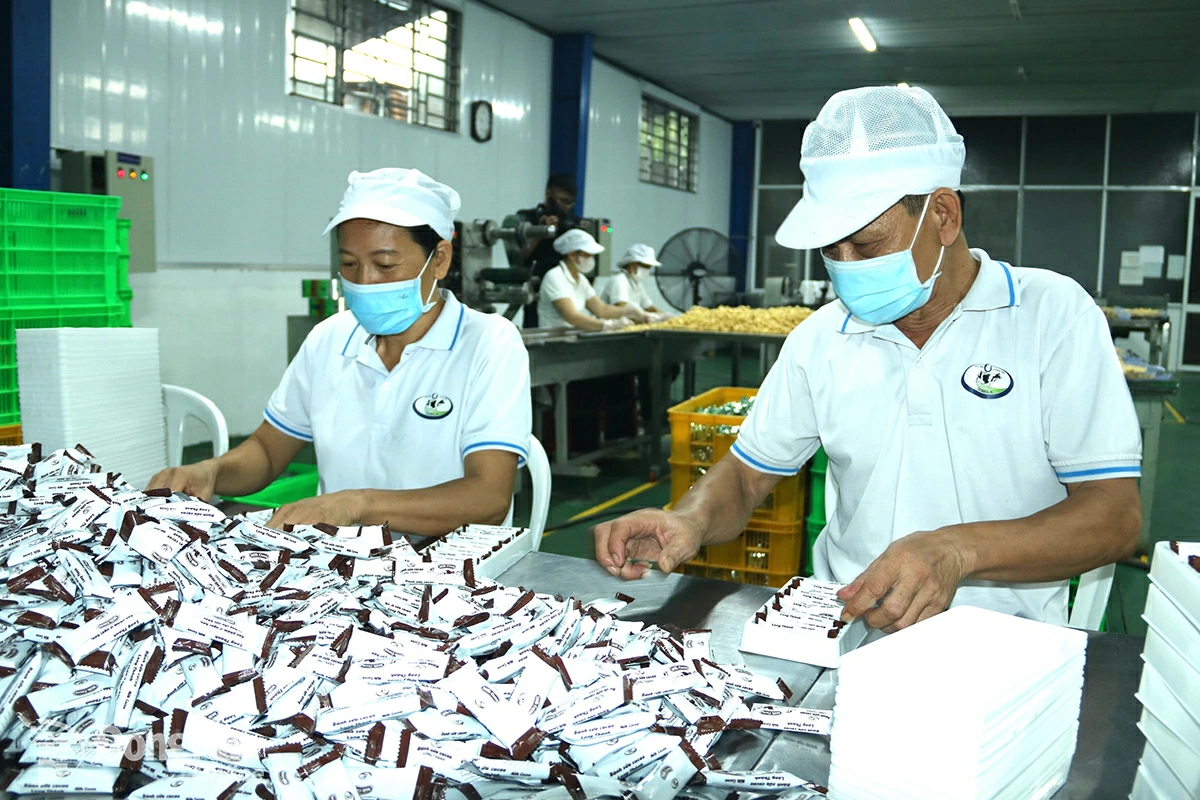 |
| Confectionery production at Domilk JSC in Long Thanh commune. The company collaborates with numerous local farmers in dairy cattle farming. Photo: Vuong The |
In recent years, with support from industrial promotion policies, enterprises and rural industrial facilities in Dong Nai have gradually invested in technologies and processes to green their production activities.
Supporting green technology innovation
Dong Nai’s rural industry is closely linked to processing locally available products and raw materials, particularly agricultural goods. To achieve sustainable development in line with broader trends, rural industrial facilities must increase their investment in technology and shift toward clean, green production. However, this process still faces obstacles.
In reality, many production facilities have not paid adequate attention to product labeling and packaging. Products from enterprises may be rated highly in terms of quality, but their production processes often lack safety and environmental friendliness. At the same time, investing in green production or green packaging increases capital costs, while most rural industrial facilities are small or micro-sized, making them hesitant to undertake such investments.
In the long term, this situation must change. Currently, the Ministry of Industry and Trade has tasked the Agency for Innovation, Green Transition and Industry Promotion with implementing various support programs to assist enterprises in their green transformation and growth.
In Dong Nai, during the 2021–2025 period, the province has supported 37 rural industrial facilities in investing in modern machinery and equipment across various sectors, including cashew processing, wood processing, mechanics, yarn spinning, food processing, and construction materials. These projects have not only helped enterprises increase productivity by 15–40 percent but also significantly improved product quality, reduced raw material losses, and ensured workplace safety.
In addition to local resources, the National Industrial Promotion Program has provided a significant boost to the economy. Notably, projects aimed at supporting the development of the cashew industry have enabled many facilities to invest in advanced machinery and build technical demonstration models in processing, contributing to increased added value for one of the key industries of Dong Nai and the Southeastern region.
Reducing greenhouse gas emissions and lowering the carbon footprint in production is a global trend. Many countries have established technical barriers related to environmental green standards, requiring enterprises in general, and rural industrial facilities in particular, to incorporate these requirements into their strategic planning.
According to Nguyen Duc Trong, Deputy Director of the Dong Nai Center for Industrial Promotion and Industrial Development Consultancy under the Department of Industry and Trade, the center will focus on enhancing the effectiveness of industrial promotion programs in the coming period. This endeavor involves enhancing support for the application of advanced technologies, energy-efficient equipment, and automation in production; promoting technology transfer and modern production models; and encouraging enterprises to adopt cleaner production practices that support green and circular economic development. At the same time, efforts will be strengthened to accelerate digital transformation in governance, trade promotion, supply-demand connectivity, traceability, and product quality management, as well as to improve the capacity of local rural industrial development consultants.
Change must start with mindset
Today, consumers are increasingly concerned about environmental issues. Green transformation enhances enterprise credibility with customers and society, thereby boosting product consumption. Accordingly, in green transformation, enterprises need to pay attention to input materials, replacing high-emission inputs with more environmentally friendly alternatives. Clean technologies should also be prioritized throughout the production process.
 |
| Production at a factory of GC Food JSC, whose products are among Dong Nai’s typical rural industrial products. Photo: Vuong The |
Nevertheless, once enterprises commit to green production processes and high-quality products, costs will inevitably rise. This challenge requires careful calculation and proactive planning from business owners. While immediate results may not be visible, in the long run, enterprises that actively innovate technologies and green their production processes will gain significant advantages.
According to Nguyen Hoang Dat, Director of Vinahe Co., Ltd. in Phuoc Binh ward, the company is striving to apply technology and green production methods to deliver quality products to the market. What local agricultural processing enterprises hope for is access to preferential loans with reasonable interest rates to invest in machinery, expand production and business scale, enhance competitiveness, and accelerate digital transformation.
Green production must also start with the business owner or head of the production facility. To promote green transformation, the first and most decisive factor is the leader's mindset. Dinh Thanh Thien, Director of Laven Group Co., Ltd. in Gia Kiem commune, shared that producing clean coffee is no easy task. He aspires to bring his company’s coffee products to a broader range of consumers. To deliver quality products to the market, production processes must first meet high standards. However, reaching customers is not easy, and the investment required for production lines, human resources, and raw material selection is higher than average. This reality requires business owners to adopt a methodical approach from the outset, build their brand, and establish intellectual property rights to create opportunities for more sustainable brand development.
By Vuong The – Translated by Thuc Oanh, Minho


Thông tin bạn đọc
Đóng Lưu thông tin