
Recently, Dong Nai’s agricultural sector has focused on transforming production and cultivation models toward eco-friendly practices, conserving resources, and improving productivity and the value of agricultural products while protecting the environment, reducing costs, and minimizing risks for farmers. Many businesses, cooperatives, and farmers have implemented solutions and initiatives to promote green practices in both crop production and livestock farming.
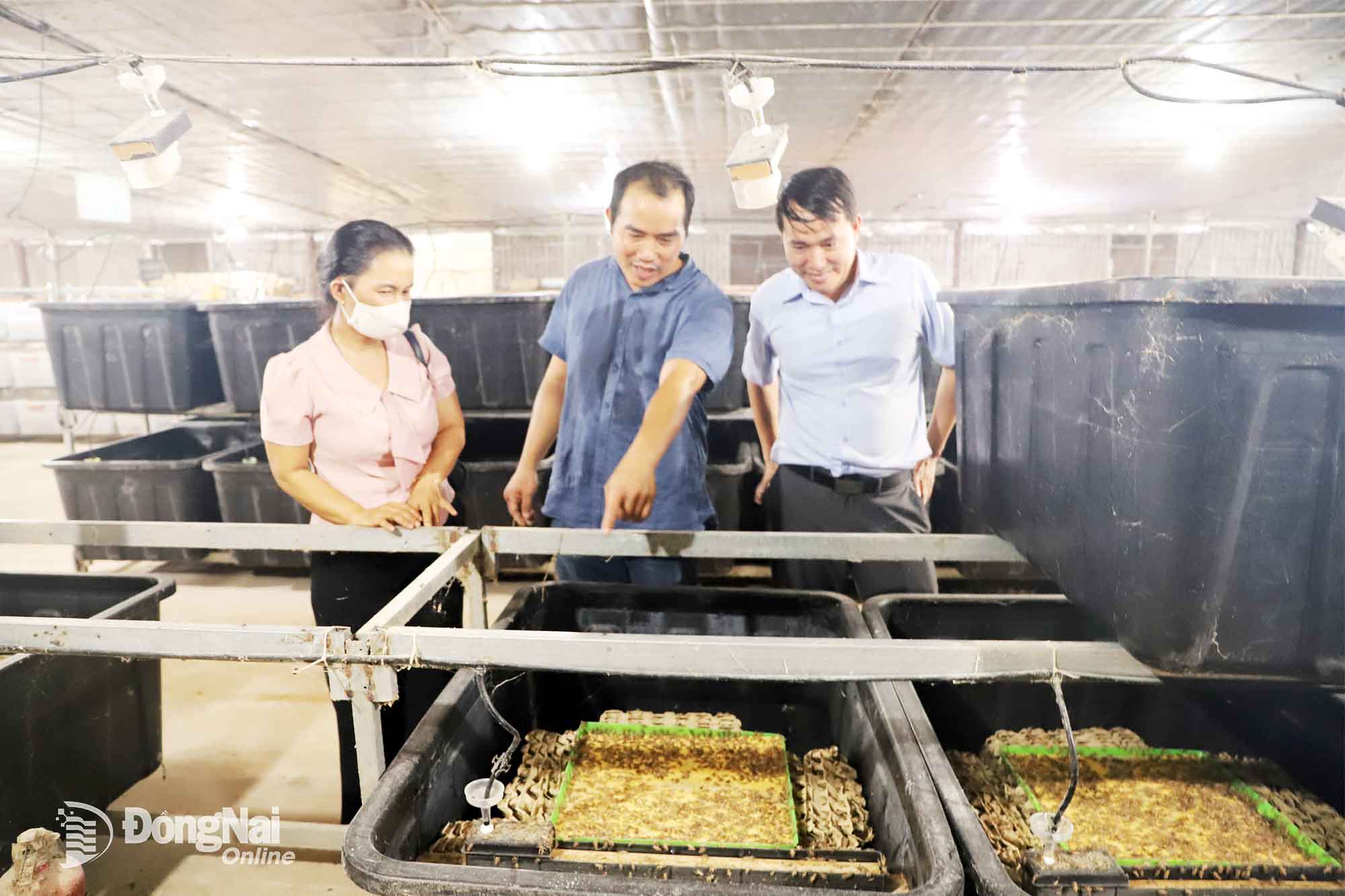 |
| Industrial-scale, environmentally-friendly cricket farming model in Loc Hung commune. Photo: B. Nguyen |
However, to form an ecosystem for green agriculture development and responsible agriculture towards a sustainable future, stronger supporting mechanisms and policies are needed to serve as a solid foundation.
Clean production at low cost
Following the merger, Dong Nai province has gained numerous advantages for developing agriculture production in both crop cultivation and livestock farming. Notably, cooperatives and farmers in the province have proactively implemented circular agriculture models to produce safely at low cost. Many innovative and effective models are willingly shared by farmers to be scaled up in practice.
From individual cricket farming models, Loc Hung commune has now developed a linked-chain cricket farming area, covering breeding, processing, and export, involving dozens of farming households. In particular, Cricket One Co., Ltd. has invested in a processing plant for cricket-based products directly in the farming area, purchasing farmers’ products at good prices and ensuring sustainable market access for them. The company’s processed products are exported to many countries worldwide. This model is encouraged by local authorities for expansion, not only because of its high economic efficiency but also as a circular economy model that contributes to the development of green agricultural production.
The exposed rocky land in Dau Giay commune often features large stones scattered on the surface and mixed within the soil. Therefore, many years ago, farmers in this area mainly cultivated annual crops or cashew trees, achieving low economic returns. These challenges have since motivated farmers to develop various initiatives for soil improvement and cultivation practices.
The specialized avocado cultivation area spanning tens of hectares in this region achieves high economic efficiency, not only due to good yields but also because of the fruit’s excellent quality. This success stems from farmers’ early adoption of creative solutions to produce according to VietGAP standards and transition toward organic practices at low cost.
Pham Duy Long, Head of the Bau Ham 2 - Quang Trung Avocado Cooperative in Dau Giay commune, stated that for many years, local avocado farmers have practiced production according to VietGAP standards, prioritizing the use of organic fertilizers and biological plant protection products. In particular, orchard owners have developed effective soil improvement methods, especially by composting their own organic fertilizers at low cost. They make use of discarded bananas after export or other agricultural by-products to make their own organic fertilizer, and plant grass in the orchards both as feed for cattle and to gradually enhance soil structure, making it more loose and fertile.
Policy-driven “boost”
The Ministry of Agriculture and Environment has recently issued an Action Plan to implement the project on low-emission crop production for the period for 2025-2035, with a vision extending to 2050. A key focus of the project is on groups of solutions to develop green agriculture while reducing emissions. The main solutions include: restructuring crop patterns suitable for ecological regions, applying low-emission technical packages, building production models along value chains, connecting markets for low-emission products, and transferring technology. Through these measures, the project aims to gradually establish an ecological and modern agricultural sector capable of effectively withstanding the impacts of climate change.
Speaking on the implementation of the low-emission crop production project for the 2025-2035 period, with a vision towards 2050, Le Quoc Doanh, Chairman of the Vietnam Gardening Association, stated that the project should focus on key crops that can both create significant impact and be easily scaled up. In particular, pilot models should be designed so that, once completed, production can be immediately expanded on a large scale. The goal is that by 2025, 100% of Vietnam’s key crops will be cultivated using emission reduction measures.
Dong Nai’s agricultural sector places great emphasis on developing circular agriculture. Circular agriculture models are continuously being expanded. The province pays particular attention to implementing programs and policies that encourage the development of circular agriculture.
NGUYEN VAN THANG, Deputy Director of the Department of Agriculture and Environment
Dr. Le Van Tri, Chairman of the Vietnam Biofertilizer Association, stated that the association is implementing biofertilizer solutions for rubber trees at several factories. With support from the Ministry of Agriculture and Environment, the Vietnam Biofertilizer Association is promoting the production of bio-products from organic by-products.
By Binh Nguyen – Translated by Huyen Trang, Thu Ha


Thông tin bạn đọc
Đóng Lưu thông tin