
Ho Chi Minh City’s Ring Road 4 (referred to as Ring Road 4) is the longest and largest-scale ring road project in the Southeastern region. Besides its goal of creating a strategic transport axis and expanding development space for the region and each locality, the project also helps ease urban traffic congestion, promote socio-economic development, and improve infrastructure quality and living standards for local residents.
 |
|
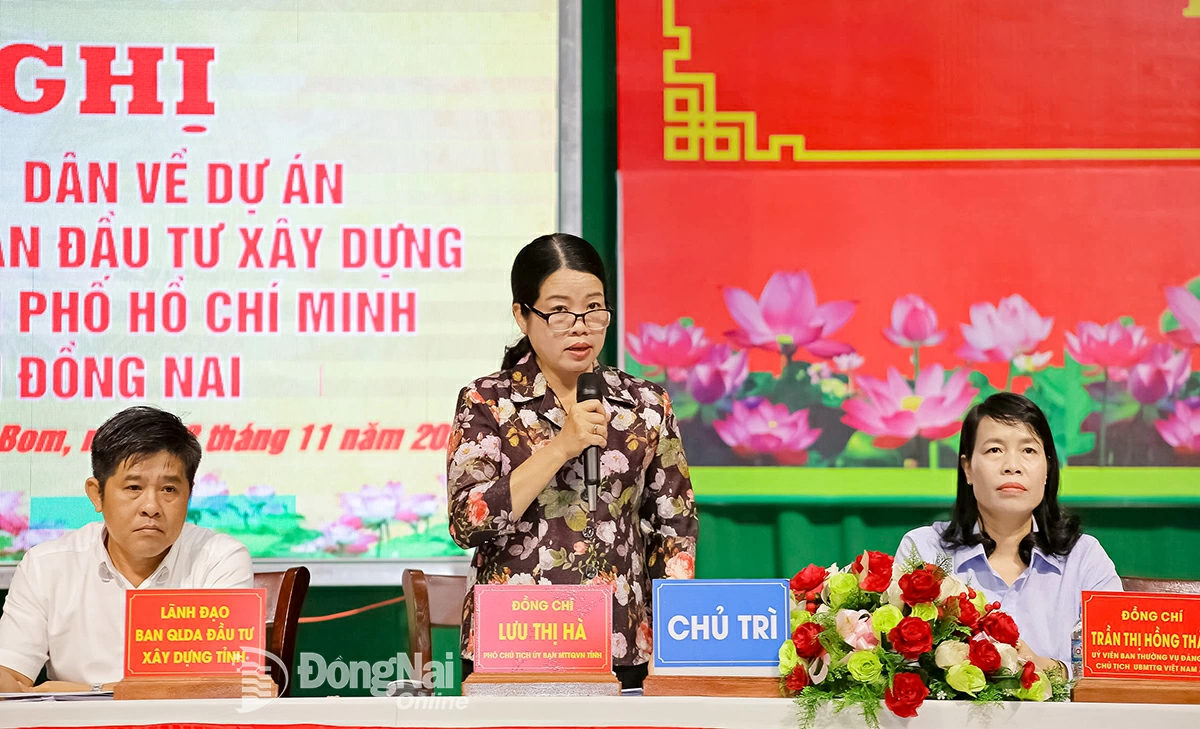
Vice Chairwoman of the Vietnam Fatherland Front Committee of Dong Nai Province, Luu Thi Ha, speaks at the conference held in Trang Bom Commune to gather public feedback on the Ring Road 4 Project. Photo: Thanh Toan |
With these objectives and significance, most residents in the project area in Dong Nai expressed strong support when consulted.
The longest ring road in the region
The Ring Road 4 Project has been approved in principle by the National Assembly, and the Government has issued a resolution for its implementation. The entire route is approximately 207km long, with Phase 1 covering more than 159km and a total investment of over 120 trillion VND. This is the longest and largest ring road in the Southeastern region.
In Dong Nai, the project runs more than 46km, starting at Km18+460 in Xuan Duong Commune (Dong Nai Province) and ending at Km64+540 according to the route alignment, in Thuong Tan Commune (Ho Chi Minh City). It passes through nine communes: Xuan Duong, Xuan Que, Binh An, Dau Giay, An Vien, Hung Thinh, Trang Bom, Binh Minh, and Tan An. The project is divided into two components: Component 1-2, focused on compensation, support, resettlement, and construction of frontage and local access roads, with a total investment of over 10 trillion VND from the provincial budget; Component 2-2, construction of the expressway section under the PPP model, with total investment exceeding 16.2 trillion VND. According to the plan, relevant procedures will be prepared in 2025, construction will begin in 2026, and the route will be completed and put into operation in 2029.
Component 1-2 has completed the public consultation phase. According to the Provincial Construction Investment Project Management Board, local access roads will at least meet rural road standards—Type B or Type A—to ensure residents’ mobility. These roads lie within the planned frontage-road corridor and will be interconnected by bridges or underpasses. At the section intersecting National Highway 1 in Hung Thinh Commune, where population density is high, the frontage road will be built to Grade IV standards with two lanes to meet traffic demand.
Vice Chairwoman of the Vietnam Fatherland Front Committee of Dong Nai Province Luu Thi Ha, emphasized that Ring Road 4 is a national key project spanning multiple provinces, including Dong Nai. Organizing public consultations is a legally required step. The Fatherland Front acknowledges the responsible and straightforward feedback from residents. She requested the Provincial Construction Investment Project Management Board, local authorities, and relevant agencies to seriously absorb residents’ opinions. Local Fatherland Front committees must continue gathering public sentiment, disseminating information, and encouraging consensus to accelerate implementation, while enhancing oversight of policy enforcement affecting residents.
High level of public agreement
On November 12, 13, and 14, the provincial Fatherland Front Committee collaborated with the nine relevant communes to hold public consultation sessions for Component 1-2. More than 2,500 households participated in the sessions, offering many thoughtful and responsible comments.
 |
| Planning map of Ring Road No. 4 – Ho Chi Minh City. Photo: Provincial Construction Investment Project Management Board. |
At the consultation meetings in Trang Bom, Binh Minh, and Hung Thinh communes, nearly 700 households attended. Most expressed support for the project, saying that once completed, it would positively contribute to socio-economic development, improve transport infrastructure, reduce congestion, and enhance quality of life.
Vu Ngoc Truu (Hamlet 4, Trang Bom Commune) stated that he fully agreed with the road construction plan, as it would create new development space. He requested full information on frontage roads, access roads, and their locations and scale to ensure convenient travel after the road is built. He also called for transparent, reasonable compensation for land, crops, livestock, and structures to minimize complaints and maintain social order.
Sharing the same view, Nguyen Thi Ngoc Lan (Hamlet 6, Trang Bom Commune) said that while building a major road is beneficial, it is necessary to ensure access for households living along both sides of the road. She noted that some past major projects had split agricultural land without providing adequate access, causing difficulties. She also hoped to soon receive information on asset inventory, compensation approval, and payment timelines to prepare for land handover.
In Binh An Commune, where the project spans over 4.3km, with about 33 hectares of land recovered across 147 plots belonging to 55 affected households, most residents agreed because the project has been planned for many years. However, many asked for clarity on compensation timelines, resettlement support conditions, and resettlement locations. Many also wanted new homes near their current residences for convenience in livelihood and schooling, and requested compensation rates close to market value, as well as completed resettlement infrastructure prior to land recovery to avoid having to rent temporary housing.
In Xuan Que Commune, residents expressed hope for quick project implementation and called for attention to their lawful rights and interests, including support for livelihood impacts. Some requested a well-designed drainage system for frontage and local roads to avoid flooding and deterioration after completion. Issues related to compensation progress, transparent disclosure of plans, and dialogue with residents were also emphasized.
From the six in-person public consultation sessions and the results of survey forms, it is evident that residents show a high level of consensus and offered many candid, constructive opinions for the Ring Road 4 Project. This strong public support forms an important foundation for smooth, transparent land clearance, compensation, resettlement, and construction. The residents’ support will help the project be completed sooner, creating new momentum for the development of Dong Nai and the entire Southeastern region.
By Hoang Loc, Translated by Trieu Ngan – Thu Ha


Thông tin bạn đọc
Đóng Lưu thông tin