
Dong Nai’s economy is well-positioned for strong growth in the coming years, thanks to its new scale and position. Recent large-scale investments in key economic sectors are expected to accelerate the province’s goal of achieving double-digit economic growth.
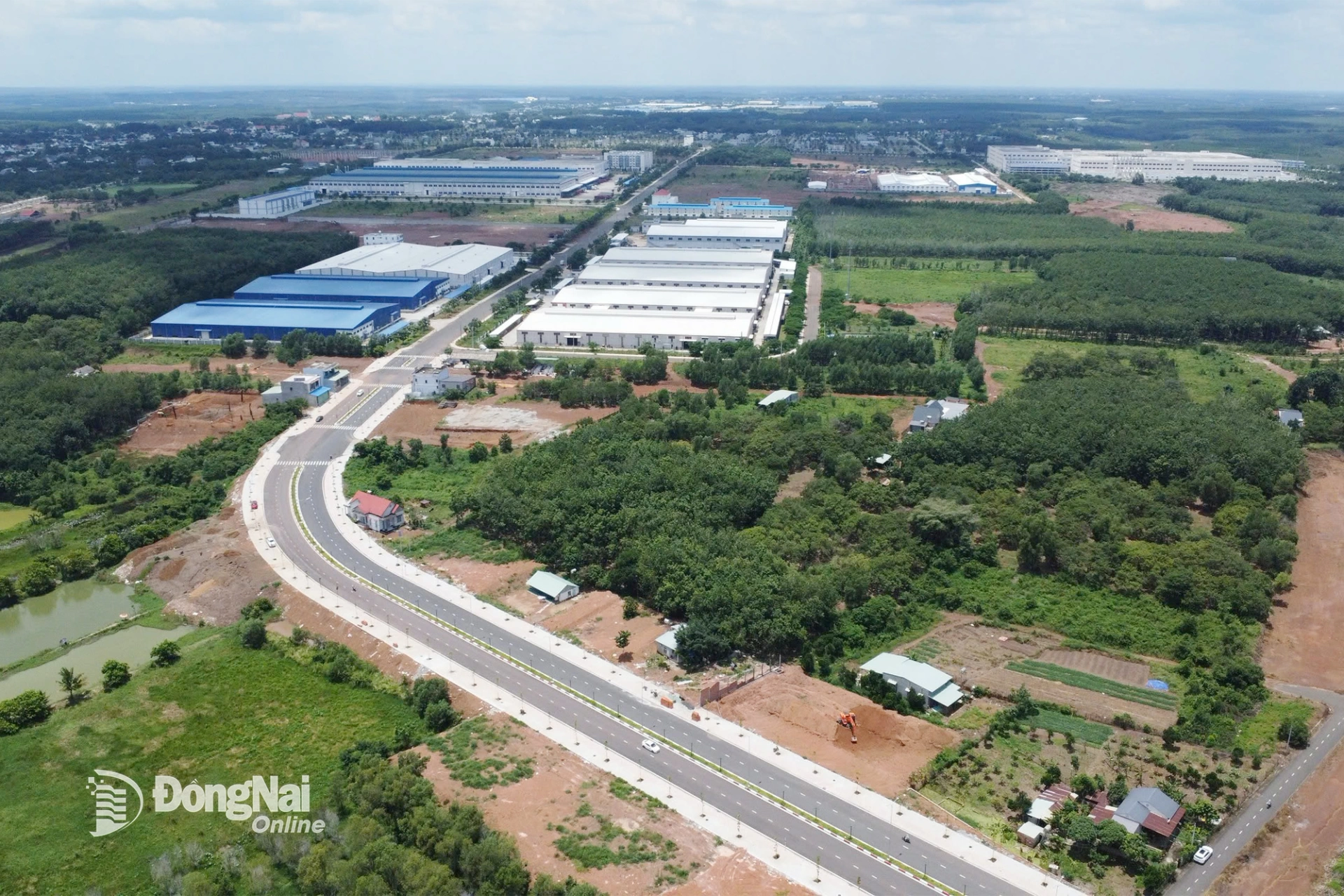 |
| Industry is a cornerstone of Dong Nai’s economic development. In photo: A part of Dong Xoai II Industrial Park. Photo: Vuong The |
Restructuring the economy to align with new circumstances, reorganizing the development space, and strengthening regional connectivity are key solutions for Dong Nai to fully tap into its potential and newly established position.
Focusing on growth cornerstones
In the coming years, Dong Nai is expected to take on a new role in economic development. The province currently has a population of nearly 4.5 million and covers an area of approximately 12,700 square kilometers. It is home to 43 operational industrial parks, with several new parks in the pipeline. Dong Nai also boasts a comprehensive range of major transport infrastructure, most notably Long Thanh International Airport, serving as an iconic infrastructure project for Vietnam in the years ahead.
To fully leverage its strategic position, Dong Nai needs to identify and focus on key growth pillars for the province.
Dr. Tran Du Lich, a member of the National Financial and Monetary Policy Advisory Council, stated that the key pillars Dong Nai should prioritize include the development of logistics, services, trade, and finance, as well as high-tech and supporting industries, and large-scale agricultural processing.
Similarly, Nguyen Anh Tuan, Director of the Department of Construction, noted that Dong Nai needs to reassess its growth drivers based on leveraging the synergistic advantages of both provinces. The province aims to plan and focus on developing high-tech and deep-processing industries, as well as high-tech and organic agriculture, logistics and aviation services, and ecotourism, cultural and historical tourism, and resort development.
According to the Department of Construction, Dong Nai’s three growth-driving regions are: the southern urban-industrial region, serving as the nucleus and a hub for high-tech industries, aviation services, finance, and logistics; the northern industrial-urban region, focused on developing processing industries, supporting industries, and new urban areas; and the northeastern agricultural and tourism region, centered on high-tech agriculture, ecotourism, and biodiversity conservation.
In the future, Dong Nai will establish strategic economic corridors. These include the urban–industrial economic corridor, which will develop along major transport axes; the high-tech agriculture and ecotourism economic corridor, located in the northern part of the province and connected to specialized agricultural zones and national parks; and the Dong Nai riverfront economic corridor, which will leverage the river landscape to develop eco-friendly urban areas, resort tourism, and high-end services.
In the industrial sector, the planning and development of industrial parks will continue to be a central pillar. According to Pham Viet Phuong, Deputy Head in charge of the Management Board of Industrial and Economic Zones of Dong Nai Province, the province is oriented to become a hub for modern, eco-friendly processing and manufacturing industries (modern, eco-friendly industrial parks) by 2030. Key targets for Dong Nai’s industrial development, previously approved by the Prime Minister, are currently being reviewed and adjusted to reflect the new context.
At the same time, Dong Nai is accelerating development in science and technology. According to Nguyen Minh Quang, Deputy Director of the Department of Science and Technology, during the 2025–2030 period, science, technology, innovation, and digital transformation are three new growth drivers, playing a central role in enhancing the productivity, efficiency, and competitiveness of local enterprises.
Restructuring the province’s economic space
Dong Nai’s current development space has taken on a new form. The province is adjacent to the maritime economic zone, connected to the airport and major industrial parks, and also neighbors Cambodia. Dong Nai has become a crucial link on the expanded East–West economic corridor connecting Ho Chi Minh City to Cambodia and Thailand. Trans-Asian infrastructure projects are either underway or planned, including the Ho Chi Minh City – Loc Ninh railway connecting to Cambodia and the Chon Thanh – Hoa Lu expressway. Dong Nai is a key gateway for Vietnamese goods to reach the ASEAN market. Border economic zones, such as Loc Ninh (Hoa Lu), need to focus on investment to attract logistics services and regional transshipment hubs for the southern region, while also leveraging tourism and investment flows from Thailand and Cambodia through the crossings.
 |
| Workers at Minh Hung – Sikico Industrial Park, Tan Khai commune, Dong Nai province, during working hours. Photo: Vu Thuyen |
According to architect Ngo Viet Nam Sơn, Dong Nai needs to study the allocation of industrial space to suit the new realities. The province must be linked to regional connections and areas adjacent to Ho Chi Minh City, while traditional development zones should focus on priority sectors. At the same time, industrial parks should be gradually transformed into urban areas, with part of the industrial development expanding toward the former Binh Phuoc.
Sharing the same view, Huynh Thanh Dien, a lecturer at Nguyen Tat Thanh University, stated that the newly restructured Dong Nai Province is entering a phase of larger-scale, long-term development. The province needs to proactively seize opportunities to comprehensively rebuild its investment ecosystem, encompassing a range of measures, including reviewing and adjusting industrial planning, streamlining licensing procedures, strengthening the legal framework, and redesigning targeted incentive policies. These measures will lay the foundation for Dong Nai to become a strategic industrial growth hub, effectively linking the region to the south with the Southeast and to the north with the Central Highlands.
Speaking with scientists at the workshop on feedback for the adjustment of Dong Nai Province’s master plan for the 2021–2030 period, with a vision to 2050, Vo Tan Duc, Deputy Secretary of the Provincial Party Committee and Chairman of the People's Committee of Dong Nai Province, affirmed that Dong Nai is opening up an entirely new strategic space. Developing under a multi-centered, multi-tiered linkage model, with growth cores located in the Bien Hoa – Long Thanh – Nhon Trach cluster and the previously established Dong Xoai – Chon Thanh cluster, will be key to fully unlocking the advantages of the restructured province. Throughout its development process, Dong Nai remains committed to collaborating with the business community and incorporating the insights and recommendations of experts and scientists, with the goal of becoming a modern and sustainable province.
By Vuong The – Translated by Thu Hien, Minho


Thông tin bạn đọc
Đóng Lưu thông tin