
In preparation for the 14th National Party Congress, the identification of three strategic breakthroughs in the draft documents holds profound significance, reflecting the Party’s new development vision in the new era.
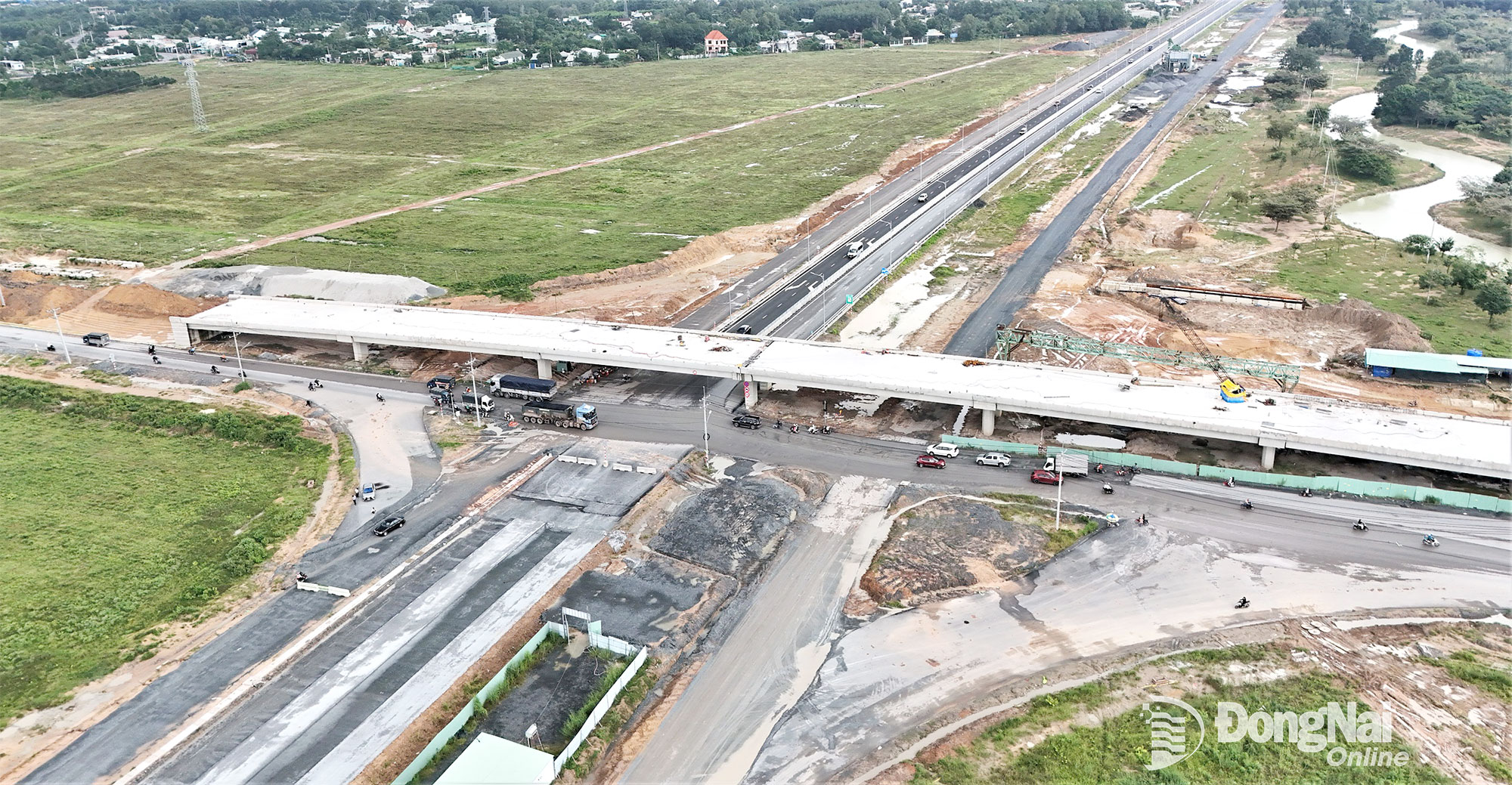 |
| The third strategic breakthrough in the Draft Political Report of the 14th National Party Congress focuses on building a modern and synchronized infrastructure. In the photo: A transport project connecting Ho Chi Minh City and Dong Nai province under construction. Photo: Pham Tung |
The three strategic breakthroughs have consistently been identified by the Party as the pillars of national development strategy. From the 11th to the 13th National Party Congress, these breakthroughs focused on improving institutions, developing human resources, and building synchronized infrastructure. The draft documents for the 14th Congress inherit this thinking but introduce new developments in connotation, scope, and approach, suitable to the evolving domestic and global context.
Strong breakthrough in institutional reform
The first breakthrough identified in the draft documents of the 14th National Party Congress is: “A strong breakthrough in institutional reform, improving the capacity for policy formulation and implementation of the Party’s guidelines and the State’s laws and policies, in order to unlock, liberate, and effectively utilize all resources.”
This orientation reflects the Party’s strategic vision in shifting the focus from building institutions toenhancing the capacity to operate them. Whereas the previous emphasis was primarily placed on completing the legal framework and policy mechanisms, the core issue now lies in the capacity for implementation, organization, and national governance. In practice, many sound and appropriate policies have been issued, yet their implementation remains inconsistent; delays, fragmentation, and bottlenecks persist across various sectors and administrative levels. Thus, this breakthrough in institutional reform aims to transform policies and resolutions into concrete, effective action, creating unified and smooth governance throughout the system.
A notable aspect is the promotion of decentralization and delegation of authority between central and local governments, accompanied by strengthened power control to ensure institutional unity while maintaining flexibility in execution. This step concretizes the policy of building a law-governed socialist state that is enabling, action-oriented, and serves the people. With greater autonomy and clearer accountability, localities can foster creativity, leverage their unique advantages, thereby generating new momentum for growth and competitiveness.
The draft also emphasizes the role of science, technology, innovation, and digital transformation in institutional reform — reflecting the Party’s modern vision of aligning institutional reform with scientific and technological progress. Institutions are not only regulatory frameworks but alsoinnovative and enabling environments that encourage experimentation and nurture new business models.
Notably, the affirmation of the role of the private sector, the startup ecosystem, and new production and business models marks a significant step forward in the Party’s development thinking. The private sector is not merely a component of the economy but is recognized as a key driver of growth, contributing to job creation, technological innovation, and national competitiveness.
Human resources – the “Breakthrough of breakthroughs”
If institutional reform is the “lever,” then human resources are the driving force behind all development. The draft documents of the 14th National Party Congress clearly state: “Focusing on restructuring and improving the quality of human resources, developing a high-quality, highly skilled workforce, and strongly attracting and utilizing talented individuals.”
The key point here is from quantitative to qualitative development of human resources, ensuring an appropriate structure. It is not only about training “enough people” but ensuring the “right people in the right positions” in the context of the digital, green, and knowledge-based economy reshaping the labor market.
This breakthrough highlights the mindset of placing the pool of cadres at the center of high-quality human resource development. The emphasis on “encouraging and protecting dynamic, innovative officials who dare to think, dare to act, and dare to take responsibility for the common good” represents a progressive governance mindset aimed at building a culture of innovation within the public sector.
Additionally, institutionalizing the principles of “recruitment and dismissal,” “promotion and demotion” concretizes the requirement to enhance the quality of leadership and management teams, ensuring personnel work is objective, fair, and effective. This approach helps overcome stagnation within the apparatus and promotes a healthy, and transparent competitive environment within the political system.
Among the three breakthroughs, the one concerning human resources carries the deepest humanistic meaning, as it aims to fully unlock the potential of the Vietnamese people and views humans as both the goal and the driving force of development.
Infrastructure - the material foundation for sustainable growth
The third breakthrough in the draft centers on building synchronized, modern socio-economic infrastructure, with a new emphasis on digital transformation, green transition, energy, and climate change adaptation.
Compared with previous congresses, the scope of “infrastructure” has been expanded and modernized. While infrastructure was previously understood primarily as transportation, urban development, energy, and information, it now also includes “infrastructure for governance and development facilitation” - including data platforms, technology, institutions, and operational mechanisms.
The identification of “multimodal infrastructure, technological infrastructure, and infrastructure for digital and green transformation” demonstrates a strategic foresight in shaping new development spaces for Vietnam. It also concretizes the country’s commitment to sustainable development and the goal of achieving net-zero emissions by 2050.
Importantly, this infrastructure breakthrough is closely linked to the breakthroughs in institutional reform and human resources, because only with open institutions and capable human resources can infrastructure investment be effective, avoiding fragmentation and poor coordination.
Compared with the 13th National Party Congress, the breakthrough in institutional reform represents a qualitative development in leadership thinking: shifting from “creating favorable environment for development” to “building an enabling institutional framework for development”; from a mindset of permission to a mindset of facilitation, ensuring that all social resources are effectively mobilized and fully utilized in the pursuit of a prosperous and happy Vietnam.
Three pillars, one vision
The three strategic breakthroughs outlined in the draft documents for the 14th National Party Congress form a coherent and mutually reinforcing framework. Institutions define the “rules” of the game for the economy; human resources are the direct actor that act and innovate within that framework; whileinfrastructure provides the material and technological foundation to realize development goals.
When these three elements are implemented in a coordinated manner, Vietnam can establish new national development capacities, capable of adapting to global fluctuations and seizing opportunities in the digital era. This marks not only a continuation but also a transformation in thinking, from “renovation” to “breakthrough development,” from “policy planning” to “effective implementation” mindset, and from “extensive growth” to “quality and innovation based growth.”
The three strategic breakthroughs in the draft documents of the 14th National Party Congress embody the Party’s practical and long-term development vision for the new period. They are not merely orientations but a strong political commitment to advancing Vietnam toward the goal of becoming a developed, high-income country by the mid-21st century.
The key point lies in the need for achieving “breakthroughs in action”, through clear mechanisms for supervision, evaluation, delegation of authority, and accountability. When institutions operate smoothly, people are empowered to innovate, and infrastructure becomes an open platform for progress, the nation will truly enter a new stage of breakthrough growth.
By Pham Ngoc Hung – Translated by Thuc Oanh, Thu Ha


Thông tin bạn đọc
Đóng Lưu thông tin