
Reporting at the first meeting of the Provincial Party Executive Committee, the 2025–2030 term, held on October 17, Alternate member of the Party Central Committee, Standing Deputy Secretary of the Provincial Party Committee (PPC) and Chairwoman of Dong Nai People’s Council Ton Ngoc Hanh said that in the first nine months of 2025, the global and regional economy continued to experience complex and unpredictable developments. Natural disasters, epidemics and climate change occurred on a large scale, negatively affecting socio-economic development. Nevertheless, the province’s gross regional domestic product (GRDP) rose by 8.86%, surpassing the government’s assigned target of 8.5%.
The PPC has consistently followed and effectively implemented the resolutions and conclusions of the Party Central Committee, the Politburo, the Secretariat, the National Assembly and the Government. It has focused on leading, directing and coordinating the synchronous execution of tasks and solutions. As a result, in the first nine months of 2025, the Provincial Party organization achieved many positive, comprehensive and significant outcomes across all sectors.
 |
| Alternate member of the Party Central Committee, Standing Deputy Secretary of the PPC and Chairwoman of the Dong Nai Dong Nai People’s Council Ton Ngoc Hanh reports on the province’s performance in the first 9 months of 2025 and outlines the work program for the fourth quarter of 2025. Photo: Huy Anh |
One of the key highlights was the completion of the project to merge Dong Nai and Binh Phuoc provinces into the new Dong Nai province; the restructuring of commune-level administrative units; and the termination of district-level administrative units. The province also successfully launched the two-tier local government model, which now operates smoothly with efficiency and effectiveness.
In terms of socio-economic management, the province has remained steadfast in its goal of achieving double-digit economic growth. As a result, GRDP increased by 8.86%, higher than the government’s target of 8.5%. Total social investment capital was estimated at VND 489.03 trillion, up 13.79%. Supply and demand, as well as commodity prices, remained stable, while production and business activities recorded positive growth. The industrial production index rose 14.03%, and total retail sales and service revenue climbed 18.3%.
Key projects and infrastructure works received close attention, with obstacles in site clearance and construction being actively addressed to accelerate progress, particularly the Long Thanh International Airport project, the Bien Hoa–Vung Tau Expressway, Ring Road No. 3, and the relocation of Bien Hoa 1 Industrial Zone. On August 19, eight projects with total investment capital of about VND 50 trillion were launched, notably including the Ma Da Bridge connecting the former Dong Nai and Binh Phuoc provinces. Another eight projects began on September 27.
State budget collection exceeded the plan, reaching VND 63.98 trillion, equivalent to 91% of the target set by the Prime Minister and 86% of the target assigned by the Provincial People’s Council. Agricultural, forestry, livestock and aquaculture production remained stable, while the new rural development program achieved outstanding results. Social welfare policies for policy beneficiaries, people with meritorious services, the poor and those in difficult circumstances were implemented effectively and timely. Cultural, social security, education, tourism, sports, information, communication, science, technology, innovation and digital transformation activities were also actively promoted. Leadership and administration methods have been renewed toward greater specificity and accountability, in line with the principle of “six clears”: clear person, clear task, clear responsibility, clear timeframe, clear authority and clear outcome.
National defense, security and social order were firmly maintained, ensuring no passivity or surprise incidents, especially during holidays and Tet. The province completed 100% of its military conscription targets across all levels. Anti-corruption, thrift practice and waste prevention were strengthened. The political and ideological situation among Party members, civil servants, employees and the public remained stable after the administrative restructuring in line with Resolution No. 18-NQ/TW.
Cadre work was carried out in accordance with procedures and regulations. Party organization principles and activities were upheld, while internal unity continued to be consolidated. Inspection and supervision were conducted as planned, with proactive monitoring of Party organizations and members to promptly address violations. Citizen reception, complaint handling and petition settlement were performed in compliance with legal procedures.
The province successfully led and organized the Party Congresses of 99 subordinate Party committees and the first Dong Nai Provincial Party Congress for the 2025–2030 term. The event was conducted solemnly, carefully and effectively, achieving all its objectives.
 |
 |
 |
 |
 |
 |
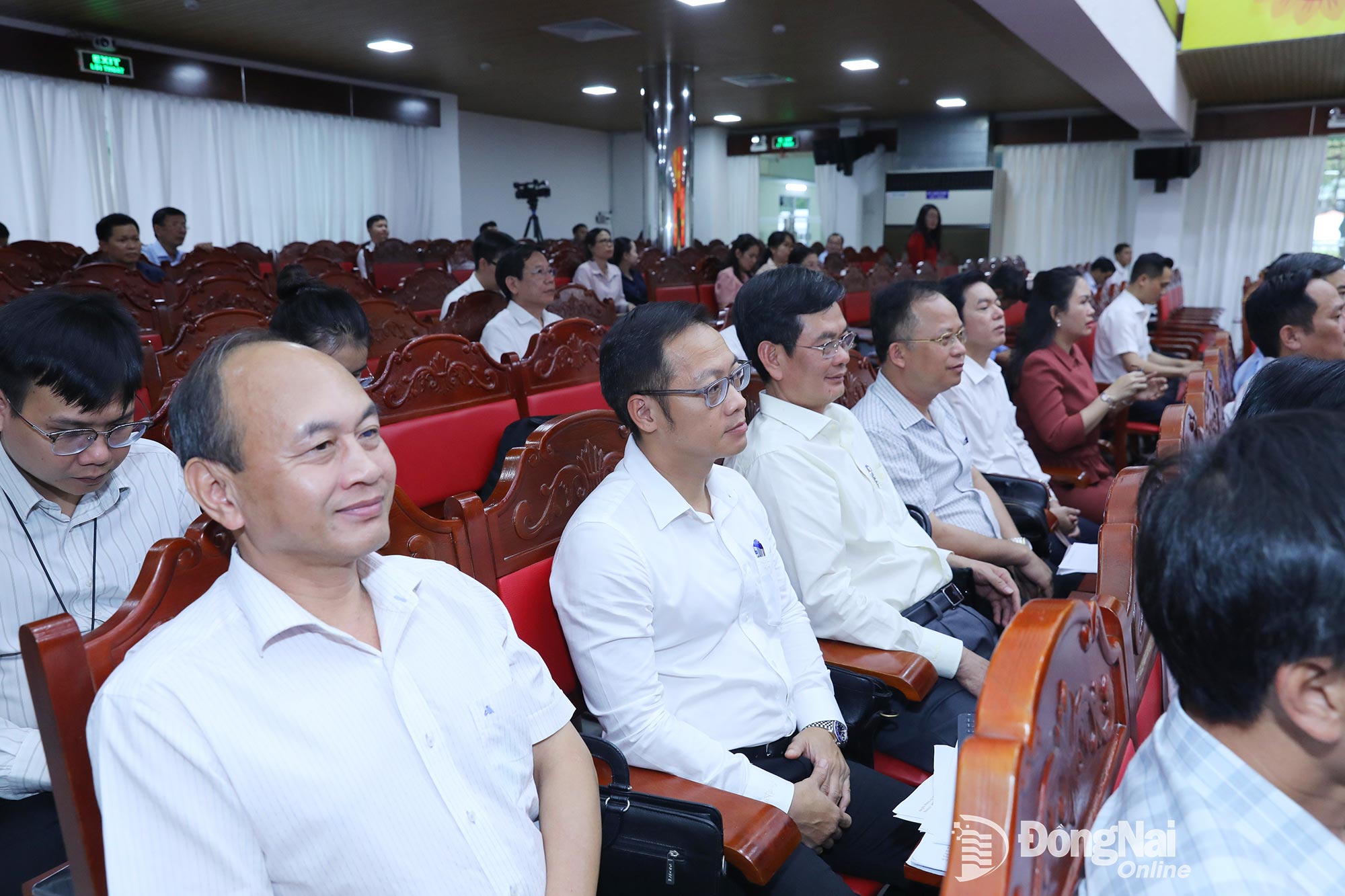
| Delegates attend the first conference of the Dong Nai Provincial Party Executive Committee for the 2025–2030 tenure. Photo: Huy Anh |
Along with the above-mentioned comprehensive achievements, some shortcomings and limitations remain. Economic growth, although positive compared to the same period last year, has yet to display a strong breakthrough. Certain growth-driving sectors and land-use advantages have been identified but are still underexploited, with unclear solutions and roadmaps.
Public investment capital disbursement, though improved, remains low, reaching only 41.08% of the Prime Minister’s assigned target. Site clearance, compensation and resettlement for several key projects have progressed but remain slow.
The handling of obstacles and long-standing issues in some projects remains behind schedule. While initial results have been achieved in land valuation and auctions, more determination and effort are needed in the fourth quarter of 2025 to meet the goals set by the PPC.
Urban and rural planning, as well as the approval of general urban planning projects and subdivision plans, have been progressing slowly. The development of social housing for officials, public servants, armed forces personnel, public employees, workers, and laborers remains at a low rate. Meanwhile, the living conditions of some residents in ethnic minority and border areas are still difficult.
Land compensation, site clearance, and resettlement arrangements for several projects have been slow, facing numerous difficulties and obstacles during implementation.
High-quality human resources, particularly for emerging industries, remain insufficient. The development of science, technology, innovation, and digital transformation has yet to show significant progress, with implementation still moving at a slow pace. Meanwhile, climate change and weather patterns continue to evolve in complex and unpredictable ways.
Medical personnel remain insufficient, failing to fully meet the needs of healthcare services and disease prevention efforts.
Rural solid waste collection rates remain low, and cultural facilities in remote areas are still lacking.
Certain types of crimes have increased, particularly fraud and asset appropriation (mainly online scams) as well as theft.
The causes of these shortcomings stem from both objective and subjective factors, with some issues affected by the rapidly changing global situation. The leadership and direction of some Party committees, organizations, and heads have not been truly proactive or resolute. Awareness of the role of Party and political system building and rectification work remains uneven. Management and administrative capacity, has, at times and in certain matters, failed to meet requirements. Problem-solving and bottleneck removal have been slow.
In some agencies, units, and localities, the implementation of tasks has, at times and in certain matters, not been carried out decisively or in a timely manner. A portion of officials still display a dependent mindset, showing hesitation, avoidance, or fear of responsibility. They lack close engagement with practical realities, initiative in coordination, and diligence in inspection, supervision, and follow-up, leading to slow and prolonged progress with limited effectiveness, particularly in areas such as public investment disbursement, land auctions, and the handling of projects and cases. In addition, some project investors have yet to proactively coordinate in matters of land compensation, site clearance, land-related procedures, investment processes, and project implementation.
Several localities are facing shortages of personnel in key sectors such as land administration, construction, finance, information technology, healthcare, and planning. They also continue to encounter difficulties related to office facilities, physical infrastructure, and equipment serving local government operations, while information infrastructure for administrative procedures has deteriorated.
Policies related to civil servants affected by administrative restructuring remain insufficient, especially for those reassigned far from home or working under high pressure.
Faced with both achievements and limitations, the conference focused on analyzing the root causes, clarifying current difficulties and obstacles, drawing lessons learned, and proposing key directions and solutions to ensure the effective implementation of tasks and objectives in the coming period.
By Phuong Hang – Translated by M.Nguyet, Thu Ha


Thông tin bạn đọc
Đóng Lưu thông tin