
In the 2025-2030 period and the following years, Dong Nai aims to develop the digital economy, green economy, circular economy, sharing economy and knowledge economy; and to take the lead in developing the aviation economy, high-tech industry, high-tech agriculture, logistics centres, science, technology, innovation and digital transformation.
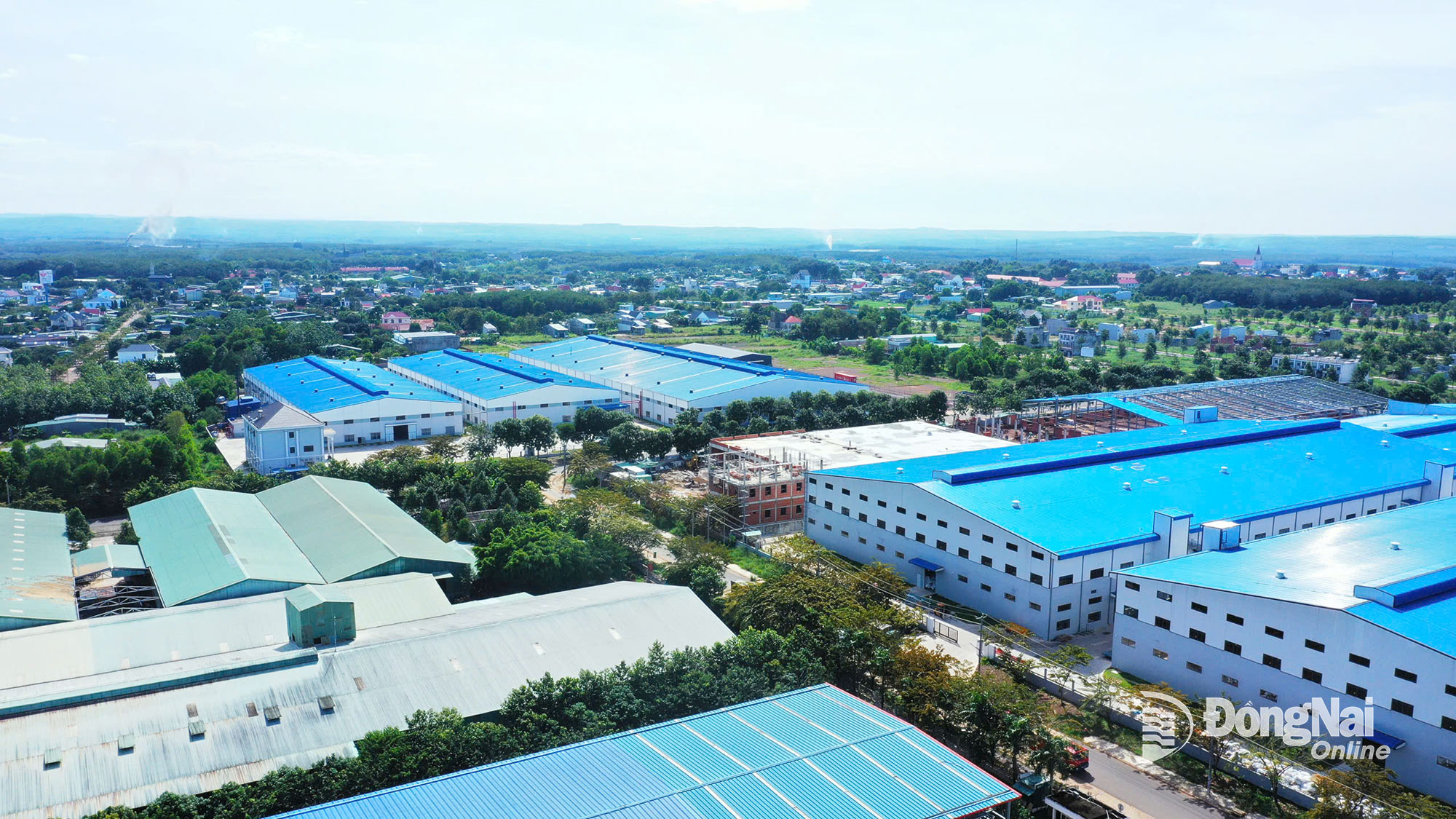 |
| Dong Xoai III Industrial Park (IP) in Binh Phuoc ward is among the destinations attracting investors. Photo: Phu Quy |
To realise these goals, Dong Nai is striving to maximise internal strengths while “paving the way” through infrastructure development, administrative reforms, strengthening external relations and international integration; and promoting its role as a regional hub in the Southeastern region to create optimal conditions for attracting potential investors, especially in sectors using foreign direct investment (FDI).
Creating a “boost” to attract FDI
With the fourth-largest economy in the country, and a high-quality labour force ready to serve enterprises, combined with a strategic location and a diverse range of transportation options, particularly the Long Thanh International Airport, a national key project expected to generate a new wave of economic growth once operational, Dong Nai is accelerating efforts to “pave the way” for a new influx of FDI.
One of the key efforts to welcome investors is the acceleration of land clearance and necessary procedures to soon start construction of new industrial parks (IPs) such as Long Duc 3 IP covering more than 244 hectares; Bau Can - Tan Hiep IP (phase 1) and Xuan Que - Song Nhan IP (phase 1), each covering 1,000 hectares. All of these IPs are located near Long Thanh Airport and are scheduled to commence construction on December 19, 2025. Once operational, these IPs are expected to attract about USD 12.7 billion in FDI and create jobs for about 80,000 to 90,000 workers.
Besides above IPs, several IPs in Northern Dong Nai are also being planned and studied. A typical example is the Dong Nam Dong Phu IP, a project proposed by Techtra Infrastructure Investment and Development Joint Stock Company in Binh Phuoc ward, with a planned area of approximately 2,000 hectares.
In addition to industrial land preparation, Dong Nai has also introduced a series of investment support policies. According to Deputy Head of the Dong Nai Industrial and Economic Zones Authority (DIEZA) Nguyen Minh Chien, enterprises investing in the province will be entitled to preferential policies on corporate income tax, export and import tax, value-added tax, and land and water surface rent… when they meet the legal requirements for investment and tax incentives. Dong Nai will continue to promote administrative reform, implement interconnected one-stop mechanism, shorten licensing time and assign focal contact points to assist businesses in resolving difficulties. The province is focusing on attracting projects that meet high-tech criteria, generate low emissions, create high added value and link effectively with domestic and regional supply chains. It is also encouraging regional connectivity to leverage synergies between Dong Nai, Ho Chi Minh City, the Central Highlands and neighbouring provinces.
In the first nine months of 2025, Dong Nai attracted more than USD 2.4 billion in FDI. Of this, 142 newly registered projects accounted for more than USD 1 billion, while 144 other projects registered to increase capital with an additional more than USD 1.3 billion. The province is currently home to more than 2,200 FDI projects with a total registered investment capital of over USD 42 billion.
Opportunities for FDI investors
In recent times, Dong Nai has welcomed numerous business delegations, embassies and consulates coming to explore local investment opportunities. Through these working sessions, the investors have consistently affirmed that Dong Nai is one of the ideal destinations in Vietnam thanks to its advantageous geographical location and well-connected transport system.
For investors who have been operating in the province for many years, Dong Nai continues to be a trusted destination. The clearest evidence is that in the first nine months of 2025, there were 144 projects registering to increase investment capital worth a total of over USD 1.3 billion, a number higher than newly registered projects.
 |
| Leather footwear production at Changshin Vietnam Co., Ltd., an enterprise with more than 30 years of investment in Dong Nai. Photo: Ngoc Lien |
Reflecting on the investment process in Dong Nai over the years, Chairman of the Taiwan Business Association in Dong Nai Dien Khon Truong said many Taiwanese enterprises have invested and operated here for more than 30 years, since Vietnam began its economic opening. During their operations, they have received strong support from provincial leaders and relevant departments. As a result, Taiwanese businesses have continuously expanded and made new investments in Dong Nai and have become among the top three countries and territories with the largest FDI inflows into the province. Recently, more Taiwanese high-tech firms have invested in electronics, semiconductors and supporting industries.
At present, Dong Nai’s investment environment offers all the essential conditions sought by FDI investors: a regional transport hub, low risk of natural disasters, synchronised and transparent master planning, abundant industrial land and stable, transparent investment policies. The province’s service-oriented governance approach also creates a sustainable competitive edge. Therefore, FDI enterprises coming to Dong Nai tend to stay for the long term, deepen links with domestic firms and enhance localisation rate to build sustainable supply chains.
Along with administrative reform, investing in a synchronised infrastructure remains a top priority. With its strategic location as a regional transport hub in the Southern key economic region, the province is expediting major projects such as Long Thanh Airport, the expressways of Bien Hoa - Vung Tau, Ben Luc - Long Thanh, Dau Giay - Lien Khuong, Gia Nghia - Chon Thanh, regional ring roads, and logistics systems connected with IPs. These projects form the “foundation” that helps foster investor confidence in expanding production and investment.
By Ngoc Lien – Translated by M.Nguyet, Thu Ha


Thông tin bạn đọc
Đóng Lưu thông tin