
In the context of fragmented agricultural production and volatile market prices, developing the collective economy is considered an optimal solution to help farmers improve market access, apply science and technology, and share risks.
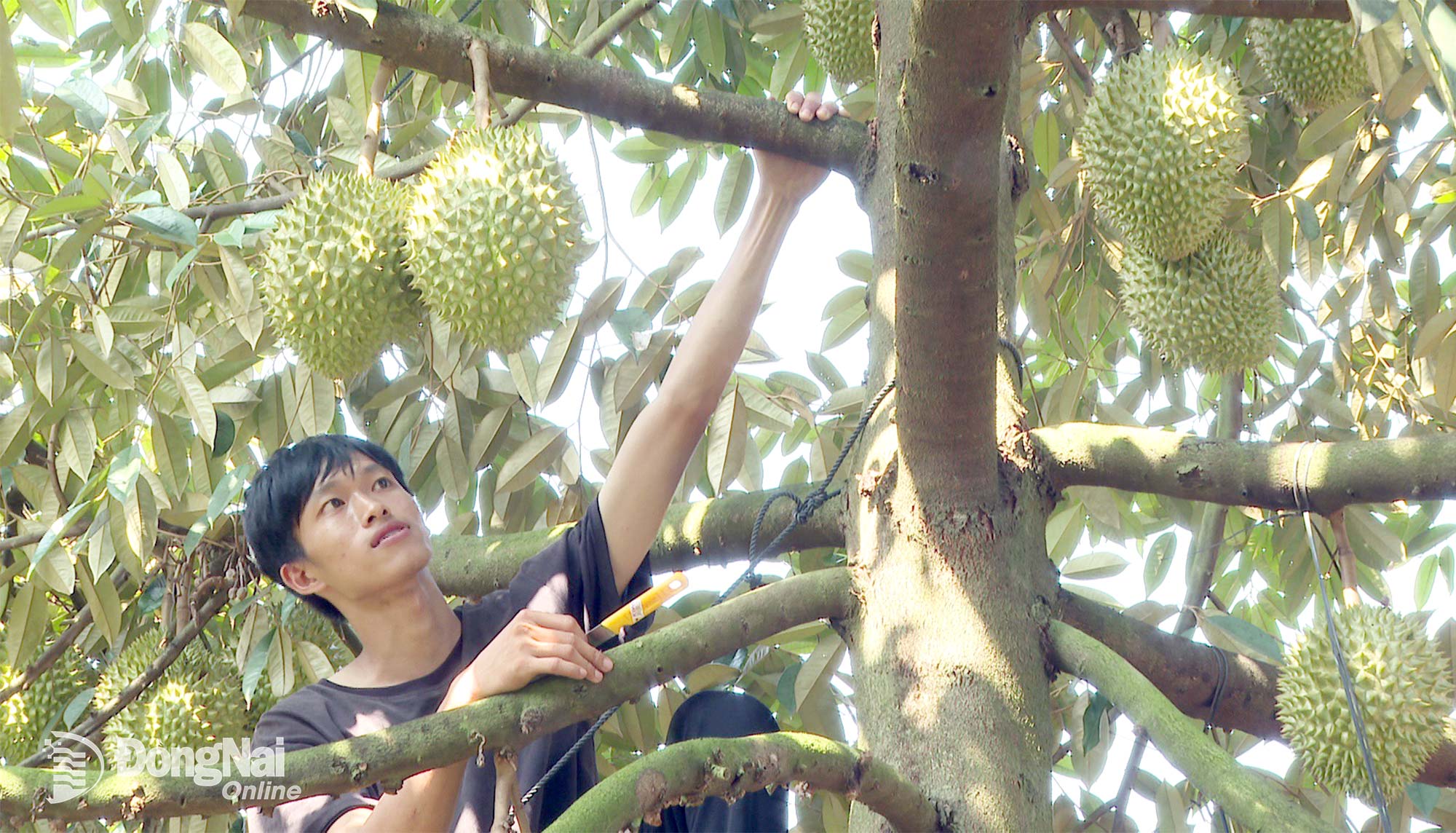 |
| Trinh The Hao, a resident of Binh Tan commune, harvests durians. |
With methodical, creative, and practical approaches, cooperative and collaborative group models in Binh Tan commune, Dong Nai province have been affirming their essential role in agricultural production, increasing farmers’ incomes, and contributing to sustainable new rural development.
Changing mindsets and approaches
Like many other localities, the collective economy in Binh Tan commune once faced a challenging period marked by low efficiency. Most cooperatives in the past faced capital shortages, lacked technical capacity, and were not closely aligned with market demand. Farmers were accustomed to small-scale, fragmented production and lacked confidence in the cooperative model, resulting in a low number of members and limited effectiveness.
However, with the implementation of the new rural development program, Binh Tan commune identified the development of the collective economy as a key task. Authorities recognized that small-scale production would make it challenging to increase product value and compete in the market. As a result, the commune coordinated with the Provincial Cooperative Alliance and relevant departments to restructure and rebuild cooperatives under a new model.
The Hong Nip Green Pomelo Cooperative in Binh Tan commune has eight members managing a total of 60 hectares, including five households from ethnic minority groups. The cooperative was founded and is directed by Lau Sy Nip, who is known as the “green pomelo billionaire.” His family alone owns 30 hectares, 25 of which are currently in harvest, generating an annual revenue of billions of VND.
The cooperative achieved a breakthrough by adopting VietGAP production standards and receiving certification from the Food and Agriculture Organization of the United Nations (FAO) for compliance with TCVN 11892-1:2017, opening a new path for green pomelo production.
Previously, farmers grew pomelos on a small scale and were heavily dependent on traders. Currently, the cooperative has adopted a new approach by organizing concentrated material zones, promoting organic cultivation, limiting the use of chemical fertilizers, and strictly adhering to technical guidelines for tree care and flower induction. As a result, the products now have stable distribution channels through supermarkets and wholesale markets, and are being prepared for direct export to high-demand markets.
According to Lau Sy Nip, the most important innovation of the cooperative is a shift in production mindset, from fragmentation to linkage, from chasing quantity to focusing on quality and brand building. Thanks to this transformation, the Hong Nip Green Pomelo Cooperative has become a model of success, helping increase farmers’ incomes and affirming the position of Dong Nai’s agricultural products.
“As the cooperative’s director, I require all members to strictly comply with regulations to ensure our pomelos always meet clean and safe standards. This helps us build a trusted brand and develop sustainably. Since 2017, all 30 hectares of my family’s pomelo orchards have been certified as VietGAP-standard production areas. Currently, the cooperative’s products are stably distributed through supermarkets and wholesale markets,” said Lau Sy Nip.
No longer at the mercy of middlemen
Since its early days, the Long Binh Durian Cooperative in Binh Tan commune has proven the pivotal role of the collective economy in stabilizing production and promoting local socio-economic development. The cooperative currently has 24 members cultivating 72 hectares of durian, with average yields ranging from 8 to 20 tons per hectare, including 20 hectares following VietGAP standards. Additionally, the cooperative’s members have also developed electronic production diaries, a digital transformation tool in agriculture, covering 20 hectares through the use of AutoAgri software, which helps ensure transparency throughout the entire process, from production to consumers.
According to Nghiem Van Giang, Director of the Long Binh Durian Cooperative, the cooperative has pursued clean production for years, fully adopting VietGAP standards and completing procedures to obtain export area codes. These codes open significant opportunities for farmers and the cooperative. To prepare for official durian exports to China, the cooperative’s members have been encouraged to comply with regulations, expand clean production areas, and invest in packaging and storage facilities meeting partner requirements.
The Long Binh Durian Cooperative has also been certified by the FAO for compliance with Good Agricultural Practices, as outlined in TCVN 11892-1:2017, for durian products. This certification enables the cooperative to supply high-quality durians to supermarkets in nearby areas, major cities across the country, and other markets with strict quality requirements.
Trinh The Hao, a cooperative member, shared: “Before joining the cooperative, my family grew durian using traditional methods, with low yields and unstable prices from traders. Since joining, I have received technical training and market support, so I feel much more secure in production. My annual income has increased by more than 100 million VND.”
The most evident outcome is the increasing income of residents in the locality. In the past, unstable prices for crops such as cashew and pepper made life difficult for farmers. Now, thanks to cooperative linkages, output prices are 10–15% higher than market rates, and the situation of “bumper harvests but falling prices” has largely been resolved.
Beyond economic benefits, the collective economy in Binh Tan has fostered a shift in mindset. Farmers have transitioned from isolated production to cooperative collaboration. The communal authority views the collective economy as a key instrument in advanced rural development, linking collective production models to income, production, environmental, and social welfare criteria.
Ongoing challenges
Despite encouraging results, the collective economy in Binh Tan still faces challenges. Many cooperatives remain small in scale, have limited capital, and lack strong management capacity. Some organizations still heavily depend on state support and lack well-defined long-term business strategies. In particular, developing collective trademarks for local agricultural products remains a difficult task.
To ensure sustainability, Binh Tan needs to continue training cooperative managers, provide access to preferential credit, and support trade promotion, brand building, and e-commerce integration to expand market access.
According to Truong Van Thap, Chairman of the Binh Tan commune Farmers’ Association: “Experience from local cooperatives shows that when farmers come together, they not only support one another with capital, technical know-how, and market access, but also help establish concentrated production zones and build local agricultural brands. This is a vivid example of how the Party’s resolutions have truly taken root in daily life, becoming a driving force for Binh Tan’s agricultural economy to develop in a modern, efficient, and integrated direction.”
Binh Tan commune currently has 10 cooperatives. The commune aims to strengthen and improve the efficiency of agricultural cooperatives from 2025 to 2030 while developing new collective economic models.
Developing the collective economy in Binh Tan is not just an economic story, as it is also a testament to the solidarity and shared commitment of local people in building new rural areas. When farmers join hands to produce within value chains, the path toward sustainable development and improved livelihoods becomes more open than ever.
By Hien Luong – Translated by M.Nguyet, Minho


Thông tin bạn đọc
Đóng Lưu thông tin