
Dong Nai’s startup and innovation ecosystem is currently assessed as having great development potential. The province has implemented numerous activities to promote the startup community in general and the innovation ecosystem in particular.
 |
| Enterprises and students tour startup and innovation booths at a panel discussion organized by Dong Nai University in response to National Innovation Day (October 1) in early October 2025. Photo: Hai Quan |
In recent times, various programs connecting and supporting young entrepreneurs, students, and startups in enhancing their knowledge of entrepreneurship, technology application, and innovation have been launched by provincial departments, sectors, and universities.
Promoting the “Quadruple Helix” linkage forums
Dong Nai has focused on developing startup connection programs and innovation contests, including many activities linking and supporting young entrepreneurs and students. In addition, the province has emphasized trade connection events, exhibitions, seminars, and fairs to help startups, small and medium-sized enterprises (SMEs), and local entrepreneurs seek partners, customers, and market expansion opportunities—particularly in niche markets with high potential.
According to Vo Hoang Khai, Deputy Director of Dong Nai Department of Science and Technology, the province has implemented specific activities to strengthen cooperation among four key actors: the government, educational institutions, enterprises, and investors in promoting startup and innovation activities. One of the highlights is the annual Techfest programs, which serve as a platform connecting participants in the innovation ecosystem and organizing thematic seminars to foster collaboration among these four stakeholders: the government, educational institutions, enterprises, and investors.
Dong Nai aims to develop a science, technology, and innovation ecosystem by building a strong, interconnected network among key components – from scientific research and technology transfer to developing a technology market and enhancing human resource capacity. Innovation is not the task of any single entity, but rather a collective effort requiring sustainable connections across the entire ecosystem. In this ecosystem: The government plays an enabling role—formulating open, preferential, and effective mechanisms and policies to develop the innovation network; Educational institutions provide knowledge, core technologies, and high-quality human resources, especially in information technology and engineering; Enterprises are the center of innovation, transforming knowledge into products and determining the pace of technological application and digital transformation; Investors serve as financial drivers, helping startups “take off” and turn ideas into real economic value.
Le Truong Son, Member of the Provincial Party Standing Committee and Vice Chairman of the Dong Nai People’s Committee
These programs focus on motivating enterprises to apply science, technology, and digital transformation. Through them, young entrepreneurs, universities, and research organizations have opportunities to meet, share ideas, and seek investment at forums organized by local authorities.
Dr. Pham Hung Duc, Vice Rector of Dong Nai University, stated that the university has always focused on implementing activities to update Party, State, and local policies on entrepreneurship and innovation. These efforts aim to create a connection space among universities, enterprises, and management agencies to share experience and resources. The connections formed through seminars and discussions on entrepreneurship and innovation will be the foundation for Dong Nai University to strive to become the local center of the startup and innovation ecosystem—where knowledge, ideas, and actions converge to create the future.
Strengthening technology supply - demand linkages
In the context of a global economy shifting toward a knowledge- and technology-based growth model, science, technology, and innovation have become key drivers of productivity, quality, and competitiveness.
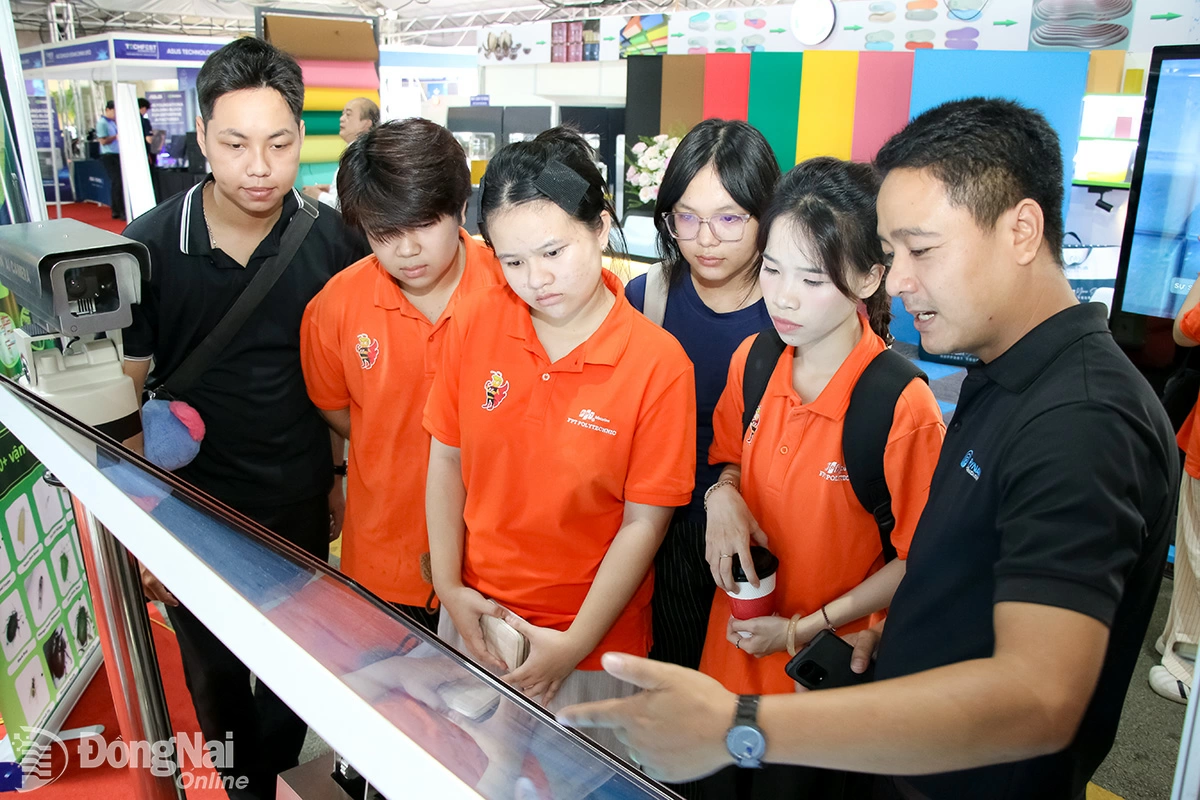 |
| Young people tour and experience innovative products at digital technology booths at Techfest Dong Nai 2025. Photo: Hai Quan |
According to the Department of Science and Technology, as of September 2025, Dong Nai had 88 innovation enterprises, 16 science and technology enterprises, and a strong network of industrial parks. The province is also home to 6 universities and branch campuses, 13 colleges, and about 60 vocational education institutions—a favorable foundation for building a sustainable startup and innovation ecosystem.
Deputy Director Vo Hoang Khai noted: “Connecting technology supply and demand and commercializing scientific, technological, and innovative products is not solely the task of scientists or enterprises, but a shared mission for society as a whole. Officials and civil servants need to adopt innovative management mindsets, improving administrative processes to better support businesses. Enterprises must boldly invest in research and technology innovation, viewing science as a lever for sustainable development. Meanwhile, the province’s youth, students, lecturers, and entrepreneurs should turn knowledge into action, ideas into products, and the spirit of entrepreneurship into a genuine creative movement.”
The mission of connecting technology supply and demand and commercializing scientific and technological products serves as a crucial link in creating a closed value chain from research to production to market.
Nguyen Viet Vi, Chairman and Director of Phuoc Thien Trading and Service Cooperative (Hung Phuoc Commune), shared:
“To promote innovation and strengthen connections that enhance product value and encourage the application of science and technology in production, we hope the local government will continue to support cooperatives and enterprises through specialized training programs on IoT (Internet of Things) operation and data utilization for producers; emphasize research and development (R&D) in production; and implement adaptive, flexible credit support packages, especially aimed at helping cooperatives and businesses invest in advanced machinery and technology for production.”
By Hai Quan – Translated by Trieu Ngan, Thu Ha


Thông tin bạn đọc
Đóng Lưu thông tin