
More than three years after the Dong Nai Provincial People's Committee and Que Lam Group Joint Stock Company in Ho Chi Minh City signed a cooperation agreement on developing organic agriculture, the partnership has yielded impressive results. To date, organic farming models based on linked production chains tied to consumption have been continuously expanded for several of the province's key products, including rice, fruit trees, and pig farming.
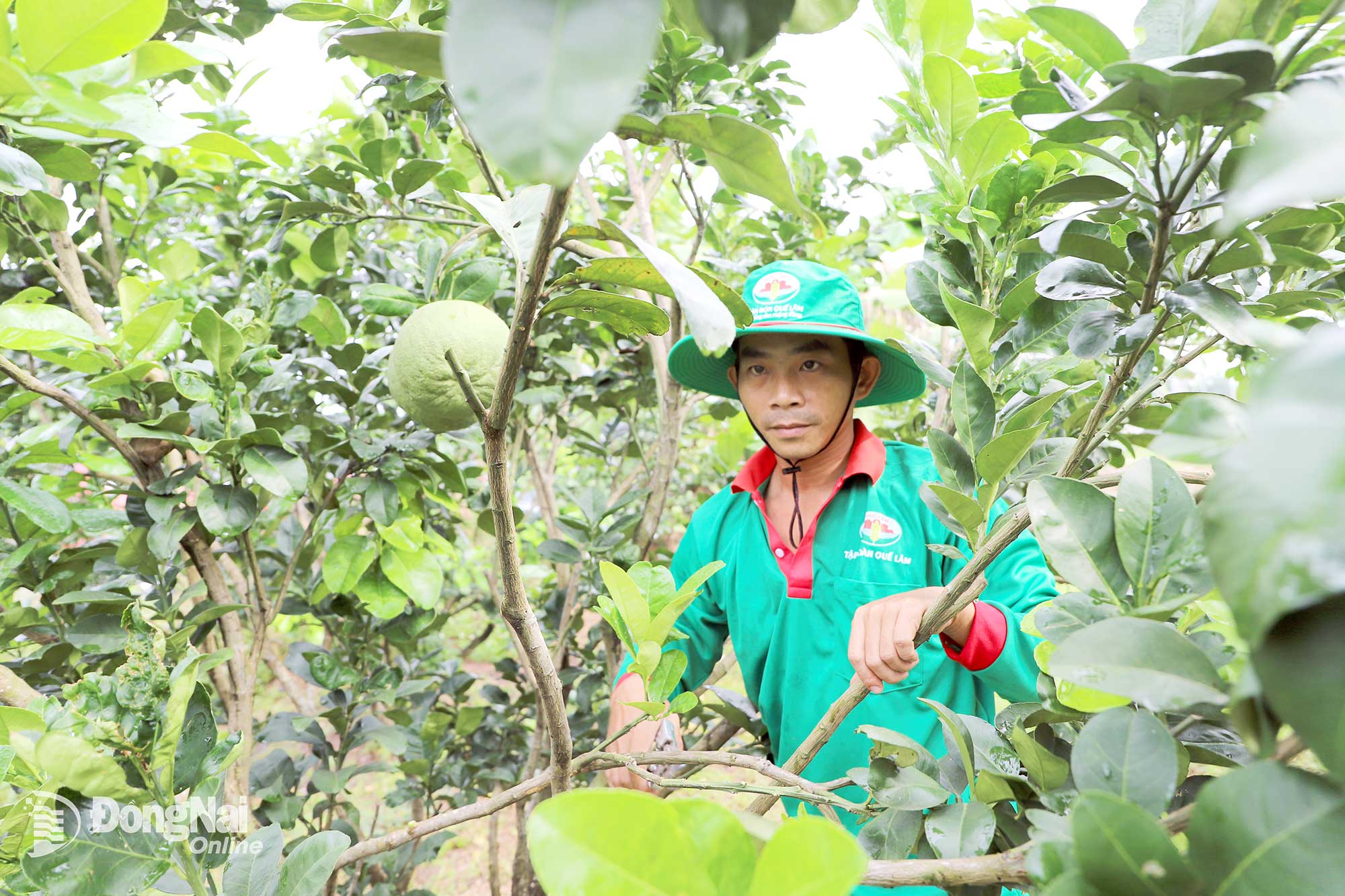 |
| The organic pomelo farming model implemented in Dau Giay commune follows the procedures of Que Lam Group JSC. Photo: B. Nguyen |
Que Lam Group JSC has truly accompanied local farmers, contributing to a new development landscape for organic-oriented agriculture.
Replicating effective models
Many organic farming models developed by Que Lam Group JSC have been transferred to farmers across the province. So far, several models have demonstrated initial effectiveness, including two rice development and investment linkage chains with a total area of more than 55 hectares.
In particular, the organic rice development and investment linkage chain in Song Ray commune spanned nearly 22 hectares during the 2024–2025 winter-spring crop, yielding 8.5 tonnes per hectare. The summer-autumn crop for 2025 is currently being implemented on almost 21 hectares. This model has successfully established a local specialty organic rice brand, with farmers organizing direct sales at prices significantly higher than the market average. The rice linkage chain at Bau Kien Agricultural Service Cooperative in Thanh Son commune has also been expanded to a larger production scale. Additionally, Que Lam Group Joint Stock Company has developed four fruit production linkage chains spanning a total of 2.8 hectares, featuring crops such as pomelo, durian, and mangosteen.
In livestock farming, the company has supported the expansion of four organic pig farming linkage chains, with a total herd of 173 pigs. Typical examples include the livestock DILC operated by farmer Nguyen Van Tay in Dinh Quan commune, with 58 pigs, and the livestock DILC of farmer Nguyen Ha Duc Kinh in Dau Giay commune, with a herd of 80 pigs.
Under the organic livestock model, the company supports farmers in applying biological bedding techniques and provides subsidies for fan repairs and the installation of misting systems in pig pens. With this model, farmers do not need to use water or antibiotics, and can utilize on-site organic feed sources. As a result, input costs are lower than in conventional livestock farming. All feed is fermented with microbial additives before use, ensuring the quality of the pork.
Changing perceptions toward organic production
Farmers participating in the organic production linkage chain of Que Lam Group JSC enjoy multiple benefits.
Nguyen Thanh Hung, Director of Bau Kien Agricultural Service Cooperative in Thanh Son commune, Dong Nai province, said: “I am now growing my third rice crop using the organic process. The yield of organic rice following the company’s process is just as high as with traditional methods. By participating in this model, cooperative members enjoy several benefits, such as access to high-quality organic fertilizers and biological plant protection products from the company at favorable prices. Farmers are also supported with deferred payment for agricultural inputs, settling costs only after the rice is harvested and sold. Technical staff are present in the fields to provide on-site guidance on clean production practices, helping ensure both high yields and rice quality. Seeing the clear economic benefits, the model has expanded from a trial scale of just over one hectare to more than 30 hectares now registered by cooperative members.”
Ho Dang Khoa, Deputy General Director in charge of technical affairs at Que Lam Group JSC, shared: “With the active involvement of the entire political system of Dong Nai province, these farming models continue to expand. Specially, the organic rice production model in Song Ray commune has formed a large-scale production area and established a local brand of organic specialty organic rice. This proves that farmers’ awareness has significantly improved. Furthermore, organic fruit-growing models have also made notable progress. In livestock production, all pilot models have avoided African swine fever. The model of organic and biosecure pig farming continues to expand, with some households already investing in dozens of breeding sows. This shows farmers’ strong support for the company’s organic agriculture approach. The company will continue surveying and organizing more training courses for local farmers.”
The most significant benefits of these organic farming models lie in protecting soil health, the ecological environment, and, most importantly, public health.
Ho Dang Khoa, Deputy General Director in charge of technical affairs at Que Lam Group JSC
“Based on these results, it is clear that awareness of organic agriculture, from provincial and local officials to farmers, has improved significantly. In the time ahead, the company hopes to receive stronger policy support from authorities to further expand these models to more communes and wards within the province and gradually to other regions nationwide,” Khoa hoped.
By Binh Nguyen – Translated by M.Nguyet, Minho


Thông tin bạn đọc
Đóng Lưu thông tin