
Dong Nai is recognized by economic experts as one of the country’s most dynamic economic localities, with numerous enterprises engaged in production, business, import-export, and trade and service activities.
The province’s trade and service infrastructure, along with its seaports, has become increasingly developed and diversified, with participation from various economic sectors. Digital technology is widely applied, and e-commerce platforms in the province have also grown comprehensively and diversely, creating more opportunities for both businesses and consumers.
 |
| Cargo handling and ship support at Phuoc An Port in Phuoc An commune. Photo: Hai Quan |
Comprehensive trade and service channels continue to expand
After nearly 40 years of renewal, under the leadership of successive Provincial Party Committees, Dong Nai has achieved remarkable results in industrialization, modernization, and comprehensive provincial reform. Alongside this, the trade, import-export, and logistics sectors have made notable results. Supermarkets, shopping centers, and modern retail chains have expanded to meet the growing consumption and shopping demands of residents in the locality.
Since 1997, the first true supermarket in Dong Nai province, and one of the first in Vietnam, was Cora Supermarket (now GO! Dong Nai Shopping Center), located at the Vung Tau T-junction in Long Hung ward. Since then, the network of supermarkets and shopping centers in Dong Nai has continued to expand and develop.
By the end of 2015, the province had four shopping centers and eight supermarkets operating. The goods and services market grew rapidly in scale, sector, and coverage, serving both daily life and business production. High value-added service sectors include ports, public transport, warehousing, logistics, import-export, agricultural production, postal and telecommunications, healthcare, finance, banking, and insurance.
By mid-2025, the province had nine shopping centers and 19 supermarkets, along with expanded convenience stores and mini-marts across districts and cities, including remote areas. Major convenience store chains such as Bach Hoa Xanh, WinMart, Co.opFood, GS25, and FamilyMart have been strengthened, alongside mini-supermarkets and self-service stores. Meanwhile, 194 traditional markets and tens of thousands of household businesses continue to supply essential goods to residents in the locality.
Nguyen Thi Bach Van, Director of Co.opmart Dong Xoai (Binh Phuoc ward, Dong Nai), shared that over more than 16 years of development, Co.opmart Dong Xoai has not only played a key role in market stabilization as part of the Saigon Co.op network, but has also served as a bridge bringing Vietnamese products to consumers, gradually affirming its position as the longest-standing Vietnamese-owned retailer in the area.
For the 2025-2030 term, Dong Nai will focus on new key areas to fully exploit potentials and advantages in industry, logistics, trade and services, tourism, agriculture-forestry, and mineral resources.
Currently, the province is focusing on developing trade and service infrastructure, expanding logistics services and related business infrastructure, promoting tourism services and diversifying tourism types, as well as strengthening e-commerce and local production-to-consumption chains for key products. In addition, the province has implemented measures to advance digital transformation and green growth during the development of the trade and service sector.
Le Duc Thuan, Director of Lotte Mart Dong Nai (Long Binh ward, Dong Nai province), stated that Lotte Mart Dong Nai will focus on integrating a modern, multi-channel retail model in the near future. Multi-channel retailing is considered the future of the retail sector in Vietnam in general and in Dong Nai in particular. This approach is an effective way to enhance the most convenient shopping experience for consumers in the digital era.
The Dong Nai Provincial Party Congress for the 2020-2025 term set out four breakthrough tasks for the period. Among them is the task of developing the application of science and technology linked with innovation, and developing modern, comprehensive trade and service sectors with competitive advantages, focusing on tourism and logistics services.
In recent times, the Provincial Party Committee and the People's Committee have promptly issued programs and plans to concretize objectives, tasks, and implementation solutions. They have also released numerous directive documents aimed at fully leveraging the province's potential and advantages, and effectively utilizing local resources to implement breakthrough areas in line with the goals set out in the Congress resolution.
The development of modern, integrated trade and service sectors is an inevitable trend and a necessary condition to meet the province’s growth in the context of international integration, accelerated digital transformation, application of science and technology, and the implementation of the 4.0 Industrial Revolution. Regarding e-commerce development, the province has maintained a top-10 national ranking in the e-commerce index for nine consecutive years.
According to the Department of Industry and Trade, during the 2021–2025 period, the e-commerce sector in Dong Nai witnessed remarkable growth in both scale and quality. Provincial e-commerce revenue grew at an average rate of 20–25% per year. This sector accounts for approximately 8–9% of the total retail sales of goods and consumer services, highlighting its increasingly important role in the digital economy. Notably, the rate of cashless payments is high, with 80–85% of residents holding bank accounts, and 100% of supermarkets and shopping centers in the province accepting digital payment methods.
Tran Duong Hung, Deputy Director of the Department of Industry and Trade, shared that improving transaction efficiency on e-commerce platforms and understanding legal issues in e-commerce business are key factors determining the rapid and sustainable growth of trade in Dong Nai. In the coming period, the department will introduce measures to support the development of e-commerce in the province, promoting its widespread use in production and business activities of enterprises, cooperatives, and daily consumption by locals.
In addition, Dong Nai ranks among the leading provinces in the country in developing OCOP products (One Commune One Product Program). The province currently has over 480 OCOP-certified products, many of which meet 4- and 5-star standards. Therefore, trade promotion activities play a crucial role in elevating the profile of the province’s OCOP products; supporting local enterprises, cooperatives, and production facilities in developing their brands and expanding markets; and helping Dong Nai’s key products reach international markets amid increasingly deep economic integration.
Developing and connecting modern logistics infrastructure
The draft political report of the Dong Nai Provincial Party Committee for the 2025-2030 term highlights that after administrative consolidation, the province has advantages in area, population, and serves as a major industrial hub in the Southeast region. Strategically located at the intersection of three of the country’s six key economic regions and adjacent to Ho Chi Minh City, Dong Nai benefits from and contributes to the economic momentum of the Southern Key Economic Region while serving as a gateway connecting other regions. The province shares a long border with Cambodia and the Hoa Lu border economic zone, providing a base for cross-border trade, services, and investment expansion.
 |
| Dong Nai OCOP products are displayed at GO! Dong Nai Shopping Center. Photo: Hai Quan |
Strategically, Dong Nai can both leverage and extend development momentum from the Southern Key Economic Region while serving as a gateway to other regions.
Experts note that Dong Nai has a multimodal transport system, including national-level infrastructure projects, particularly Long Thanh International Airport, port systems, and inter-regional highways. Once fully synchronized, these will position Dong Nai as a modern national logistics hub, playing a key role in domestic and international supply chains.
Doctor of Science and architect Ngo Viet Nam Son, Chairman of NgoViet Architects & Planners in Ho Chi Minh City, Member of Dong Nai province’s Economic and Social Advisory Board, commented that Dong Nai has significant advantages for developing free trade zones (FTZs). The province has ample land for building concentrated FTZs directly linked to Long Thanh Airport and the Cai Mep–Thi Vai seaports, as well as Phuoc An Port. To fully leverage the potential and efficiency of these FTZs, the province needs to integrate them with key provincial infrastructure and connect them with urban areas and economic-financial centers.
Dong Nai is implementing strategies to develop its port system in parallel with enhancing the professionalism of customs management, aiming to meet the growing demand for import and export activities. The province’s active ports are located along key river routes, including the Dong Nai, Nha Be – Long Tau, and Thi Vai rivers. International ports along the Dong Nai River are organized into three port clusters, Long Binh Tan, Nhon Trach, and Go Dau, featuring multiple wharves, including both specialized and general-purpose terminals.
Notably, Phuoc An Port spans nearly 800 hectares with a total investment of approximately VND 20 trillion, making it the largest seaport in Dong Nai province. According to the planning scheme, Phuoc An Port is divided into port zones and logistics service zones. The port is committed to sustainable development, contributing to the modernization of the logistics sector and positioning Dong Nai as an attractive destination within the global maritime transport network.
Truong Hoang Hai, Director of Phuoc An Port Petroleum Investment and Exploitation Joint Stock Company (JSC), shared that Phuoc An Port will focus on investing in green port infrastructure, modernizing equipment that uses clean energy, with most of its operational systems transitioning to electrification. The port will proactively connect and collaborate with shipping lines, logistics companies, and supply chain partners to jointly create an international green transport corridor. This approach is not only an inevitable trend but also a driving force to enhance the competitiveness and position of Vietnam’s seaport industry on the global trade map.
The emergence of Long Thanh Airport urban area, the core of the country’s largest aviation service zone, along with the Dong Nai River corridor, the modern urban development axis of the Southern province, acts as a dual engine. It simultaneously stimulates trade and logistics, activates the real estate, finance, and tourism markets, and generates a breakthrough in the local economy.
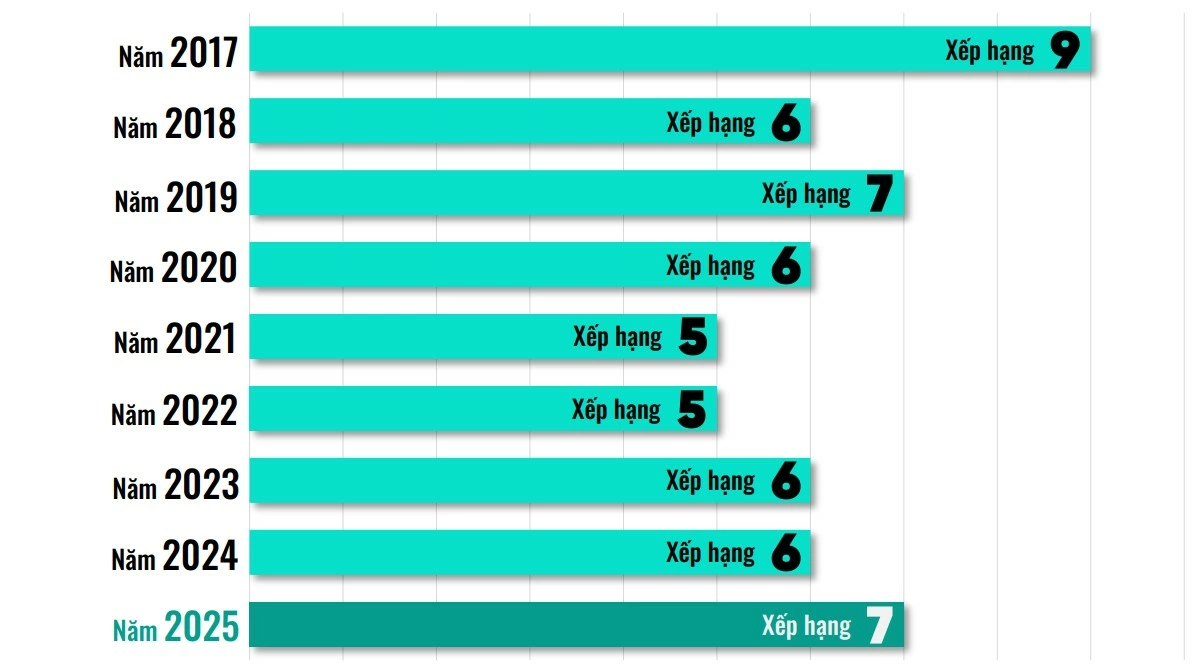 |
| Graphic illustrating Dong Nai’s e-commerce index rankings from 2017-2025, according to the Vietnam E-commerce Association (VECOM) |
Notably, the province is studying a proposal to establish a free trade zone (FTZ) in Dong Nai, linked to Long Thanh Airport and Phuoc An Port, with an estimated area of approximately 8,200 hectares. The infrastructure and transport system will provide direct connectivity from the FTZ to the airport and nearby seaports, forming a multimodal cargo transport model that fully leverages the strategic competitive advantages of Long Thanh Airport, Phuoc An Port, and the Cai Mep – Thi Vai deep-water port system (Ho Chi Minh City).
Ho Van Ha, Member of Provincial Party Committee, Vice Chairman of Dong Nai People’s Committee, stated that the complex FTZ is expected to include four functional zones. With special policies and mechanisms, it is expected to become a hub for high-tech industries, financial services, logistics, innovation, and international trade.
Dr. Truong Minh Huy Vu, Director of Ho Chi Minh City Institute for Development Studies and Head of Dong Nai province’s Economic and Social Advisory Group, stated that the FTZ should focus on regional linkage and the development of new growth spaces centered on Long Thanh Airport, leveraging the development potential of the new Dong Nai. In developing the FTZ, the province needs to pay attention to transportation connectivity and implement suitable mechanisms to attract investors to the hub with comprehensive and modern services.
Moreover, Dong Nai has ample room to develop urban infrastructure, border trade infrastructure, economic zones, industrial parks, and clusters, along with digital infrastructure linked to e-commerce. The province prioritizes training a skilled, professional workforce to meet fast and sustainable socio-economic development needs. Recently, investments have focused on the Hoa Lu border economic zone infrastructure, including roads, joint inspection stations, and goods consolidation areas, facilitating operations and state management of import-export activities.
By Hai Quan – Translated by M.Nguyet, Minho


Thông tin bạn đọc
Đóng Lưu thông tin