
Climate change, environmental pollution, and resource depletion are among the most pressing global challenges. In this context, promoting a green economy, circular economy, and sustainable development has become an inevitable trend.
 |
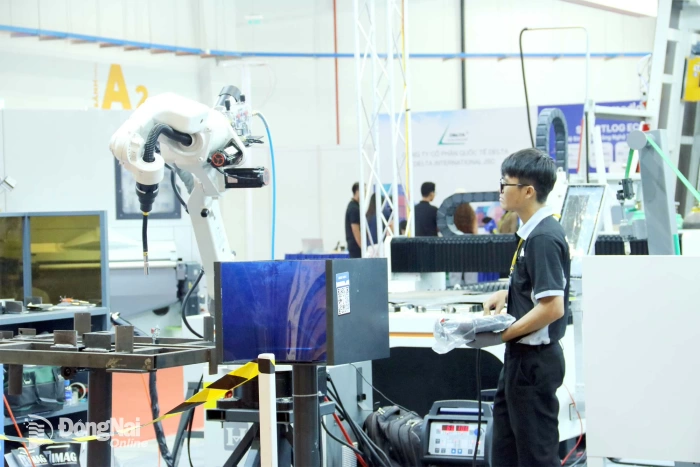
| Businesses invest in modern equipment and machinery to operate efficiently and sustainably. Photo: Trung Quang |
Dong Nai, one of the provinces with the fastest pace of industrialization and urbanization in the country, is also undergoing a strong shift in this direction. This transition is not only a strategic choice but also an inevitable path for long-term development, ensuring harmony between economic growth and environmental protection.
A green economy is an economic model aimed at reducing greenhouse gas emissions, using resources efficiently, and ensuring social equity. Dong Nai currently has 83 industrial parks(IPs) planned, with tens of thousands of enterprises in operation. Therefore, pursuing a green economy is an urgent requirement to ease environmental pressure, improve the quality of life, and enhance the competitiveness of the economy.
In recent years, the former provinces of Binh Phuoc and Dong Nai have introduced a range of policies to encourage businesses to invest in clean technologies, renewable energy, and the efficient use of resources. Newly developed industrial parks are all planned with an ecological orientation, integrating wastewater and solid waste treatment systems, green spaces, and sustainable transport infrastructure. Several leading enterprises, such as Changshin Vietnam Co., Ltd., VRG Dongwha MDF Joint Stock Company, and Taekwang Vina Joint Stock Company, have been pioneers in adopting cleaner production models, recycling wastewater, and utilizing alternative energy sources for factory operations.
With strong political will and the concerted efforts of the entire society, Dong Nai has the potential to become a model province of balanced development, harmonizing industry, modern agriculture, and a clean living environment.
Tran Anh Tuan, Head of General Affairs at VRG Dongwha MDF Joint Stock Company, located in Minh Hung III Industrial Park (Minh Hung ward), said: “The MDF VRG Dongwha plant is equipped with the most advanced German technology, enabling complete waste treatment and regeneration into energy for production. The factory uses clean, green raw materials and produces environmentally friendly products. Notably, the factory grounds are landscaped in a way that breaks from the typical industrial park design, offering a sense of greenery, cleanliness, and visual appeal.”
Notably, many businesses in industrial parks have begun shifting toward “zero waste” and “green factory” models. As a result, they not only reduce long-term operating costs but also meet the stringent environmental standards required by export markets such as Europe, the United States, and Japan. In response, infrastructure developers in industrial parks have also embraced the principle that long-term viability depends on integrating economic growth with environmental sustainability in the roadmap for green industrial development.
Dong Nai is also facing a major opportunity for agricultural transformation. Over the years, the province has made strong strides in applying high technology, using organic fertilizers, recycling livestock waste, and developing circular farming models. Practices such as organic vegetable cultivation, bio-secure livestock farming, and water-saving irrigation systems have been implemented in many localities across the province, yielding initial positive results.
With a circular economy model that links goat farming to the cultivation and care of key local crops, Can Le Agricultural Service Cooperative in Loc Thanh commune has attracted widespread farmer participation and delivered strong economic results. According to Dao Xuan Phong, Deputy Director of the cooperative, “The model has been replicated across residential areas, contributing to reduced environmental pollution and lower use of chemical fertilizers and pesticides. At the same time, the agricultural products it yields have earned consumer trust and strong market reception, generating substantial economic value. This affirms that the circular economy model is steadily gaining recognition and meeting the expectations of farmers.”
Green agriculture is not merely about reducing chemical use, as it is a sustainable and environmentally friendly production system that ensures food safety and helps protect natural resources. This approach not only enhances product value but also encourages farmers to remain committed to clean farming practices.
Gia Bao Group JSC in Binh Phuoc ward has recently put into operation its Agricultural and Food Processing Plant, with a total investment of 6.5 million USD. Tran Van Son, Chairman of the Board of Gia Bao Group JSC, shared: “The plant is equipped with Japanese and German technology to produce top-quality products that meet the demands of even the most discerning consumers worldwide. This undertaking also provides a foundation for the company to work alongside farmers in advancing clean agricultural production and strengthening the value chain of Vietnamese agricultural products.”
 |
| A closed-loop farming model brings high economic efficiency to farmers of Can Le Agricultural Service Cooperative in Loc Thanh commune. Photo: Trung Quang |
Le Thi Anh Tuyet, Deputy Director of the Dong Nai Department of Agriculture and Environment, said: “In the coming time, the province’s agricultural sector will focus on creative transformation, applying digital technology to ensure transparency across the entire process from inputs such as seeds and materials to science and technology applications, production, consumption, and export. At the same time, the sector will continue to establish cooperatives and enterprises in agriculture to build high-value product chains. Particularly, Dong Nai has issued Resolution No. 143/2018/NQ-HDND dated December 7, 2018, on policies to support production and consumption linkages for agricultural products. Accordingly, the province will focus on developing value chains for key crops and livestock to promote sustainable agricultural development.”
Pursuing a green economy, circular economy, and sustainable development is not only a smart choice but also an inevitable path for Dong Nai to enhance quality of life, safeguard natural resources for future generations, and elevate its standing in the global economy, which is rapidly shifting toward green transformation.
By Thanh Mang, Trung Quang – Translated by M.Nguyet, Minho




Thông tin bạn đọc
Đóng Lưu thông tin