
Viet Nam is laying the foundation to establish Long Thanh International Airport as a hub for the Southeast region which will handle all international flight routes while Tan Son Nhat will focus primarily on domestic traffic, according to the Airports Corporation of Viet Nam (ACV).
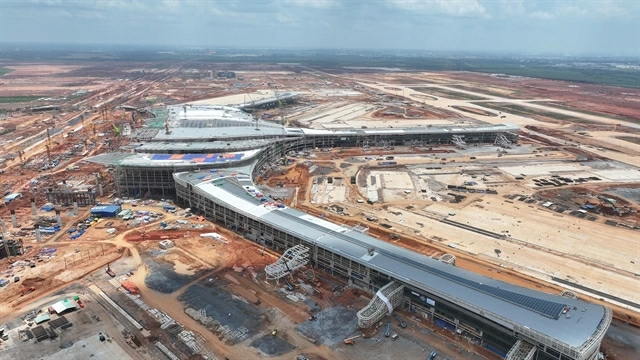 |
| The construction site at Long Thanh International Airport. Viet Nam is laying the foundation to establish Long Thanh International Airport as a hub airport for the Southeast region. |
AVC said it was pressing to redistribute flight traffic between the two international airports to optimise air traffic management in southern Viet Nam, especially in the context that Tan Son Nhat Airport, the country’s busiest airport, is overloaded.
The reallocation was also expected to improve service quality, enhance aviation safety and improve Viet Nam’s southern airport system.
In the ACV’s latest report proposing reallocation of flight routes and operation roles between Long Thanh and the overcrowded Tan Son Nhat, ACV proposed two operational scenarios when Long Thanh enters its first phase of operation in 2026.
In the first scenario, all international flights will be shifted to Long Thanh, allowing Tan Son Nhat to concentrate solely on domestic operations. This will see Long Thanh handling over 19 million international passengers annually in its first phase, plus 1.5 million domestic passengers for the purpose of transit.
This means Long Thanh will handle 100 per cent of international traffic and Tan Son Nhat 95 per cent of domestic traffic, creating foundation for the formation of a hub airport in the South.
In the second scenario, Long Thanh will handle all international flights, particularly those over 1,000 km and a part of domestic transit traffic, with around 15 million international passengers per year. Tan Son Nhat will focus on domestic routes and short-haul international routes with around 4 million international passengers per year.
ACV said that in the first scenario, Long Thanh could accommodate up to 92 million passengers per year by 2060 while the number would reach only 67 million in the second scenario.
The ACV’s report stressed that splitting international traffic between multiple airports in the same urban region could weaken a hub airport’s transfer capabilities, citing global examples such as Tokyo's Narita and London’s Heathrow. In both cases, the lack of centralised international connectivity undermined their roles as key regional transit points.
International air cargo
ACV also proposed to relocate all international air cargo operations from Tan Son Nhat to Long Thanh with an aim to transform the new airport into a regional logistics powerhouse.
The move aims to modernise the country’s air transport and capitalise on the country’s deepening integration into the global supply chains.
The air cargo strategy also includes a 257-ha logistics complex in the airport’s southwest which will house cargo terminals and freight forwarding facilities while serving international cargo carriers and logistics firms.
Strategically located near key highways — including the Long Thanh–Dau Giay and Bien Hoa–Vung Tau expressways — and planned high-speed rail links, Long Thanh is also set to connect with deep-sea ports at Phuoc An and Cai Mep–Thi Vai, which will enable multimodal transport solutions, reduce logistics costs and transit times for both imports and exports.
Concentrating international cargo operations in Long Thanh would create an opportunity for Viet Nam to become an aviation logistics hub in the South and Southeast Asia region, ACV said.
The development of an international air cargo hub at Long Thanh is expected to attract major logistics players in the world and foster a logistics ecosystem from bonded warehousing to packaging, cold-chain logistics, and cross-border e-commerce. This is expected to generate significant revenue and employment in the region.
Long Thanh will create opportunity for Viet Nam to take advantage of its strategic location in Southeast Asia to become a new logistics hub amid the global supply chain shifting and production diversification.
The modern infrastructure at Long Thanh International Airport will also allow the application of green logistics solutions, digital logistics to reduce emissions and improve energy efficiency toward sustainability.
“In the context of rapidly evolving global trade dynamics, the transition of all international cargo operations to Long Thanh represents a strategic move that will bring long-term economic, operational, and planning benefits for the national aviation system,” ACV concluded.
The Ministry of Construction has asked ACV to work with carriers to thoroughly study, assess the impact of the flight exploitation plan as well as roadmaps to move international flights to Long Thanh. Report must be submitted within September.
The construction of Long Thanh is being sped up with target to receive its first flight on December 19 this year.
Covering 5,000ha and a total investment of US$1 billion for the first phase, Long Thanh is expected to become an international aviation hub in Southeast Asia. When completed, the airport can serve up to 100 million passengers and 5 million tonnes of cargo per year.
(Source: VNS)


Thông tin bạn đọc
Đóng Lưu thông tin