
(ĐN)- Vietnam is home to nearly 1 million businesses, yet only around 5,000 of them are truly engaged in the global supply chain. Of these, just over 100 are Tier 1 suppliers, while the rest mostly contribute through simple processing steps. In Dong Nai, only a limited number of companies are involved in production and supply chains.
Workforce training, management, technology support, and holistic solutions to help enterprises standardize production processes are essential if Vietnamese companies are to integrate more deeply into global supply chains.
 |
Still a modest presence
This issue is especially evident in the manufacturing sector. As global production shifts, Vietnam has attracted interest from international manufacturers. This presents an opportunity for Vietnamese businesses to collaborate and supply supporting products, components, and parts to major corporations—but the path isn’t easy.
Key challenges for small and medium-sized enterprises (SMEs) in Vietnam include weak management skills, low technological innovation, and limited access to finance. Moreover, the technology and productivity spillover from foreign direct investment (FDI) firms to domestic businesses remains limited. So far, only a handful of Vietnamese companies in the automotive, motorcycle, and electronics sectors have integrated successfully.
While some supporting industry firms have started supplying to FDI corporations, their number remains small. To help local industries become part of global production networks, the Ministry of Industry and Trade's Industry Agency is fast-tracking the establishment of industrial development support centers in both northern and southern Vietnam.
In Dong Nai, Tuong Lai Co., Ltd. (Long Thanh District) supplies rubber products to FDI firms in the automotive and motorcycle sectors. The company has joined the Supplier Development Program (SDP), a joint initiative by the International Finance Corporation (IFC) and the Industry Agency.
According to Director Truong Quoc Cuong, joining such programs and being able to supply to global firms is far from simple. The biggest challenge for Vietnamese businesses is meeting the stringent technical, management, and delivery requirements set by top-tier global partners. This requires establishing systems for product quality, enterprise management, labor safety, and environmental compliance—areas where many SMEs still fall short.
Strategies to go deeper
At the "Connecting Global Supply Chains" export forum held this June in Ho Chi Minh City, Deputy Minister of Industry and Trade Phan Thi Thang said that free trade agreements (FTAs) have created a vast market network, motivating Vietnamese firms to expand internationally. Export promotion activities have helped make it easier for Vietnamese goods to reach global customers.
Beyond direct exports, on-the-spot exports—where local companies supply products to FDI enterprises within Vietnam—are also an effective strategy to raise their position. Encouraging FDI enterprises to use more domestic materials and equipment remains a long-term challenge.
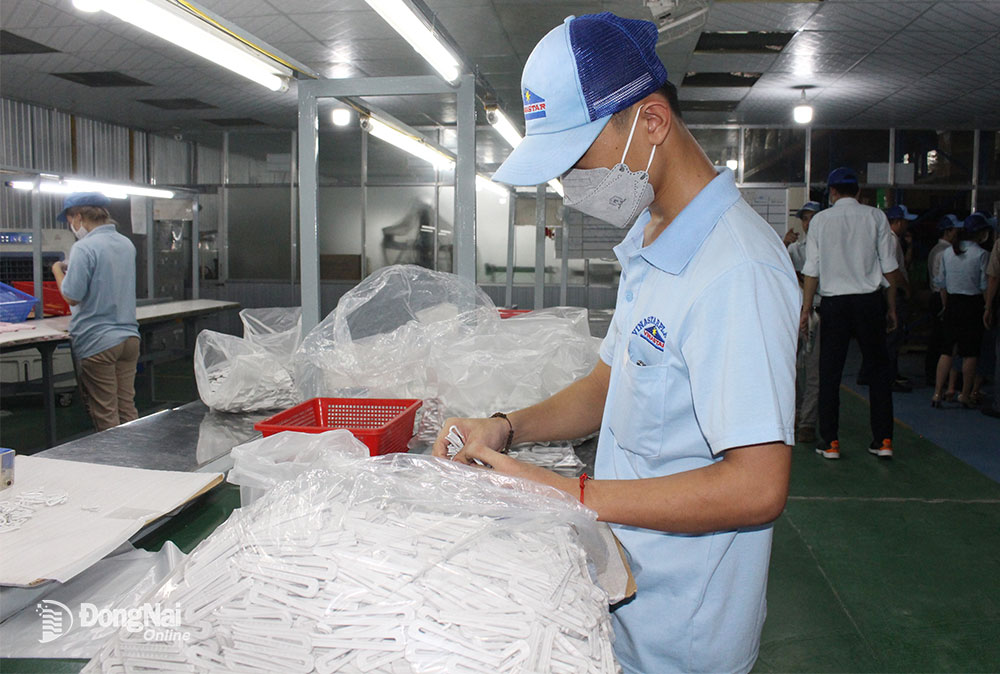
Mai Khanh, Director of Vinastar Technical Plastic Co., Ltd. (Bien Hoa City), shared that the company aims to become a leading mold and plastic product manufacturer in Vietnam. With its modern technology, Vinastar is capable of handling both production and mold processing orders. It currently supplies FDI clients in Vietnam and exports to Japan, South Korea, and others. Despite this initial success, the company is continuing to invest in training for mid- and senior-level managers. Vinastar’s long-term goal is to achieve annual revenue of USD 50 million by 2030 and build additional factories.
Similarly, Nguyen Thi Hoang Quyen, CEO of Hoang Gia Pha Le JSC (Nhon Trach District), emphasized that in today’s fiercely competitive market, optimizing production costs is critical. Her company, which is labor-intensive, is working to reduce labor dependence and boost productivity. While the company has expanded exports, it is still far from tapping its full potential. Moving forward, Hoang Gia Pha Le plans to strengthen collaboration and networking to improve production capabilities and management expertise.
Van Gia


Thông tin bạn đọc
Đóng Lưu thông tin