
Dong Nai is one of the country’s major localities in terms of area, population and economic scale, with a highly connected system spanning industry, urban areas, agriculture, seaports, airports, and inter-regional transport routes. The stable operation of Dong Nai City's urban administration has opened up an entirely new development space.
 |
| Infrastructure is a key focus in opening up new space to attract investment to Dong Nai. In the picture: The Long Thanh intersection connects the Ho Chi Minh City–Long Thanh–Dau Giay Expressway, the Bien Hoa–Vung Tau Expressway, and Long Thanh Airport. |
Notably, the Politburo’s Resolution No. 16-NQ/TW, dated July 21, 2026, on building and developing Dong Nai City through 2035, with a vision to 2065 (referred to as Resolution No. 16), has set out a longer-term vision for the city's future development. Capitalizing on its strategic advantages, Dong Nai is making step-by-step efforts to realize the goal of developing the city into a strong development pole, an economic hub for the region and the country, with global reach.
From an industrial pole to a multi-center economic space
Dong Nai's current economic scale provides an important foundation for the city to enter a new development cycle. In 2025, the city’s gross regional domestic product (GRDP) grew by 9.63%, the size of the economy reached approximately USD28 billion, and GRDP per capita stood at about USD6,000. Industry remains a pillar of the economy, but Dong Nai's advantages no longer lie solely in production. Long Thanh International Airport, the seaport system, expressways, ring roads, and the network connecting the city with Ho Chi Minh City are creating favorable conditions for the formation of an economic space integrating industry, logistics, trade, services, and urban development.
Dong Nai's targets under the Politburo’s Resolution No. 16: By 2030, GRDP is expected to reach approximately USD44 billion, with GRDP per capita of USD9,200. By 2045, the economy is projected to reach USD150 billion, with GRDP per capita of about USD23,000. By 2065, Dong Nai aims for GRDP of USD600 billion, with GRDP per capita of about USD67,500.
Dong Nai City's development space is being expanded from industrial parks in the South to the Northern region, while hubs for urban development, logistics, high-tech industry, and modern agriculture are being formed simultaneously. Specifically, the Long Thanh–Nhon Trach area can fulfill its role as an aviation and logistics gateway; Bien Hoa and its surrounding areas serve as space for urban development, services, and high-tech industry, while the North has conditions for developing new industries, high-tech agriculture, and eco-urban areas.
Resolution No. 16 places this development space within a longer-term vision. The goal is not merely to expand the scale of the economy but also to shift Dong Nai toward a growth model based more on science and technology, innovation, the digital economy, and high-value-added industries. The resolution specifies developing Dong Nai into an airport city, a riverside city that is polycentric, multifunctional, green and smart.
 |
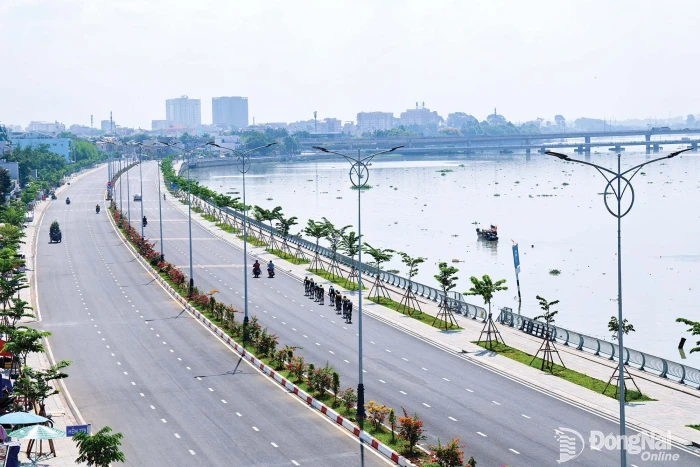
| A view of Tran Bien Ward, the central urban area of Dong Nai City. Photo: Cong Nghia |
Resolution No. 16 sets the goal for Dong Nai City to strive for an average annual GRDP growth rate of over 10% by 2030, with the digital economy accounting for at least 30% of GRDP and an urbanization rate of about 55%. By 2035, Dong Nai is set to become a center for high-tech industry, the aerospace industry, and modern logistics services. Looking further ahead, with a vision to 2045 and 2065, Dong Nai is positioned as a modern aviation hub for the Asia–Pacific region, moving toward becoming a globally connected city.
Dong Nai's new economic space is not merely an expansion of administrative boundaries but a qualitative transformation. The city is shifting from a major industrial locality into a multi-center urban-economic hub, where high-tech industry, aviation, logistics, urban development, services, and the digital economy together form new growth drivers. The biggest challenge at present is to turn the advantages of scale and location into actual competitive capacity so that the major orientations of Resolution No. 16 can quickly be translated into specific projects, economic sectors, and growth values.
Activating new growth drivers
To create momentum for the new development phase, Dong Nai is focusing on strongly activating breakthrough growth drivers and moving beyond the limitations of traditional development models. In this process, high technology, green urban areas, and the aviation economy are the city's key aspirations.
With Long Thanh Airport preparing to enter commercial operation, together with a deep-water seaport system, such as Phuoc An Port, and a dense expressway network, Dong Nai now possesses the region’s most complete multimodal logistics system. The aviation economy model will serve as an entirely new driver, turning Dong Nai into an international-scale transshipment hub for goods and passengers while reducing logistics costs for the entire Southern key economic region.
At the same time, adhering to the principle of not trading the environment for mere economic growth, Dong Nai is making a strong shift from traditional industrial parks to a model of smart, ecological industrial parks. According to Deputy Secretary of the Dong Nai City Party Committee and Chairman of the City People's Committee Nguyen Van Ut, if the city is satisfied with its existing infrastructure conditions and is slow to transform, the risk of falling behind is inevitable. The city is focusing on attracting projects in high technology, semiconductors, electronics, precision engineering, clean energy, and the circular economy. This helps not only optimize labor productivity and increase domestic value but also ensure quality of life and sustainable development for future generations.
Dr. Nguyen Duc Hien, Deputy Head of the Central Commission for Policy and Strategy, stated that Resolution No. 16 is a historic milestone for Dong Nai. The resolution allows the city to apply many specific superior mechanisms and serves as an important legal basis for Dong Nai to pioneer the formation of innovation centers and the development of the aviation and high-tech industries – sectors that require a more flexible policy framework than the traditional industrial management model.
Alongside economic development, Dong Nai consistently pays attention to social security, implements large-scale social housing programs for workers and laborers, and completes systems of high-quality cultural, healthcare, and educational institutions. When the material and spiritual lives of the people are improved, the service, trade, and financial sectors will have a more solid foundation for strong breakthroughs, accounting for an even larger proportion of the city's GRDP structure.
By Vuong The – Translated by Minh Hong, Thu Ha


Thông tin bạn đọc
Đóng Lưu thông tin