
Long Khanh ward serves as a key commercial and service hub in Dong Nai City's northeast region. The local administration is focusing on effectively utilizing resources and accelerating key projects to transform the region into a modern and livable urban center.
 |
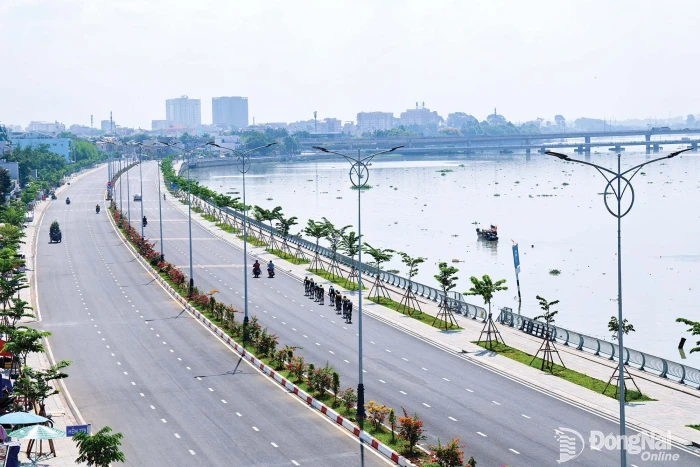
| A green, clean, and beautiful street in Long Khanh ward. Photo: Binh Nguyen |
Even as a central ward, Long Khanh still retains large areas dedicated to specialty fruit cultivation. Many growers are actively transitioning to organic production, applying technology, establishing supply chains, and developing brands to enhance product value while maintaining a balance between economic development, environmental protection, and enhancing urban quality.
Building a modern, livable urban area
Long Khanh ward currently has a population of more than 78,000, with a high population density and growing demand for mobility, education, commerce, and access to public services. Therefore, following the transition to the two-tier local government model, the ward People's Committee identified its core mission as prioritizing investment in essential infrastructure, addressing urgent social issues, and gradually completing urban infrastructure.
The ward is implementing more than 20 public investment projects and works, focusing on transportation, education, digital transformation, administrative reform, drainage, and urban beautification. In addition, the ward is prioritizing local transport infrastructure projects, constructing new educational facilities, and upgrading existing ones to meet national school standards.
Alongside major projects, the ward People's Committee is allocating substantial resources to public works, including the construction of drainage systems in flood-prone areas, dredging sewer systems, maintaining and repairing roads, installing additional road markings and traffic signs, and improving urban landscapes.
Chairman of the Long Khanh ward People's Committee Tang Quoc Lap stated that the ward is committed to integrated and modern development while remaining people-centered, with improving residents' quality of life as its ultimate goal. In pursuit of green and modern urban development, the local administration is focusing not only on multi-billion-VND projects but also on promptly addressing specific issues. These may include a flooded alley, a deteriorated section of road, or an area lacking street lighting.
In the coming period, the locality will continue to focus on completing urban infrastructure. Priority will be given to transport connectivity projects, drainage systems, public lighting, green parks, educational and cultural facilities, and digital infrastructure. All projects must aim to improve the living environment, expand green spaces, enhance landscapes, and promote a civilized urban lifestyle.
"I believe that with the attention of city leaders, the support of the business community, and the consensus of the people, Long Khanh ward will effectively utilize existing resources, accelerate the progress of key projects, and gradually become a modern, livable urban area," said Tang Quoc Lap, Chairman of the Long Khanh ward People's Committee.
Toward a green urban area
Long Khanh ward is often referred to as the “second Da Lat” of the eastern region due to its temperate climate, fresh living environment, and abundant green spaces.
Nguyen Thi Hue, a resident of Long Khanh ward, said, "I have lived here for many years. The most wonderful thing is the green living environment in the heart of the city. People have space to exercise every day." According to Hue, in addition to developing public green spaces, the locality has launched campaigns to plant trees and maintain environmental hygiene along many streets. These activities help create a green, clean, and beautiful landscape while improving residents' quality of life.
Long Khanh is also one of the urban areas that retain large-scale agricultural production zones in neighborhoods such as Bau Tram and Bau Sam. The locality has oriented agricultural development toward organic practices to help shape a green and modern city in the future.
The Toan Thang Agarwood Facility currently produces about 30 handicraft products made from agarwood, three of which have been granted One Commune, One Product (OCOP) certification. Pham Xuan Toan, the owner of the facility, said that from an initial 11-hectare seed garden, the facility has expanded its operations by providing seedlings and transferring agarwood cultivation techniques to farmers, increasing the Aquilaria planting area to nearly 70 hectares in the ward and neighboring localities.
Notably, the facility's operation is a green agricultural model because the garden is cultivated in harmony with nature, limiting the use of chemical fertilizers and pesticides to preserve the pure scent of the agarwood. Each agarwood garden includes a water reservoir and fish farming, with fish feed sourced primarily from weeds in the gardens. Water from the ponds, containing fish waste and various microorganisms, is used for irrigation, helping keep the gardens lush and green. All parts of the agarwood tree are processed into valuable products. Even agarwood leaves, which were once discarded, are now dried to make tea valued at millions of VND per kilogram.
Chairman of the Long Khanh ward People's Committee Tang Quoc Lap emphasized that promoting digital transformation and building a digital government are among the ward's new development drivers. The locality will continue investing in information technology infrastructure and applying digital data in urban management to better serve the people.
By Binh Nguyen – Translated by Minh Hong, Thu Ha


Thông tin bạn đọc
Đóng Lưu thông tin