
Dong Nai possesses enormous fisheries potential with nearly 90,000 hectares of water surface and the Dong Nai and La Nga river systems flowing through it. In addition, the province has 20 lakes currently used for aquaculture and fishing, with a total area of nearly 51,500 hectares.
Among these, Tri An Lake, with a surface area of approximately 323 km² (equivalent to 32,300 hectares), is the largest artificial lake in Southern Vietnam. It plays a crucial role in supplying water to the Tri An Hydropower Plant and for domestic use in the downstream area of the Dong Nai River and Ho Chi Minh City.
 |
| The households raising fish in cages on Tri An Lake in Suoi Tuong hamlet, Tri An commune, all own fishing boats, and the income from fishing helps them make ends meet. Photo: B. Nguyen |
In the province, there are nearly 1,300 rafts and over 5,200 cages used for aquaculture. The total annual aquatic product output reaches over 6,400 tons. Tri An Lake is the province's key area for raft fish farming. Tri An Lake once housed hundreds of species of freshwater fish and shrimp, many of which are listed in the Vietnam Red Data Book.
 |
| Fishing port in Suoi Tuong hamlet, Tri An commune. Photo: B. Nguyen |
Anchovies are one of the primary resources harvested by fishermen on Tri An Lake. Anchovy fishing and harvesting on the lake take place year-round. The anchovies in Tri An Lake are typically no larger than the tip of a chopstick and have soft bodies, so every stage, from netting and harvesting to processing and preservation, is done manually and requires meticulous care from the workers.
 |
| Anchovy fishing boats return to the harbor after a night of casting their nets. Photo: B. Nguyen |
The fishing port in Suoi Tuong hamlet, Tri An commune, Dong Nai province, is one of the areas with a high concentration of fish farms on Tri An Lake. Fishing activities in this area are quite vibrant, with anchovies being caught and brought to the port year-round.
 |
| Anchovies from fishing boats are brought to the dock to be sold to purchasing centers. Photo: B. Nguyen |
According to fishermen in Suoi Tuong hamlet, Tri An commune, they harvest whatever is in season. They sell some of the fish they catch to cover their daily living expenses and use the rest as feed for the fish they raise in cages. Among these, anchovies usually yield significantly more than other aquatic species.
 |
| Fishermen reap a bountiful catch of anchovies after a night of fishing. Photo: B. Nguyen |
In the past, during the peak fishing season, a single fishing boat could catch up to 100 kg of anchovies per night. Nowadays, even boats that encounter a good school of fish typically manage to catch only 30-40 kg per night. The anchovy population in Tri An Lake is declining, but the selling price, which used to be only a few thousand dong per kg, has now increased to around 15,000 VND per kg. Each fishing boat could earn 400,000-500,000 dong per night from a single net cast.
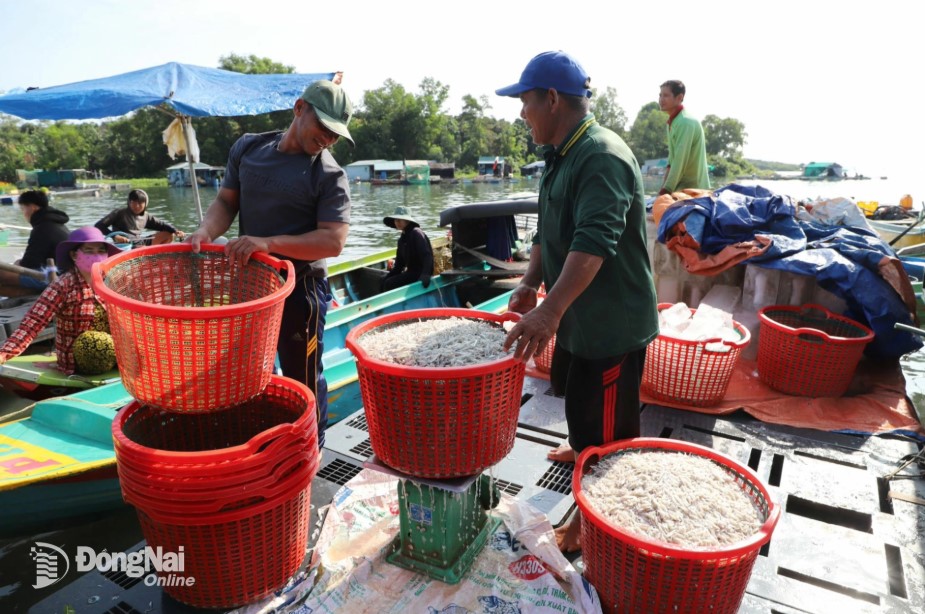 |
| Anchovies are weighed and sold by fishermen as soon as their boats return to the dock. Photo: B. Nguyen |
Nguyen Le, owner of a wholesale fish market specializing in purchasing anchovies from Tri An Lake in Suoi Tuong hamlet, Tri An commune, shared: "Anchovies are brought to the dock by fishing boats, weighed, cleaned, packed in ice, and then transported for distribution everywhere. The fish reach consumers still fresh."
 |
| Abundant anchovy resources are harvested from Tri An Lake. Photo: B. Nguyen |
These are naturally sourced fish of excellent quality, making them increasingly popular in the market. Despite being a specialty product, the price of anchovies distributed to retail outlets is quite reasonable, usually stable at 20,000–22,000 VND per kg.
 |
| A bustling scene of harvesting at the fish market. Photo: B. Nguyen |
At the fish market, anchovy purchasing activities usually take place daily from 7 to 10 a.m. In previous years, the market averaged 4 to 5 tons of anchovies per day, requiring 2 to 3 truckloads to supply various destinations. Anchovies from Tri An Lake were distributed to traditional markets and supermarkets in many provinces and cities, including Ho Chi Minh City and Tien Giang.
This year, due to the impact of storms and floods, the fish population in the lake has dropped sharply compared to previous years, and the market is now able to purchase only about 1 ton of anchovies per day. Currently, the supply of this specialty product is not enough to meet demand.
 |
| Anchovies are rinsed with ice water before preservation. Photo: B. Nguyen |
 |
| Ice is used to preserve fish. Photo: B. Nguyen |
 |
| The process of preserving fish before transporting them for consumption. Photo: B. Nguyen |
By Binh Nguyen - Translated by Quoc Dung, Minho


Thông tin bạn đọc
Đóng Lưu thông tin