
As a generation born and raised in the digital era, with a strong capacity to adapt quickly to advances in science and technology (S&T), innovation, and digital transformation, young union members and youth are consistently placed at the center of the nation’s development process.
Therefore, alongside the education sector, the Youth Union, Associations, and the Ho Chi Minh Young Pioneer Organisation across the province have consistently focused on organizing programs and activities in recent years aimed at nurturing a passion for discovery, fostering creativity, and developing scientific thinking among union members, children, and young people. These efforts have gradually deepened the impact of science and technology, innovation, and digital transformation activities.
Starting from robotics competitions…
Nguyen Tran Phuong Ha, Deputy Secretary of the Provincial Youth Union, said the robotics competition is an activity that the Youth Union has maintained in coordination with other partners for many years. Over multiple editions, the competition has left a lasting impression and become an essential scientific platform for children and young people.
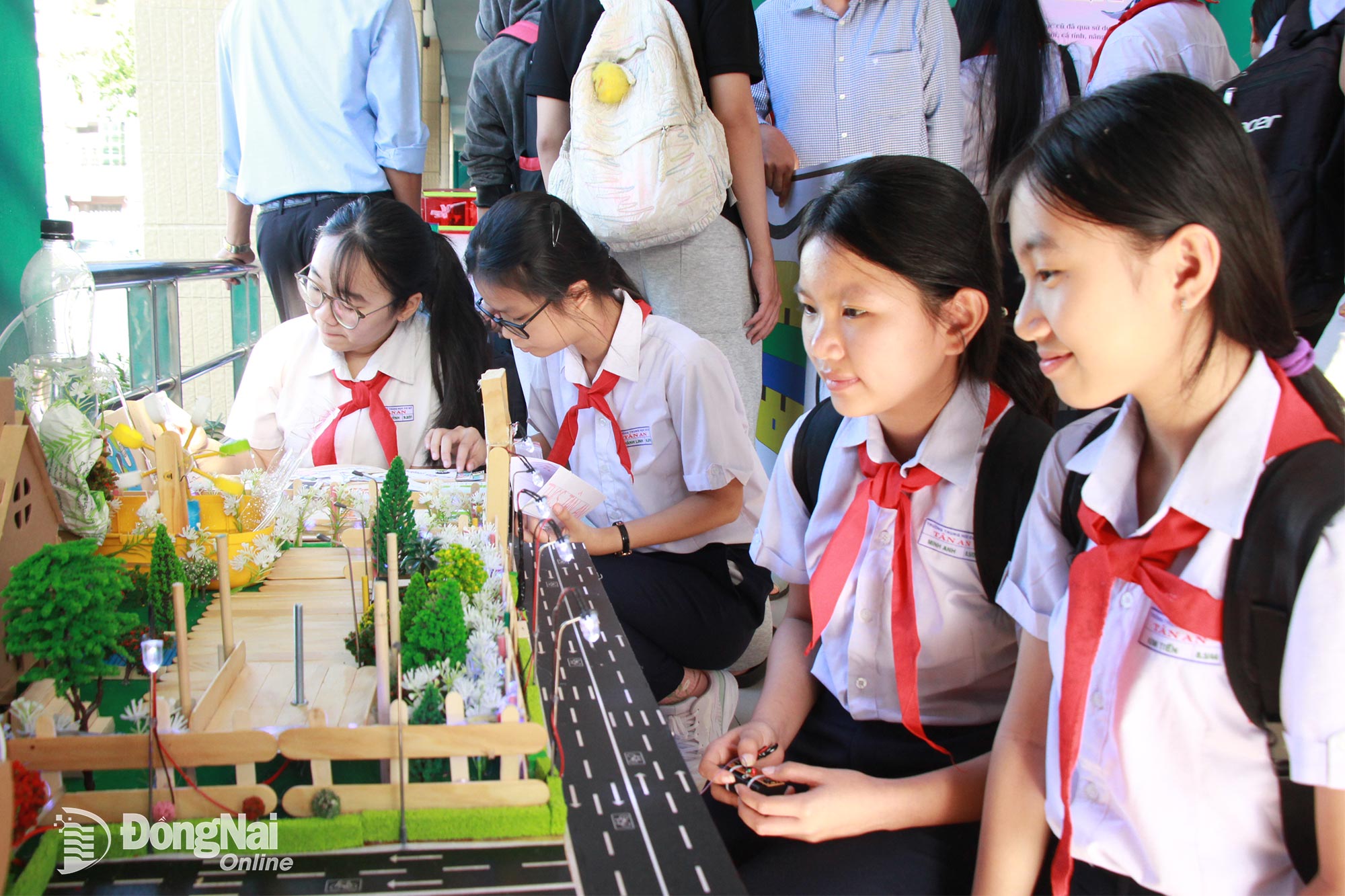 |
| Students from Tan An Secondary School (in Bien Hoa Ward) display their Smart Home model at the STEM Festival. Photo: Nga Son. |
Driven by a lifelong passion for robotics, Ho Si Dung, now a student in class 5/9 at Long Binh Tan Primary School (Long Hung Ward), has been a regular participant in the provincial Robotics Competition since he was in second grade. This year-long engagement has provided him with extensive experience in both robot assembly and competitive tactics.
Sharing his experience at the 2025 Robotics Competition, Dung noted that participants could either bring their own robots or borrow equipment from the Organizing Committee. He chose to assemble his own robot and spent three days practicing intensively in preparation for the competition.
With the theme “Disaster Recovery,” the Organizing Committee required contestants in the primary school division (Group A) to complete a series of tasks within a four-minute time frame. These included operating robots to clear debris by moving blocks representing trees, wood, and rocks that obstructed pathways and returning them to their designated positions on the competition field. For the relief mission, contestants were also required to maneuver their robots to transport cargo blocks from the supply area to the designated rescue shelter on the competition arena.
Contestants in the secondary school division (Group B) carried out the same tasks as those in Group A, and the Organizing Committee increased the level of difficulty for the debris-clearing mission. Teams had to operate their robots to open a road barrier and pass through it within six seconds; if the robot failed to pass within that time, the barrier would automatically close again.
Meanwhile, the competition category for high school students and learners from vocational education and continuing education centers (Group C) was entirely different. Using a set of equipment consisting of a kit and a programming/control device, teams and contestants were required, within 30 minutes, to assemble and program a dinosaur-shaped robot that met the Organizing Committee’s specifications for form and size. After completing the assembly and programming stages, the teams proceeded to compete in a race-track challenge.
For two students, Tran Anh Tuan and Bach Cung Nghi, both from class 10TN5 at Bu Dang High School (in Bu Dang Commune), this was their first time participating in a robotics competition, and they won first prize in Group C (Cluster 2). Tuan said that before the competition, all teams had received training and were introduced to the equipment sets and programming methods. However, during the competition, Tuan and Nghi showed greater creativity: instead of assembling four legs for the robot, they used two wheels from the equipment set as the robot’s legs. As a result, the robot completed the race track in just over 20 seconds.
"Beyond the achievement itself, the competition provided me with a valuable opportunity to learn, accumulate knowledge, and skills that will serve my studies and future contests," Tuan shared.
…To the activities of the STEM Day
Moving beyond robotics competitions, the Provincial Youth Union has also co-organized STEM Festivals to ensure that the seeds of science and technology continue to sprout and flourish among the youth. The highlight of this event is an exhibition showcasing STEM projects researched and developed by the students themselves.
At this year's STEM Festival, a group of six students from Tan An Secondary School (Bien Hoa City) presented their 'Smart Home' model, impressively crafted from recycled materials.
Tran Le Minh Anh, an eighth-grade student from Class 8/5 at Tan An Secondary School and one of six students who created the Smart Home model, stated that recently, after watching television, she and her group noticed that many areas in Vietnam had been affected by flooding, resulting in significant property damage. This reality prompted Minh Anh and her teammates to devise the idea of designing a Smart Home.
Both the robotics competition and STEM Festival are activities that help create an intellectual, healthy, and enriching environment, encouraging students to take initiative in learning, scientific research, and the practical application of technology. At the same time, they provide opportunities for students to exchange ideas and learn from one another, gradually fostering scientific thinking and enhancing digital competencies to adapt to the digital era.
According to Minh Anh's sharing, it took a long time to conceive the idea, but turning the idea into a model only took a week. Using recycled materials and accessories, Minh Anh and her teammates created a Smart Home model capable of rising when the water level increases. Next to the house, a large pond was arranged along with a system of greenery and an eye-catching flower garden. While the idea has so far only been realized as a model, it partly reflects the students’ creative thinking while conveying their desire to contribute to disaster mitigation, bringing safety and peace to the community and society.
Le Thi Thuong, a teacher of Natural Sciences at Hoa Binh Secondary School (in Tam Phuoc Ward), said that Hoa Binh Secondary School places great emphasis on organizing activities that nurture creativity among students through participation in programs showcasing innovative products.
At this year’s STEM Festival, organized by the Provincial Youth Union, Hoa Binh Secondary School showcased products made from recycled materials and dried leaves, such as a dan nguyet (Vietnamese moon lute) crafted from discarded plastic and reused wood; a solar-powered carousel made from cardboard and wooden ice-cream sticks; and paintings created from dried leaves and dried paper flowers. Beyond demonstrating students’ creativity, the exhibition also inspired creative thinking and helped spark new ideas among students. At the STEM Festival, in addition to viewing innovative products, children and adolescents had the opportunity to interact with robots and explore creative science and technology models, creating a more visual and engaging learning environment for young people.
By Nga Son – Translated by Thu Cuc, Minho


![[Photo series] Long Khanh Ring Road 1 ramps up construction for technical traffic opening on Feb. 3](/file/e7837c02876411cd0187645a2551379f/012026/anh_2_resized_20260119144842_20260119151818.jpg?width=500&height=-&type=resize)
Thông tin bạn đọc
Đóng Lưu thông tin