
During the official session of the 1st Congress of the Dong Nai Provincial Union of Science and Technology Associations (2025–2030 term), delegates listened to presentations from various units sharing their experiences on strengthening the role of members in intellectual work; promoting the role of the Provincial Women Intellectuals Association in implementing Resolution No. 57-NQ/TW on breakthroughs in the development of science, technology, innovation, and national digital transformation (Resolution No. 57); and discussing the current situation and proposing solutions to enhance the quality of communication activities and knowledge dissemination by the Union of Science and Technology Associations in the new period.
Strengthening the role of members in intellectual work
Speaking at the congress, Dr. Pham Hung Duc, Vice Rector of Dong Nai University, emphasized that intellectual work should go beyond simply training and utilizing individual intellectuals. It is vital to leverage the collective strength of organizational members, especially higher education institutions, which act as key hubs for generating and sharing knowledge.
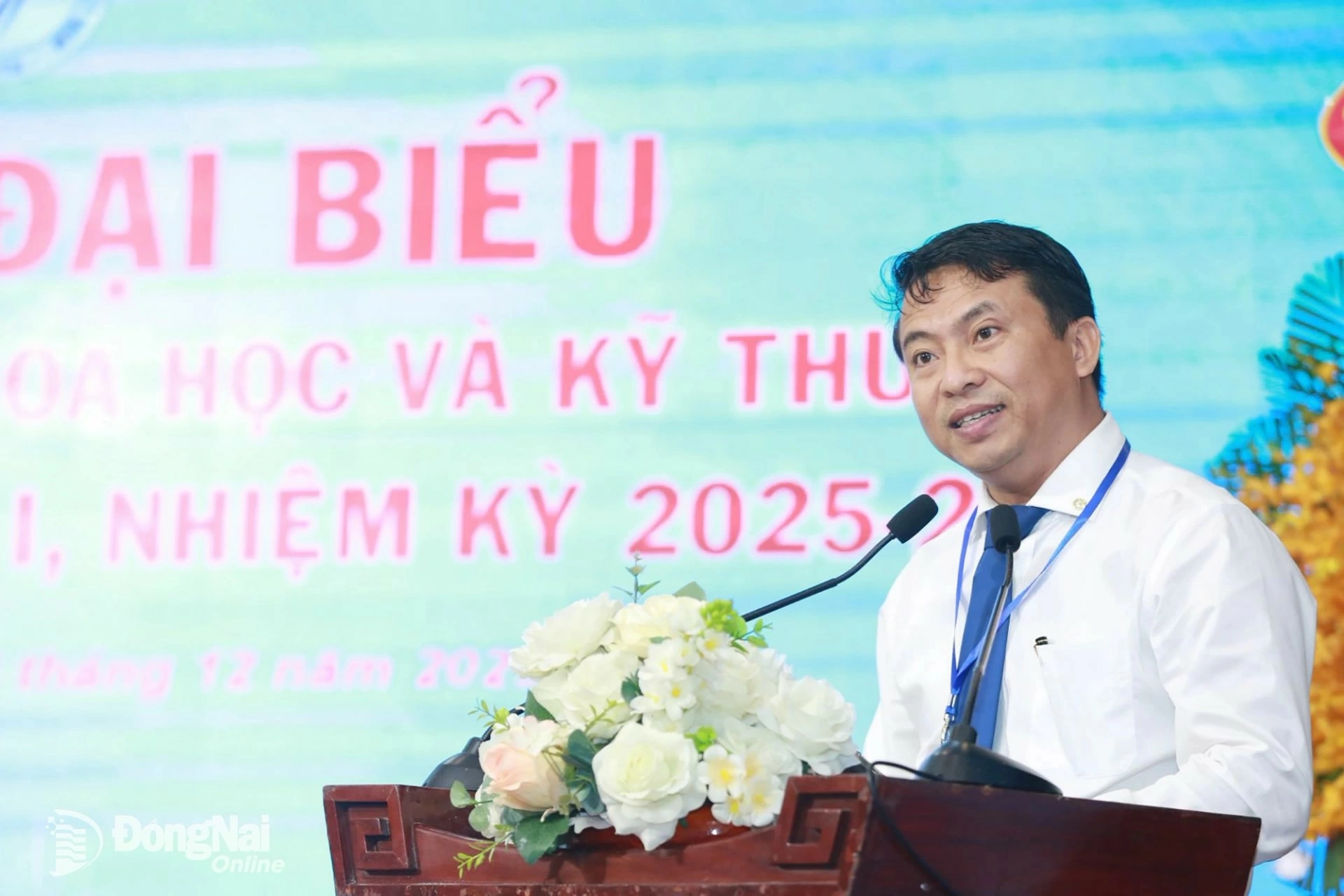 |
| Dr. Pham Hung Duc, Vice Rector of Dong Nai University, delivers his presentation at the congress. Photo: Huy Anh |
As the province’s hub for training and scientific research, and as an organizational member of the Dong Nai Provincial Union of Science and Technology Associations, Dong Nai University has actively collaborated with the Union in advisory, evaluative, applied research, and high-quality human resource development activities, contributing to the province’s socio-economic development goals.
To further enhance members' roles in intellectual work, Dr. Pham Hung Duc, Vice Rector of Dong Nai University, proposed several measures for both the university and the Provincial Union of Science and Technology Associations.
He recommended that the Provincial People’s Committee establish mechanisms to position Dong Nai University as the central hub for coordinating with other universities that have signed cooperation agreements with the province. He also suggested that the university be tasked with conducting scientific research, participating in the evaluation of research projects, and allocating funding for science and technology. Meanwhile, the Union should strengthen its coordination role by surveying the science and technology needs of provincial departments, agencies, and enterprises to inform task assignments for member organizations.
Dong Nai University will continue to innovate its collaboration methods to ensure the effective implementation of tasks. The university plans to proactively suggest research topics that address urgent provincial issues, including thoughtful urban planning, natural resource and environmental management, high-quality education development, and high-tech agriculture. It will also focus on establishing and developing young science clubs and innovation incubators to create a vibrant environment for young talents.
Promoting the role of the Provincial Women's Intellectual Association in implementing Resolution 57
Speaking on strategies to enhance the role of the Provincial Women Intellectuals Association in implementing Resolution No. 57, Hoang Thi Lai, Vice Chairwoman of the Dong Nai Provincial Women Intellectuals Association, highlighted the significance and results achieved under the resolution. Beyond gathering a strong team of female intellectuals, the Association has made notable contributions across various fields.
 |
| Hoang Thi Lai, Vice Chairwoman of the Dong Nai Provincial Women Intellectuals Association, delivers her presentation at the congress. Photo: Huy Anh |
According to Lai, Dong Nai is a province with strong industrial and service development, located in the Southern Key Economic Region. Consequently, the pace of industrialization, modernization, and the demand for digital transformation and innovation are increasing, placing greater expectations on female intellectuals. In response, the Association has identified several strategies to strengthen its role in implementing Resolution 57.
Key measures include improving members’ digital and science-technology skills; expanding networks to mobilize and utilize the collective intelligence of female intellectuals across sectors, enterprises, and educational institutions, especially at the commune and ward levels; and strengthening ties with professional associations to create a network of women in science and innovation in Dong Nai. The Association also plans to innovate its training programs, covering digital skills, foreign languages, AI workshops, specialized courses, and updates on international integration, enabling female intellectuals to undertake major scientific tasks confidently.
Additionally, greater emphasis will be placed on scientific research, technology transfer, practical innovations, and digital transformation within union activities. Research outcomes will be closely linked to production, management, and everyday life. A Fund for Scientific Research and Innovation will be established to support deeper engagement of female intellectuals in technological development. Efforts will also be made to recognize and honor outstanding female intellectuals, thereby promoting the image of modern, intelligent, resilient, and compassionate women from Dong Nai.
Mentoring models will be developed to connect senior and younger generations of female intellectuals. In contrast, young female researchers will be encouraged to participate in research projects, innovation initiatives, and tech startups. Special support mechanisms in various forms will be implemented to remove bottlenecks and fully unlock the potential of female intellectuals, particularly in key sectors prioritized by the province, such as logistics, high technology, and airport urban management.
Enhancing the quality of communication and knowledge dissemination activities
In her presentation on enhancing the quality of communication and knowledge dissemination within the Provincial Union of Science and Technology Associations in the new era, Phi Thi Nhung, Deputy Head of the Union's Professional Affairs Department, highlighted that, amid rapid digital transformation and the swift progress of science and technology, effective communication and the dissemination of scientific and technological knowledge are vital for encouraging innovation, increasing public awareness, and supporting sustainable development.
 |
| Phi Thi Nhung, Deputy Head of the Professional Affairs Department at the Dong Nai Union of Science and Technology Associations, delivers her presentation at the congress. Photo: Huy Anh |
During the 2021-2025 period, the Provincial Union of Science and Technology Associations launched over 150 communication and knowledge dissemination initiatives across schools and residential areas, reaching nearly 69,000 students and thousands of residents, farmers, and businesses. Regular programs, including the “Knowledge Bridge” television series and the "Science and Life" newsletter, have effectively integrated scientific and technological insights into daily life. Furthermore, specialized seminars and scientific forums have been held frequently, facilitating the practical application of technical advancements in production, environmental protection, digital transformation, and innovative entrepreneurship.
In addition to identifying limitations in science and technology communication, Phi Thi Nhung proposed several solutions to improve the quality of science and technology communication and knowledge sharing in the new context. Key measures include expanding and diversifying communication channels; S&T content should be delivered in multiple formats, not only through traditional media such as newspapers and television but also via social media platforms.
She also recommended investing in developing a digital knowledge space for Dong Nai science and technology, serving as an open data platform that comprehensively integrates topics, documents, publications, images, and videos related to the province's science and technology activities. This platform would serve the needs of researchers, learners, farmers, enterprises, and officials.
Furthermore, she emphasized the importance of strengthening regular connections between scientists, research institutes, universities, businesses, and the public, with the Provincial Union of Science and Technology Associations acting as the primary hub for knowledge transfer, showcasing effective application models, and deriving practical value from research results.
Finally, the Union should focus on training communication staff in both professional knowledge and skills, proposing specific policies to support science and technology communication, and securing stable, ongoing funding to ensure these activities are carried out effectively.
By Nga Son - Translated by Hong Van, Minho


Thông tin bạn đọc
Đóng Lưu thông tin