
After nearly 5 years under construction, Phase 1 of Long Thanh International Airport has witnessed the inauguration of several facilities and welcomed its first official flight, marking a major milestone in Vietnam’s aviation development following almost five years of construction.
This marks a significant milestone in the development of what is regarded as one of the country’s landmark infrastructure projects.
Flights reflecting the nation’s aspirations and determination
Long Thanh Airport is a nationally significant project approved by the National Assembly under Resolution No. 94/2015/QH13 dated June 25, 2015, with a planned capacity of 100 million passengers and 5 million tonnes of cargo annually. The project is being developed in three phases. Phase 1 includes the construction of a passenger terminal designed to handle 25 million passengers per year and is built to ICAO Category 4F standards, the highest classification set by the International Civil Aviation Organization (ICAO). The Airports Corporation of Vietnam (ACV) has been designated as the investor for Component Project 3, which covers the airport’s essential infrastructure works.
 |
| Politburo member and Permanent Deputy Prime Minister Nguyen Hoa Binh, along with other passengers, arrives on the first special flight at Long Thanh International Airport on the morning of December 19. Photo: Courtesy of VNA |
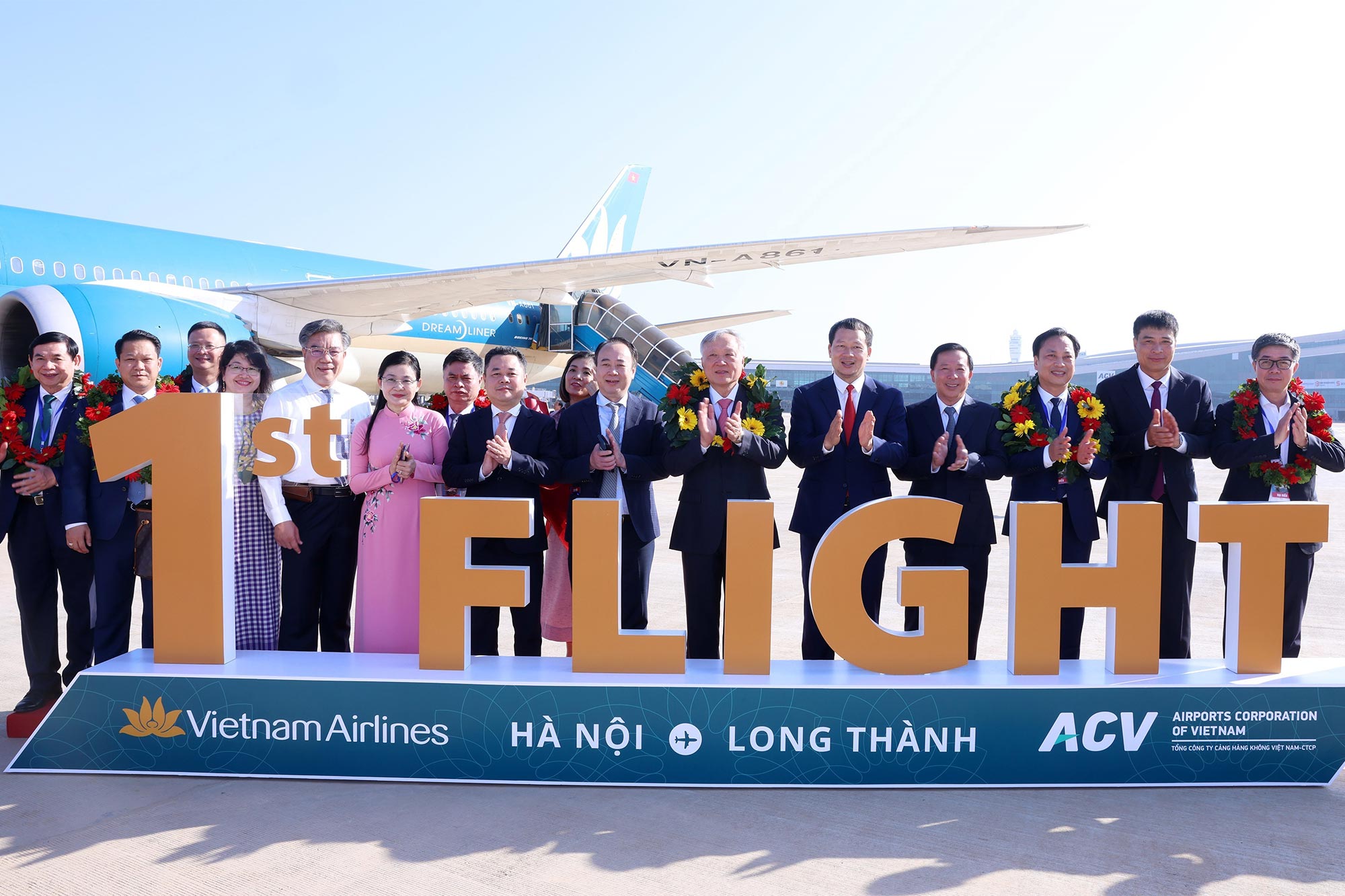
Construction of the project officially began in early 2021. On December 19, 2025, almost five years later, Phase 1 of Long Thanh International Airport welcomed the inauguration of several facilities and its first official flight.
Vu The Phiet, Chairman of the Board of Directors of ACV, said the Long Thanh International Airport project stands out not only for its vast investment scale and technical complexity, but also for its strategic importance as a long-term growth engine for Vietnam’s socio-economic development. He noted that the project has confronted a series of unprecedented challenges throughout its implementation. Among the most significant was large-scale land clearance, directly affecting the livelihoods of tens of thousands of residents. Construction was further disrupted by the Covid-19 pandemic, when worksites faced acute labor shortages, a lack of specialized expertise, supply-chain disruptions, sharp volatility in construction material prices, and shortages of key inputs. At the same time, the project has been under constant pressure to meet tight schedules and stringent quality benchmarks, while complying with the highest international standards. “These difficulties were not abstract or theoretical. They were felt every day, every hour, on the construction site, in every decision taken and every shift completed,” he said.
Phiet added that strong, hands-on leadership from the Party, the State, the Government and the Prime Minister proved decisive in overcoming those obstacles. Bottlenecks were addressed through timely decisions and special mechanisms, guided by a clear resolve: challenges would not be allowed to hinder development, nor delays permitted to slow the project or the nation’s momentum. That firm, consistent and accountable approach enabled the project to move swiftly toward completion. “At this meaningful moment, as Long Thanh Airport successfully welcomes its first three flights, these are not merely routine operations,” he said. “They are flights carrying the nation’s aspirations, confidence and determination to move forward, following a long journey marked by effort and perseverance.”
Speaking at the groundbreaking, inauguration and technical opening ceremony for major projects on December 19, held in celebration of the 14th National Congress of the Communist Party of Vietnam, Prime Minister Pham Minh Chinh highlighted the scale and significance of the achievements. He noted that numerous strategic and nationally important projects had been completed and brought into operation, describing them as works reflecting both the Party’s vision and the people’s aspirations, guided by the principle of leaving no one behind. These include the unprecedented projects, the first-of-their-kind initiatives, and those carrying historic importance. The Prime Minister also pointed to the inauguration and technical opening of nearly 3,200 kilometers of expressways nationwide, including the main North–South Expressway, key East–West corridors, around 325 kilometers of interchanges and access roads, and more than 1,700 kilometers of coastal roads, as well as the landing of the first flight at Long Thanh International Airport.
Developing Long Thanh Airport into a green, smart airport
During a working visit to the Long Thanh Airport project on November 13, 2025, Party General Secretary To Lam noted that the project has begun to demonstrate strong financial efficiency and the growing self-reliance of Vietnamese enterprises, with expectations of a shorter payback period and lower overall investment costs. He highlighted the application of advanced management technologies, including the Smart Airport Operations Control Center (Smart APOC), the integrated Airport Management System (AMS), the high-speed ICS baggage handling system, OneID and VNeID platforms. These innovations, he said, are positioning Long Thanh Airport toward the standards of a green, smart, five-star international airport.
 |
| Politburo member and Permanent Deputy Prime Minister Nguyen Hoa Binh is a special guest on the first passenger flight to land at Long Thanh International Airport on the morning of December 19. Photo: Courtesy of VNA |
Vu The Phiet said that once operations begin in the first half of 2026, Long Thanh Airport is set to become a five-star international smart green airport, offering passengers a seamless, fully digital travel experience. He noted that key features will include a Smart Airport Operations Control Center developed in-house by ACV with proprietary core technologies, along with a digital passenger journey enabled through platforms such as VNeID, the iACV app, or airlines’ online check-in applications. These tools allow passengers to register biometric identities under the ACV ID system, access real-time information on check-in areas and departure gates, and plan travel times to the airport more efficiently.
Phase 1 of the Long Thanh Airport project comprises four component sub-projects. Component Project 1 covers facilities for state management agencies and is invested in by the relevant government authorities. Component Project 2 includes air traffic management facilities, with the Vietnam Air Traffic Management Corporation (VATM) serving as the investor. Component Project 3 consists of the airport’s essential infrastructure works, developed by ACV. Component Project 4 involves other supporting facilities, for which the Ministry of Construction, formerly the Ministry of Transport, is responsible for leading the investor selection and implementation process.
At the airport, passengers are offered a range of newly deployed automated technologies developed and mastered by Vietnamese engineers. These include an electronic toll collection (ETC) system and a smart parking facility equipped with AI-powered cameras and a centralized control platform that provides real-time space availability, automated parking guidance and cashless payment. Traffic data is transmitted directly to the Airport Operations Control Center (APOC), supporting traffic management, demand forecasting, congestion reduction and an improved passenger experience from the point of entry.
Inside the terminal, passengers are provided with a smart and seamless check-in system built around a fully digital journey. The facility is equipped with 96 biometric-enabled self-service check-in kiosks that allow facial recognition, boarding pass printing and baggage tag issuance, including 12 kiosks located at the parking area. In addition, 64 biometric self bag-drop units enable passengers to check in luggage through facial scanning, while 160 conventional check-in counters are available to support biometric enrollment, allowing passengers to access paperless services throughout the airport.
The airport is also equipped with a range of advanced aviation technologies designed to ensure precise and safe operations, including an intelligent aircraft docking guidance system, comprehensive surveillance camera networks, and systems for water treatment and reuse, as well as solar energy generation. Infrastructure supporting green mobility has also been developed, with dedicated charging areas for ground support equipment (GSE) and public spaces. “These modern technologies are not only a source of pride but also a solid foundation for generating significant socio-economic value for the country,” Phiet added.
By Pham Tung - Translated by Tam Binh, Thu Ha


Thông tin bạn đọc
Đóng Lưu thông tin