
On the morning of November 17, the Vietnam Fatherland Front (VFF) Committee of Dong Nai Province held a social feedback conference on the draft resolution regulating the 2026 land price table and the draft resolution establishing criteria for determining land areas and locations in the province. Nguyen Thi Hoang, Provincial Party Committee member and Vice Chairwoman of the Dong Nai People’s Committee, attended the conference.
 |
| Nguyen Tan Phu and Luu Thi Ha, Vice Chairpersons of the VFF Committee of Dong Nai Province, co-chair the conference. Photo: Hoang Loc |
Luu Thi Ha, Vice Chairwoman of the VFF Committee of Dong Nai Province, opened the conference by noting that under the 2024 Land Law, starting from January 1, 2026, the land price tables will be updated annually instead of every five years as practiced currently, and they must closely reflect prevailing market prices. In addition, from July 1, 2025, Dong Nai operates a two-tier local administration model, which entails the need to build a land price table according to the new commune and ward administrative units.
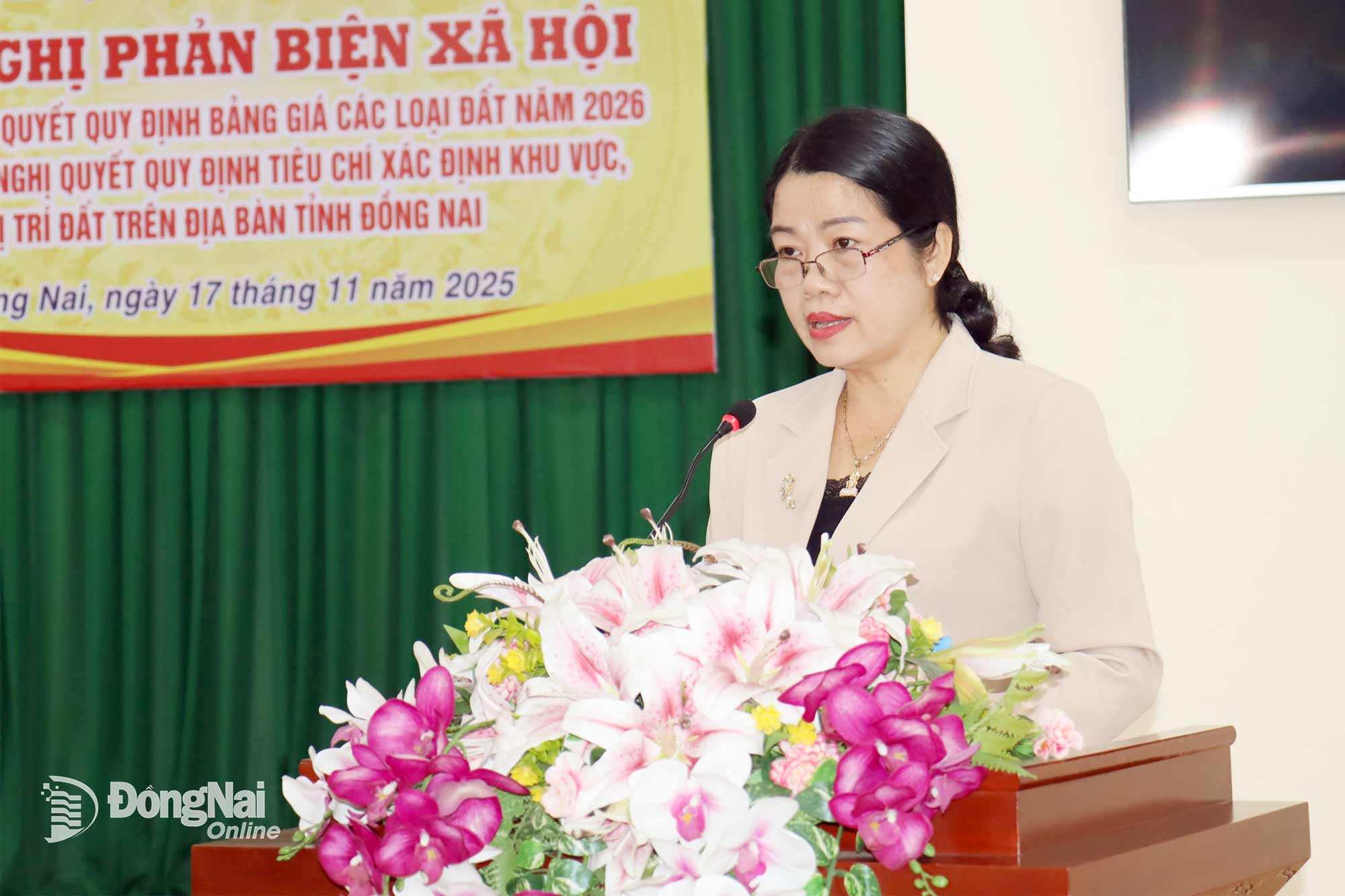 |
| Luu Thi Ha, Vice Chairwoman of the VFF Committee of Dong Nai Province, speaks at the conference. Photo: Hoang Loc |
She also noted that the land price table serves as a key basis for calculating compensation when the State recovers land, as well as for determining taxes, land use fees, and land rental charges. It directly affects the rights of citizens, businesses, and the province’s investment environment. Therefore, the development of the land price table must be objective, scientific, transparent, and aligned with Dong Nai’s socio-economic development. She urged delegates to actively contribute responsible, candid, and constructive feedback to help finalize the resolutions.
 |
| Nguyen Thi Hoang, Provincial Party Committee Member and Vice Chairwoman of the Dong Nai People’s Committee, and other delegates attend the conference. Photo: Hoang Loc |
During the conference, a representative from the consulting unit presented a summary of the content, new points, and proposed adjustments in the draft land price table to facilitate discussion. The conference received over ten direct and written comments from units under the Dong Nai VFF Committee, local communes, and the Provincial Bar Association. These comments analyzed and provided feedback on the necessity of issuing the 2026 land price table. They also evaluated its compliance with the law and Party policies, its practicality and scientific basis, and forecasted its socio-economic impacts. In addition, the comments suggested ways to finalize the draft to balance the interests of the state, citizens, and businesses.
 |
| Tran Quang Toai, former member of the Dong Nai Provincial VFF Committee, shares his views at the conference. Photo: Hoang Loc |
 |
| A representative from Tho Son Commune delivers a speech at the conference. Photo: Hoang Loc. |
In his concluding remarks, the leader of the Provincial VFF Committee said the conference received in-depth input from experts, scientists, socio- organizations, and local delegates. Most participants agreed that setting the 2026 land price table and defining criteria for classifying land areas and locations is necessary to implement the 2024 Land Law and provide a legal basis for land management, use, taxation, compensation, auctions, allocation, and leasing.
 |
| A representative from the consulting unit prepares Dong Nai Province’s 2026 land price table presents at the conference. Photo: Hoang Loc. |
The leaders of the VFF Provincial Committee asked the drafting agency to further refine the draft. They emphasized that the methods and data for setting land prices should reflect market values and avoid large gaps between areas. The impacts on residents and businesses should be carefully assessed, especially regarding compensation, resettlement, production costs, and the investment environment. Mechanisms for public disclosure and oversight of the application of land price table should ensure transparency, consistency, and practicality. Special attention should be given to remote areas, ethnic minority communities, industrial zones, and border areas to avoid placing unreasonable pressure on livelihoods and production.
The leaders of the Provincial VFF Committee asked the consulting unit to supplement land price survey data, provide market comparison tables, and finalize the criteria for zoning and land location. Relevant departments and agencies were urged to work closely to ensure transparency in the process of building land price table and fostering social consensus.
The Standing Committee of the Provincial VFF Committee is compiling all feedback that will be forwarded to the Standing Committee of the Provincial People’s Council, the Provincial People’s Committee, and the drafting agency for review, consideration, and response prior to submission to the Provincial People’s Council for approval.
By Hoang Loc – Translated by Tam Binh, Thu Ha


Thông tin bạn đọc
Đóng Lưu thông tin