
Dong Nai is a key province for industrial development, including the supporting industry. Most Vietnamese enterprises in the supporting industry sector are small or medium-sized, meaning their production and business activities rely heavily on the customer contracts they can secure.
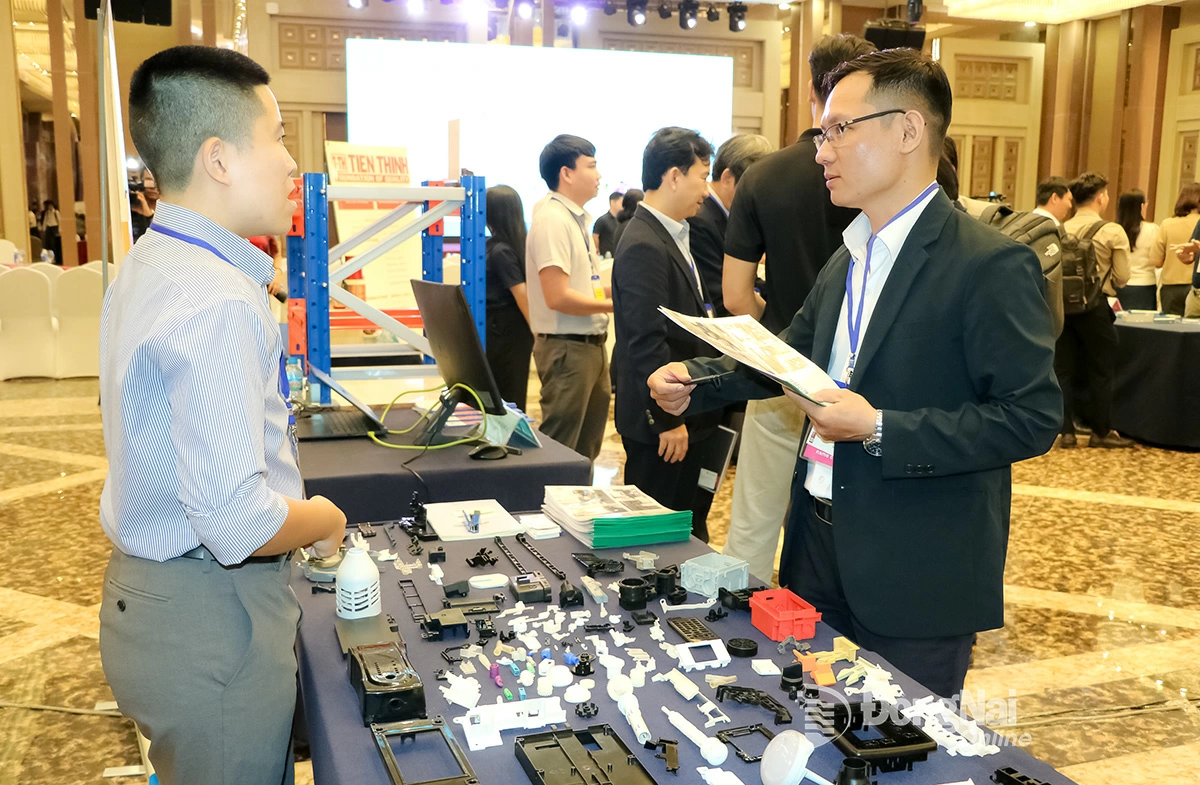 |
| A supporting-industry product from a Dong Nai enterprise on display to seek partners at the 2025 Vietnam-Japan Business Networking Conference. Photo: Vuong The |
Along with support from government policies, many supporting-industry enterprises in Dong Nai have recently made efforts to expand production and business operations, diversify their customer base, and strengthen their manufacturing capabilities.
Customers: a matter of survival
Just after welcoming a Japanese partner who visited to tour the facilities and learn about the company’s mechanical manufacturing products, Phan Van Tu, Director of Kim Vinh Thang Co., Ltd. (plant located in Ho Nai Industrial Park), said the initial impressions between the two sides were positive, with promising opportunities to expand cooperation.
In recent years, Kim Vinh Thang Co., Ltd. has been significantly impacted by the relocation of its plant from Bien Hoa 1 Industrial Park to accommodate the province’s development plans. After stabilizing its production infrastructure, the company is now ramping up production toward the end of the year. According to Phan Van Tu, participating in direct business-matching programs organized by the Dong Nai Supporting Industry Promotion Coordination Team, as well as other trade networking activities, has proven to be an effective channel for finding new customers.
In addition to programs held within Dong Nai, participation in national and regional initiatives is also helping businesses broaden opportunities to connect and cooperate with customers and partners. In early December, Ho Chi Minh City will host the Exhibition-Forum on Supporting Industries and the 2025 Supply Chain Demand-Supply Connection Conference. As the largest annual event for the supporting industry, it is expected to bring together over 200 enterprises and several industrial parks. The event offers a valuable platform for domestic companies, manufacturing groups, FDI partners, and industrial parks to strengthen ties, expand cooperation, and seek opportunities in global supply chains.
Similarly, Nguyen Quoc Hung, Director of Tinh Nguyen Hao Co., Ltd. (located in Phuoc Tan Ward), shared that alongside supplying Vietnamese manufacturers, a significant portion of the company’s output comes from cooperation with foreign-invested enterprises (FDI) operating in the province. During challenging periods, especially the COVID-19 pandemic and the subsequent global economic downturn, the company’s production volume was severely impacted. Several foreign partners reduced their purchase orders, and securing output continued to be an ongoing concern. After a period of recovery, Tinh Nguyen Hao has now achieved greater stability and has built an additional plant to meet rising demand.
To support enterprises in the supporting industry, in addition to general national policies, Dong Nai Province has also implemented more targeted initiatives. Most recently, the province hosted the Vietnam-Japan Business Networking Conference, attracting participation from over 100 enterprises.
Nguyen Huu Duc, Deputy Head of the Dong Nai Supporting Industry Promotion Coordination Team, assessed that the opportunities and cooperation potential among enterprises are substantial. However, several objective factors have caused information gaps between companies. Therefore, following large-scale networking events, the Coordination Team will proactively connect each domestic enterprise with specific FDI enterprises, helping both sides grasp clear information, assess potential, and explore cooperation opportunities so that support efforts can be more practical and effective.
Enterprises gradually overcome their weaknesses
In reality, most Vietnamese supporting-industry enterprises have grown from small-scale businesses, so access to government policies, directives, and support mechanisms still faces certain limitations. Barriers such as access to loans, support for factory construction, tax incentives, or meeting required production standards continue to pose challenges for small and medium-sized enterprises. Only by overcoming these obstacles can businesses truly demonstrate their capabilities and take part more deeply in global supply chains.
According to Nguyen Huu That, General Director of Diep Nam Phuong Investment JSC (located in Loc An - Binh Son Industrial Park), the company’s factory used to be modest in scale and located outside a centralized manufacturing zone. To enhance production capacity and meet partners’ increasingly high standards, the company invested in constructing a modern factory in the Loc An - Binh Son Industrial Park. With a favorable location and tens of billions of VND spent on upgrading new machinery systems, the company is now more confident in meeting stringent customer requirements.
Nguyen Huu That affirmed that competition in the supporting industry is growing increasingly intense, requiring stronger cooperation among local enterprises to leverage each company's strengths comprehensively. Prioritizing the use of one another’s products and services, or sharing supply sources at specific points in time, serves as a solution to generate added momentum for businesses in implementing their production and business strategies.
Alongside upgrading production infrastructure, human resources remain a critical factor that continues to receive strong attention from enterprises. Investing in people, through training, improving skills and technical expertise for staff and workers, and developing soft skills to enhance work performance, is a long-term foundation for sustainable development.
By Vuong The - Translated by Quynh Nhu, Minho


Thông tin bạn đọc
Đóng Lưu thông tin