
The Resolution of the first Congress of the Dong Nai Provincial Party for the 2025–2030 term sets a target that by 2030, 92% of the urban population will have access to centralized clean water supply, while 85% of the rural population will use clean water that meets national standards.
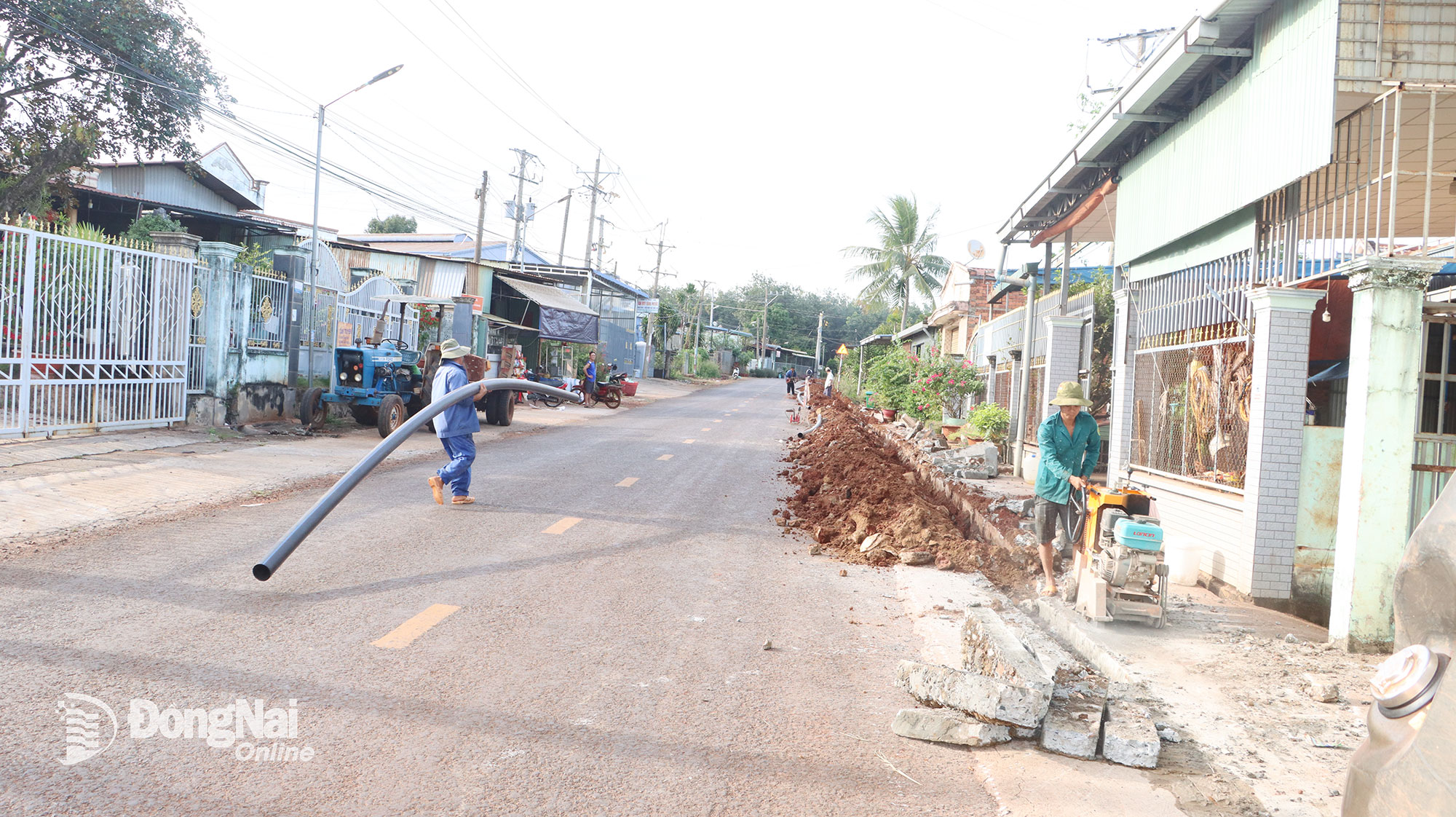 |
| Binh Phuoc Water Supply and Sewerage Joint Stock Company invests in a centralized water supply network in Binh Tan Commune, Dong Nai Province. Photo: Vu Thuyen |
This reflects the province’s political commitment to improving quality of life, protecting public health, and promoting sustainable development.
Determined to increase the proportion of the population with access to clean water
In recent years, both provinces of former Binh Phuoc and Dong Nai have introduced plans, projects, and programs aimed at increasing the proportion of households with access to clean water. Various measures have been implemented with positive results, including expanding urban water supply networks to rural communes, investing in and upgrading centralized rural water stations, increasing the capacity of water treatment plants, and no longer granting permits for the drilling of groundwater wells in areas already served by water supply infrastructure. However, the development of clean water supply has yet to reach its targets due to high investment costs and the persistence of rural households’ habit of using self-dug wells.
Building on these achievements, the resolution of the first Congress of the Dong Nai Provincial Party Committee for the 2025–2030 term set targets for clean water development. The resolution aims that by 2030, 92% of the urban population will have access to centralized clean water supply, while 85% of the rural population will use clean water that meets national standards. In the Action Program implementing the resolution, the Provincial Party Executive Committee also identified the development of a clean water system as a key priority within the province’s technical infrastructure strategy.
Nguyen Anh Tuan, Provincial Party Committee member and Director of the Department of Construction, said the construction sector is reviewing the Dong Nai Province Clean Water Project for the 2021–2025 period as a basis for developing plans for 2026–2030 period. He added that clean water is not only an essential need but also a measure of quality of life and a factor in protecting public health and natural resources. It is also an important criterion in evaluating urban and rural infrastructure.
At present, the province is implementing a range of measures to increase the proportion of households with access to clean water. Priority is given to upgrading and expanding existing water supply systems, particularly in rural areas, and encouraging investment in large-scale clean water projects. In addition, enterprises are required to apply modern technologies to manage networks efficiently, reduce water loss, ensure water quality, and maintain policies supporting household connections to piped water. Local authorities are also stepping up public awareness campaigns to encourage residents to shift away from using well water.
Nguyen Thi Hoang, Provincial Party Committee member and Vice Chairwoman of the Provincial People’s Committee, has repeatedly emphasized that providing clean water for residents is not only a political task but also closely linked to social welfare goals. The province’s aim is not merely to reach 80 or 90 percent coverage but to ensure that all residents have access to clean, standard-quality water. Completing this task as soon as possible will improve people’s quality of life and health.
Active participation of enterprises
There are currently three key sources for increasing the proportion of the population with access to clean water: government investment in rural water supply infrastructure in certain priority areas, households installing their own water filtration systems, and, most importantly, enterprises investing in and developing centralized water supply networks for residents.
As the largest clean water supplier in the province, Dong Nai Water Supply Joint Stock Company has been implementing numerous projects to develop water infrastructure in the southern area of the province under the Dong Nai Province Clean Water Project for the 2021–2025 period. In addition, the company has been modernizing treatment technologies and completing procedures to expand the capacity of existing water plants, ensuring a stable and high-quality water supply to meet both residential needs and industrial development.
In the Northern area of the province (formerly Binh Phuoc Province), Binh Phuoc Water Supply and Sewerage Joint Stock Company has extended its water network to cover the former Dong Xoai City, the former Phuoc Long Town, and surrounding areas, providing clean water to approximately 46,000 customers.
Pham Thi Loan, Deputy General Director of Binh Phuoc Water Supply and Sewerage Joint Stock Company, said the company is implementing several key projects, including the Nha Bich Water Plant, which will have a capacity of 60,000 m³/day by 2030 and increase to 180,000 m³/day after 2030, and the Phuoc Long Water Plant Upgrade Project, with a capacity of 33,000 m³/day by 2030, rising to over 61,000 m³/day thereafter. At the same time, the company is conducting surveys and seeking investment approval for water supply systems in Tan Loi, Dong Tam, Thuan Loi, Phu Trung, Long Ha, Binh Tan, and Bu Gia Map communes to expand coverage and increase the proportion of households with access to clean water.
Local authorities are taking proactive steps to boost the share of households with access to clean water.
Nguyen Chi Thuong, Vice Chairman of the Dong Tam Commune People’s Committee, noted that the commune focuses on raising public awareness about the benefits of clean water while also leveraging social resources and national target programs to invest in and connect water supply networks to local residential clusters.
Bui Viet Anh, Vice Chairman of the Binh Tan Commune People’s Committee, emphasized that to reach the target of 85% of households having access to clean water by 2030, the commune will work with enterprises to develop centralized water supply projects. He also called on the province and relevant departments to provide funding support and favorable policies to help residents more easily connect to, install, and use piped water.
Several communes and wards have also developed plans, proactively working with water supply companies and assessing resources to invest in clean water projects. These efforts not only help improve residents’ quality of life but also contribute to realizing the goal of building a greener, more livable Dong Nai.
By Hoang Loc, Vu Thuyen – Translated by Tam Binh, Thu Ha


Thông tin bạn đọc
Đóng Lưu thông tin