
Dong Nai is a fertile land with many specialised zones for industrial crops, agricultural produce, and fruit trees that boast exceptional quality. This abundant source of raw materials has enabled the development of numerous unique and delicious local dishes, many of which have become renowned specialities.
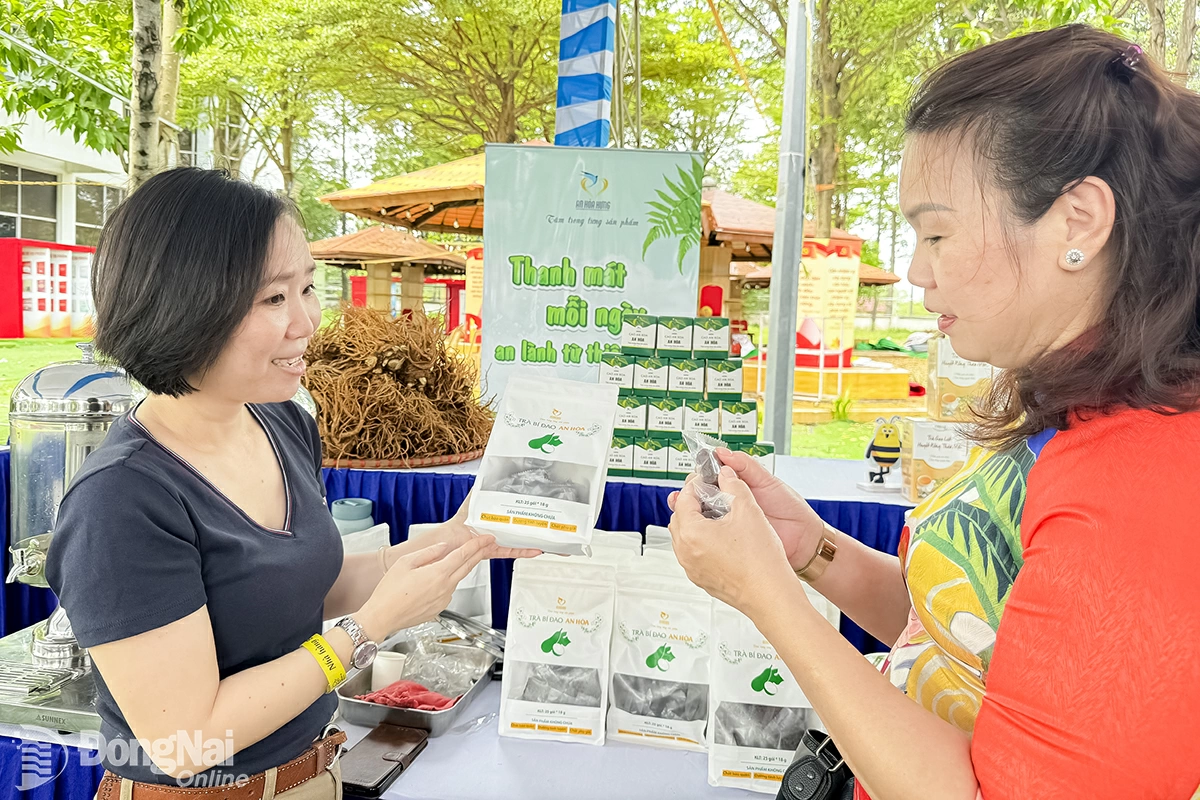 |
| Winter melon tea produced by An Hoa Hung Facility in Long Hung Ward, Dong Nai Province, is showcased at a trade promotion event in Tran Bien Ward. Photo: Binh Nguyen |
Traditional specialities of Dong Nai are entirely handcrafted, with meticulous attention given to every stage, from selecting ingredients to processing. This dedication and refinement have created distinctive flavours that consumers are willing to pay premium prices to enjoy.
This is a niche, yet promising market that many farmers and local businesses are investing in with confidence, gradually building the brand of handcrafted specialities that carry the cultural imprint of Dong Nai.
High demand for handcrafted delicacies
Fresh cashew nuts roasted with firewood using traditional methods by Hoang Phu Cashew Company Limited in Loc Tan Commune, Dong Nai Province, have obtained various brand and quality certificates. The product has been recognized by the Ministry of Industry and Trade as an outstanding Vietnamese brand and was nominated to represent the Vietnamese cashew industry at the 2013 Guangzhou International Fair in China. The company has also received the Golden Cup Tam Nong Award from the Vietnam Farmers Union; been rated as an A-grade ready-to-eat food by the Vietnam Cashew Association; and been certified as an Outstanding Vietnamese Brand for Consumer Rights Protection by the Vietnam Union of Science and Technology Associations.
Hoang Chuan, Director of Hoang Phu Cashew Company Limited, located in Loc Tan Commune, stated that the product's deliciousness and careful handcrafting result in a wholesale price range of 360,000 to 500,000 VND/kg. It is supplied to high-end retail channels, and in many places, customers are willing to pay millions of dong to purchase it.
Sharing the story of his entrepreneurial journey in handcrafted firewood-roasted cashews, Hoang Chuan said: “I used to collect agricultural produce and realised that the cashews from my hometown were exceptionally flavourful, yet the best-quality nuts were exported. That motivated me to invest in processing. From my own intention and dedication, I wanted to build a cashew brand rooted in this province’s raw material areas.”
He started with two cast-iron pans for traditional roasting. Later, he invented a wood-fired roasting stove, a solution that won the Provincial Technical Innovation Award of the former Binh Phuoc Province.
According to Hoang Chuan, the company has invested in drying yards and warehouses capable of storing 400–500 tonnes of cashews, ensuring year-round supply for processing. The nuts are sourced by collecting directly from Khmer and Stieng ethnic communities in the border communes of Loc Ninh and Bu Dop, where cashews are grown naturally, ensuring quality and safety.
During production, the company focuses on selecting and grading nuts to ensure only the highest-quality cashews are used. Firewood for roasting is sourced from longan trees in northern provinces, which produce little smoke and long-lasting embers, contributing to the product’s rich and savoury aroma.
Thanks to its superior quality, the product has spread naturally through word of mouth, beginning with local residents who purchased it for personal consumption or as gifts. Its reputation gradually spread across the country and even abroad.
The can wine (ruou can) of the M’nong and Stieng ethnic groups in Bu Gia Map Commune is another speciality with meticulous, traditional processing methods found nowhere else. Notably, the M’nong people create the fermentation starter from wild forest leaves. The leaves are chopped, ground, and dried. The rice must be perfectly cooked, not too soft nor too dry, before being mixed with the starter. In the past, the wine was made only for household use or community events. In recent years, as tourism has grown, the Dak Mai Agricultural-Forestry-Service Cooperative in Bu Gia Map Commune has invested in processing and developing the market for jar wine. Their goal is to preserve traditional techniques and transform the product into a tourism speciality, thereby increasing income for cooperative members.
Opportunities to promote local specialities
Many local specialities are prepared meticulously using traditional methods, which consumers are willing to pay more for high-quality handcrafted products. Recognising this opportunity, numerous processing businesses and farmers have invested in producing and supplying these specialities to the market.
 |
| The firewood-roasted cashew processing line of Hoang Phu Cashew Company Limited in Loc Tan Commune. Photo: Binh Nguyen |
An Hoa Hung Facility in Long Hung Ward, Dong Nai Province, has recently introduced An Hoa winter melon tea to the market. Notably, this tea is presented in a soft, jelly-like concentrate cut into small cubes that easily dissolve in water at room temperature, offering great convenience. Another newly introduced product, ginseng-stewed tea, has also gained consumer interest.
Hoang Thi Kim Anh, owner of An Hoa Hung Facility, stated that the unique feature of these new products is that they are meticulously handcrafted using fresh, natural ingredients. The winter melon tea is made from green winter melon grown following safe farming practices in Ha Giang Province, combined with health-promoting ingredients such as molasses, monk fruit, and rehmannia glutinosa. The ginseng stewed tea contains rehmannia glutinosa, Chinese yam, codonopsis javanica, ligusticum striatum, coix lacryma-jobi, wolfberries, and jujube. All ingredients are self-processed from fresh components using traditional methods, which enhances the flavor and deliciousness of the dishes.
Corn sticky rice cakes, sticky rice cakes, and khao cakes are traditional handmade delicacies of the Tay and Nung ethnic groups in Thuan Loi Commune. The green sticky rice dish is made from corn or glutinous rice. Corn or glutinous rice is popped manually to achieve perfect crispness. Malt syrup and ginger are traditionally cooked, mixed with the popped grains, then pressed into moulds and cut into bite-sized pieces. Khao cake is made from popped glutinous rice ground into flour. This traditional Tay cake is offered on ancestral altars during Tet, symbolising wishes for prosperity and good fortune in the new year.
According to Thach Ni, Chairman of Thuan Loi Farmers Association, these delicacies were once made only during festivals or Tet. However, with the rise of tourism and consumer demand for local specialities, many households now produce them year-round, increasing their income.
In recent years, farmers in Loc Thanh Commune have shifted to cultivating and processing speciality products for the market. The commune currently has nearly 20 households growing tiliacora triandra leaves, with some producing dried tiliacora triandra leaves products. This dried product has gained market interest as it can be stored for longer while still producing jelly with the same freshness and quality as fresh leaves. It also offers advantages for distribution due to its convenience. The commune is also known for Chum Buong wine, a fully handcrafted speciality. Its unique flavour and reputed health benefits position it in the high-end market, priced at several million dong per litre.
By Binh Nguyen – Translated by My Le, Thu Ha


Thông tin bạn đọc
Đóng Lưu thông tin