
With a series of connecting transportation infrastructure projects already underway or in the process of being implemented, along with the gradual completion of the adjusted urban master plan, opportunities for breakthrough development in Nhon Trach urban area are increasingly expanding.
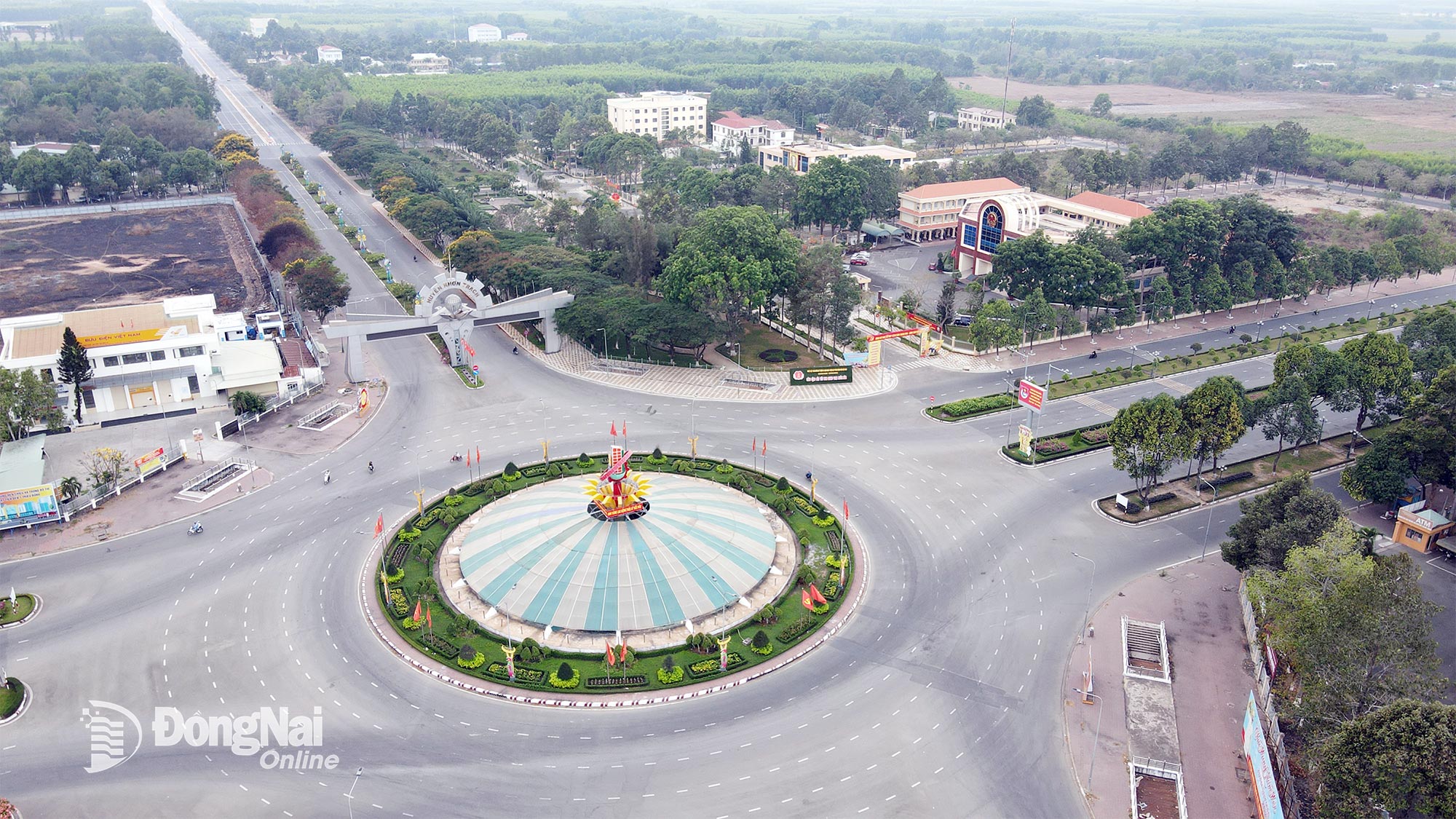 |
| A corner of Nhon Trach urban area. Photo: Pham Tung |
Eliminating connectivity “bottlenecks”
In mid-August 2025, Component Project 1A, the Tan Van-Nhon Trach section, featuring the key Nhon Trach Bridge connecting Nhon Trach urban area with Ho Chi Minh City, was officially inaugurated and put into operation. The inauguration and operation of the project not only provide an additional route from Dong Nai to Ho Chi Minh City but also play a vital role in alleviating traffic pressure in the inner city area, particularly at Cat Lai Ferry and the Ho Chi Minh City-Long Thanh-Dau Giay Expressway. For Nhon Trach urban area specifically, putting into operation Component Project 1A not only shortens the distance between this urban area and Ho Chi Minh City but also opens up significant opportunities for socio-economic development.
Truong Thi Huong Binh, Member of the Provincial Party Committee and Director of the Department of Finance, stated that the inauguration and operation of Component Project 1A, Tan Van-Nhon Trach section, will facilitate the transportation of goods and strengthen trade exchange between Dong Nai and Ho Chi Minh City.
Component Project 1A is a section of the Ho Chi Minh City’s Ring Road No. 3. According to the plan, this entire route will be technically open to traffic in December 2025 and completed and put into synchronous operation in 2026. By then, this route will become one of the most important transportation axes connecting Nhon Trach urban area with Ho Chi Minh City.
Alongside the Ho Chi Minh City’s Ring Road No. 3 Project, the Ben Luc-Long Thanh Expressway, another key route connecting Nhon Trach urban area with Ho Chi Minh City, is also scheduled for completion in 2026. In addition, the Phuoc An Bridge Project is planned to be completed in 2027.
Most recently, the Cat Lai Bridge construction investment project has received approval from Dong Nai provincial government for the proposed investor to proceed. According to Ho Van Ha, Member of the Provincial Party Committee and Vice Chairman of the Provincial People’s Committee, Dong Nai aims to commence construction of the Cat Lai Bridge in 2026.
The Cat Lai Bridge is one of the most anticipated road bridge projects connecting Dong Nai with Ho Chi Minh City for residents of both localities. In particular, for Dong Nai, the bridge is expected to provide a major boost to the development of Nhon Trach urban area.
Nhon Trach urban area is located at the center of the Southern key economic region, playing an extremely vital role in the socio-economic development of Dong Nai. Geographically, Nhon Trach urban area is close to the country’s largest urban area, Ho Chi Minh City. However, Nhon Trach and Ho Chi Minh City are separated by several rivers, including the Dong Nai, Long Tau, Dong Tranh, and Thi Vai rivers. The separation by rivers and the lack of synchronized transportation infrastructure connecting the two urban areas has been a major “bottleneck” limiting Nhon Trach’s development for a long time. Therefore, once this “bottleneck” is removed, opportunities for Nhon Trach urban area to achieve breakthrough growth are greatly expanded.
Ho Chi Minh City’s government is also considering promoting the Phu My 2 Bridge Construction Investment Project across the Dong Nai River. The Phu My 2 Bridge will start at Nguyen Huu Tho Street in Ho Chi Minh City and end by connecting to the inter-port road in Nhon Trach urban area, Dong Nai province.
Accelerating the completion of urban master plan adjustments
In April 2024, the Prime Minister issued a decision approving the task of comprehensively adjusting the master plan for the new Nhon Trach urban area up to 2045. The adjustment aims to respond to new development situation and address limitations and shortcomings in the current planning scheme.
According to the approved comprehensive master plan adjustment task, Nhon Trach urban area is oriented to become an industrial city with port and logistics services, as well as riverside tourism services. It is set to play a role as one of the key urban areas in the Southern dynamic hub and the central sub-region of the Southeast, while also serving as the nucleus for socio-economic development in the central urban area of Dong Nai province.
In addition, Nhon Trach urban area will become one of Dong Nai province’s centers for economy, culture, science and technology, and innovation; it will also support functions such as housing, education and training, healthcare, and commerce to help alleviate population pressure on other urban areas in the central sub-region of the Southeast.
Deputy Director of the Department of Construction Do Thanh Phuong stated that the comprehensive master plan adjustment for Nhon Trach urban area has been completed by Dong Nai province after incorporating feedback and explanations from the Ministry of Construction and other relevant ministries and agencies. A key advantage in preparing this plan is that, following the administrative reorganization at the commune level in the province, Nhon Trach urban area’s boundaries remain unchanged compared to the boundaries of the former Nhon Trach district used in the original planning.
On the part of the Dong Nai Provincial People’s Committee, to provide a basis for implementing detailed zoning plans and attracting investment projects, Comrade Vo Tan Duc, Deputy Secretary of the Provincial Party Committee and Chairman of the Provincial People’s Committee, has requested the Department of Construction and relevant agencies to accelerate the preparation, appraisal, and approval of the comprehensive master plan adjustment for Nhon Trach urban area. The target is for the plan to be approved by December 2025.
By Pham Tung - Translated by Huyen Trang, Thu Ha

![[Photo Series] Vibrant National Sailing Championship on Tri An lake](/file/e7837c02876411cd0187645a2551379f/112025/img_9982_20251108164158.jpg?width=300&height=-&type=resize)


Thông tin bạn đọc
Đóng Lưu thông tin