
PART 2
STRENGTHENING CADRES FROM THE COMMUNE LEVEL
For Dong Nai Province to achieve double-digit economic growth and shape a stronger, more resilient profile, its 95 communes and wards must first accomplish this goal. From this grounded, comprehensive perspective, the Standing Board of the Dong Nai Provincial Party Committee has chosen to begin with a thorough preparation of personnel—cadres, civil servants, and public employees—at the commune level after the administrative merger.
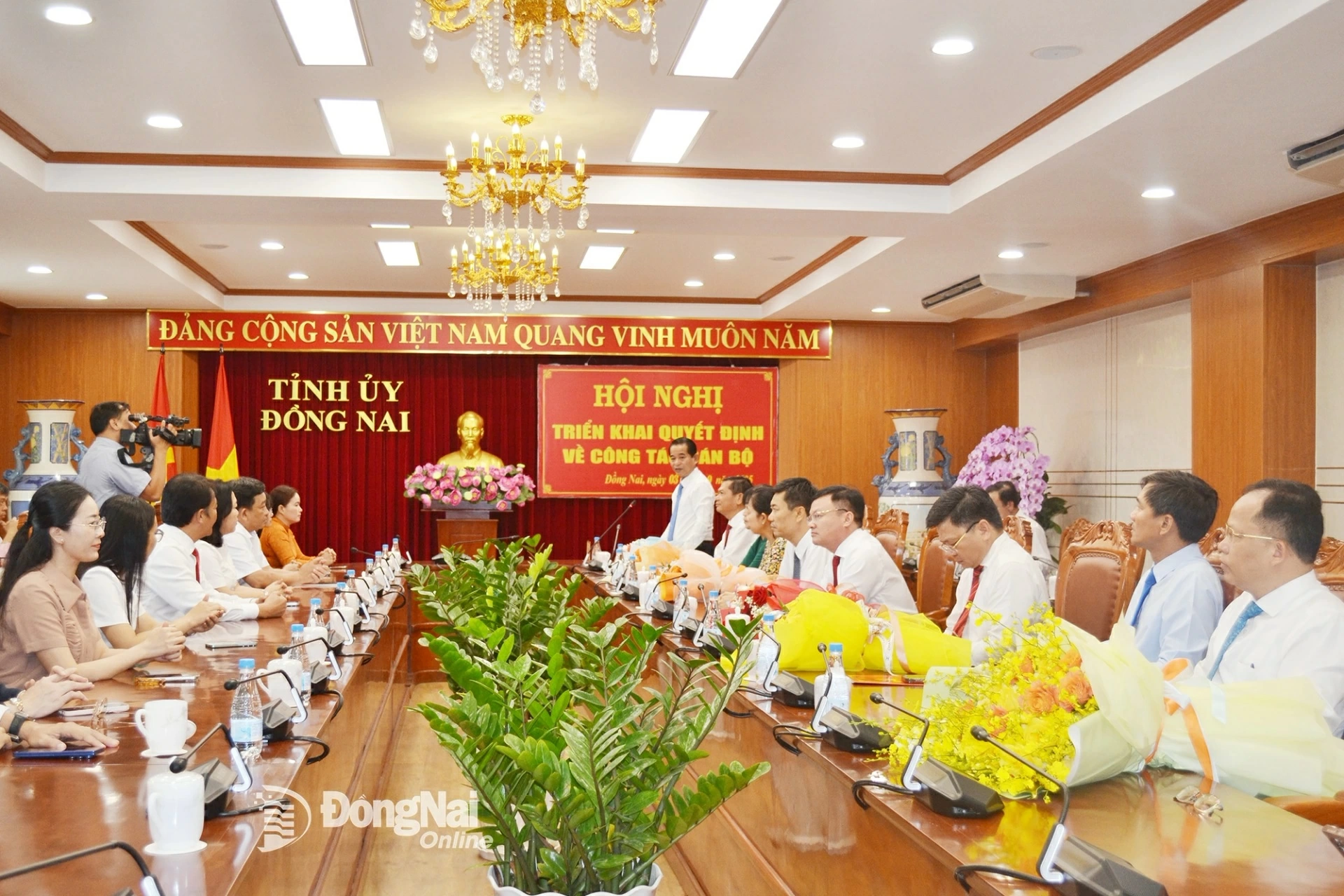 |
| Comrade Thai Bao, Deputy Secretary of the Provincial Party Committee, Head of the Provincial Party Committee’s Organization Commission, and Secretary of the Party Committee of Dong Nai’s Party Agencies, speaks at the Conference announcing personnel decisions, September 3, 2025. Photo: Phuong Hang |
Appointing the right people for the right work
The revolution to streamline organizational structure places commune-level authorities in a completely new position and role. Although the previous commune-level cadre workforce was reasonably well trained, it cannot immediately keep pace with the increased workload, higher intensity, greater complexity, and more specialized demands following the merger of communes and wards, as well as the elimination of the district-level government.
To address this urgent “bottleneck” at the grassroots level, the province adheres to the principle of assigning people based on the needs of the work. A major round of personnel transfers and appointments—from provincial departments down to the commune level—has been carried out at an unprecedented scale, maximizing the effectiveness of existing human resources. “We are shifting our mindset—starting with defining the overarching goal of achieving double-digit growth. This requires accompanying groups of solutions, and first among them is a capable contingent of cadres,” stated Comrade Ton Ngoc Hanh, Alternate Member of the Party Central Committee, Permanent Deputy Secretary of the Provincial Party Committee, and Chairwoman of the Provincial People’s Council. She emphasized that commune-level cadres must be knowledgeable, experienced, both well-rounded and specialized in their assigned fields, deeply understand their locality, be proficient in their work, dedicated, and truly committed to serving the people in order to properly implement the core resolutions of both the Central Government and the province.
Contributing wholeheartedly to this reform, several members of the Provincial Party Standing Committee have volunteered to take up leadership positions as heads of commune-level Party committees in key economic-growth localities such as Long Thanh, Tran Bien, Binh Phuoc, and Long Khanh.
Comrade Duong Minh Dung, member of the Provincial Party Standing Committee who previously served as Vice Chairman of the Provincial People’s Committee, volunteered to assume the role of Secretary of the Long Thanh Commune Party Committee and Chairman of the Commune People’s Council. He shared: “I see this responsibility as both an honor and a profound mission. To me, leadership is not merely administration—it is a journey of fostering trust and nurturing human values. Long Thanh is not only a strategic area for economic development and infrastructure—it is the heart of the province’s aspirations for sustainable and humane development. With that vision, I choose to prioritize breakthroughs in human development and education. Infrastructure, industry, or urban development can advance through investment capital, but building a community with resilience, knowledge, responsibility, and aspiration must begin with education and human culture. I believe that when all policies and decisions of the Commune Party Committee place people at the center and take education as the foundation, every path of Long Thanh’s development will lead to sustainability and happiness. The initial changes may be modest, but they are evident in residents’ satisfaction with faster administrative procedures and in the bright eyes of students learning in better conditions.”
Marking a new style of Party leadership, within the first two months of operating under the two-tier local government model, the Provincial Party Committee and Provincial People's Committee transferred 115 provincial-level leaders and managers to assume leadership positions at the commune level. Recently, the Provincial People’s Committee continued to issue lists of civil servants and public employees for review to fill remaining vacancies at commune- and ward-level People’s Committees. Working directly in the tier closest to the people—handling all legitimate needs of residents and businesses—has also become an effective training ground for cadres, helping them gain real-world experience. If later reassigned to higher levels, they will have far greater practical competence. Comrade Vu Hong Van, Secretary of the Provincial Party Committee and Head of Dong Nai’s National Assembly Delegation, emphasized that the Standing Committee has set a clear directive: any cadre being planned or appointed to leadership positions at any level must first gain experience working at the commune level.
With the trend of granting greater authority to communes and wards, the province aims to resolve difficulties directly at the grassroots. The Department of Agriculture and Environment has actively seconded hundreds of cadres and civil servants to 95 communes and wards to provide hands-on support and help turn the situation around. The Provincial Party Standing Committee also requested that other departments and agencies replicate effective approaches—working directly with communes to help translate ideas into tangible results.
The key to true transformation and internal strength lies in accurately evaluating cadres and employing the right people for the right jobs at the right time, as required by the Party General Secretary. For those who lack dedication, initiative, or fail to deliver results, commune- and ward-level Party committees must assess them thoroughly. Anyone unable to meet job requirements must be considered for replacement and removal from the state apparatus. Where local human resources are insufficient, the province must be consulted for additional personnel.
— Comrade Thai Bao, Deputy Secretary of the Provincial Party Committee,
Head of the Provincial Party Committee’s Organization Commission
A system moving in substance, not form
“Let every working day be a day of creation. Let each person be a soldier on the front line of reform.” These words of Party General Secretary To Lam have been genuinely embraced by commune-level cadres in Dong Nai, who now maintain a working spirit of finishing the work, not just finishing the hours. The old phenomenon of “showing up in the morning and leaving in the afternoon without substance” has fundamentally disappeared.
In the mountainous commune of Dak Lua, the province has boldly piloted a model that does not establish specialized divisions under the commune People’s Committee. This places heavy demands on cadres. Nguyen Thanh Hien, Deputy Party Secretary and Chairman of the Commune People’s Committee, shared: “Having just arrived in this remote area to take on my new role, the expectations of local residents—for a government closer to the people and capable of resolving issues on the spot, bringing change to rural life—have motivated us to work at three times the effort.”
According to Phan Quang Tuan, Secretary of the Party Committee and Chairman of the People’s Council of Trang Dai Ward, the two-tier local government model requires the entire administrative apparatus to work decisively and methodically—otherwise management becomes like “throwing a stone into a pond of duckweed”. “Here, we consider the 95 commune and ward Party secretaries across the province as a classroom of 95 students,” said a former department-level leader who had just assumed a leadership role in one of the most complex wards. Citing progress in an area once known as a hotspot for illegal construction, he noted that since tightening control, the ward has detected more than 50 cases of building or expanding structures on agricultural land and has firmly enforced corrective action from the outset.
Cadres are immersing themselves in communities, bringing the spirit of reform to 1,772 hamlets, villages, and neighborhoods across the province, generating momentum even in border, remote, and mountainous areas. Farmer Tran The Tinh (from Xuan Bac Commune) expressed his satisfaction: “With reduced staffing and a more streamlined and capable administration, the local government feels closer to the people. We are ready to support policies because we can clearly see their benefits.”
Dr. Nhi Le, former Deputy Editor-in-Chief of Communist Review, assessed: “Assigning hundreds of provincial-level cadres to key commune-level leadership positions is a strategic and far-sighted decision. It is not only necessary but delicately and wisely executed—ensuring cadres with a broad, strategic perspective can simultaneously address specific, real-world local needs. Without this, achieving meaningful development in Dong Nai—both socio-economic progress and the development of a stronger cadre force—would be extremely difficult. Dong Nai’s approach provides valuable lessons for other provinces nationwide.”
By Thanh Hai, Translated by Trieu Ngan – Thu Ha
Part 3: Cadre work is moving in the right direction


Thông tin bạn đọc
Đóng Lưu thông tin