
The merger of the province, carried out in parallel with restructuring and streamlining the administrative apparatus under the new two-tier local government model, is an unprecedented task. It presents requirements and challenges never before encountered in the apparatus and personnel management. The Resolution of the 1st Congress of the Dong Nai Provincial Party Committee for the 2025–2030 tenure identifies its first strategic breakthrough as improving the quality of cadre contingent, particularly key officials at all levels who possess firm political resolve, sufficient qualifications, competence, a strong action-oriented mindset, and an aspiration to contribute, and the credibility required to meet the demands of their responsibilities.
PART 1
CADRES DETERMINE EVERY SUCCESS
The springboard that propels Dong Nai to “take off” into a new era is not merely its scale, potential, or established position. The true impetus accelerating the province’s aspirations and long-term vision comes from its cadre factor. The province’s contingent of key leaders serves as the “brain” that formulates policy, the “heart” that inspires collective resolve, and the “hands” that translate resolutions into vivid reality.
SUCCESS FROM A THOROUGH REFORM
A “leap forward” of great significance has been made in the current context. For the first time in many years, Dong Nai’s economy regained its double-digit growth in Q3 2025, ranking third nationwide. Provincial leaders are confident that, building on the recent 10.18% GRDP growth rate, Dong Nai will achieve double-digit economic growth for all of 2025 and reach the milestone of VND 100 trillion of budget revenue.
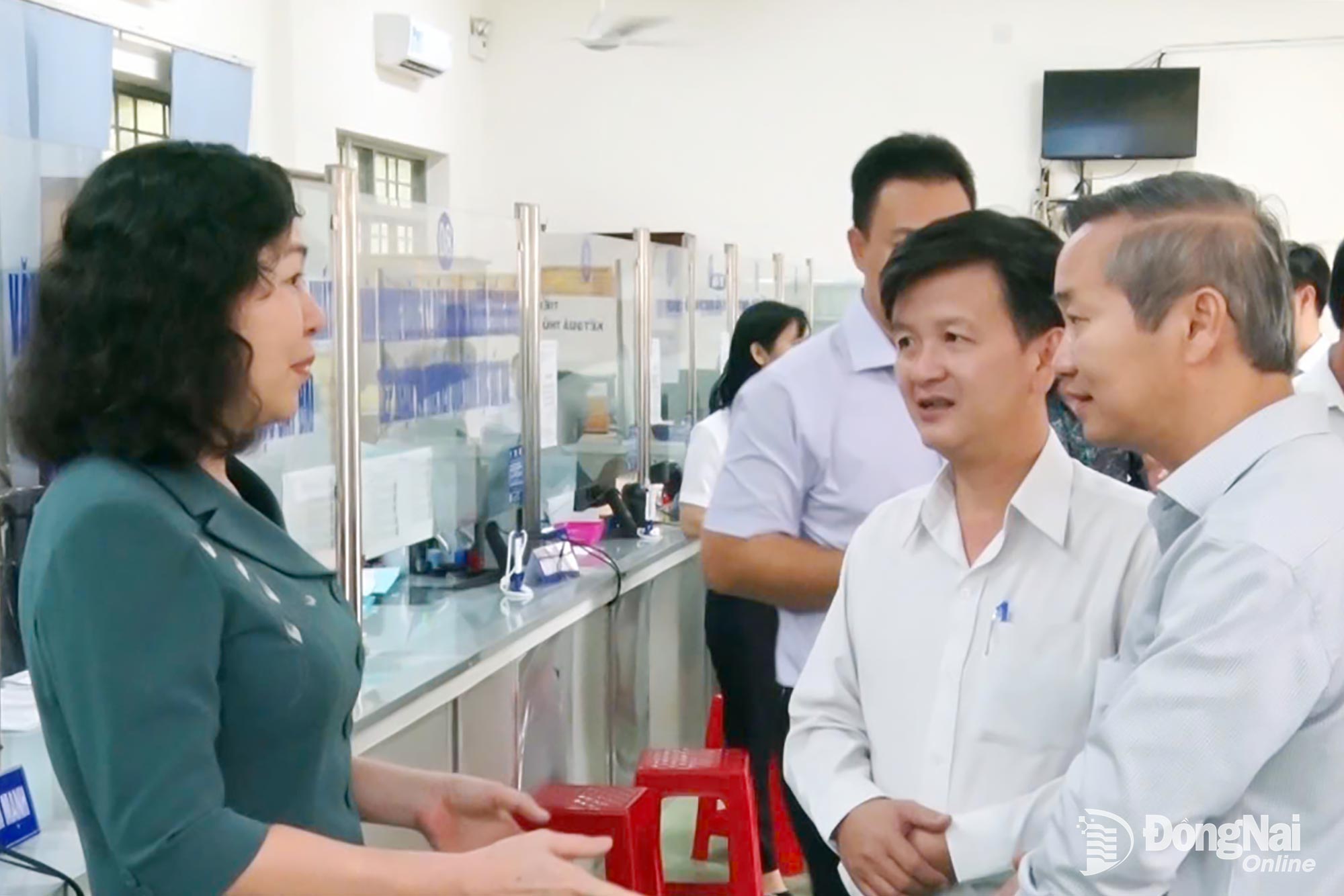 |
| Comrade Huynh Thi Hang, Deputy Secretary of the Provincial Party Committee and Chairwoman of the Vietnam Fatherland Front Committee of Dong Nai Province, conducts an on-site inspection of Dau Giay Commune following the administrative merger. Photo: Hoang Van Quang |
This promising sign came at the same time with another mutually reinforcing piece of news: Dong Nai rose to first place nationwide in September in the Public Service Index, which measures the performance of administrative procedures and public service delivery for citizens and businesses, scoring 84.96/100 points, ranking 1st out of 34 provinces and cities nationwide. On average, during the first four months of operating the new two-tier local government model, the province consistently remained among the top three nationwide.
The highlight of the major political event, the 1st Congress of the Dong Nai Provincial Party Committee for the 2025–2030 tenure, was its resounding success. Previously, Party congresses at all lower levels had been completed 15 days earlier than the timeline set by the Central Committee, making this political session widely influential. The Party Congresses and the revolution on arranging the organizational apparatus provided an opportunity to review, assess, and streamline the contingent of cadres, particularly leaders and managers at all levels. Standing members of the Provincial Party Committee and members of the Provincial Party Standing Committee as well as the provincial Party Committee members exemplified political resolve, intellect, dedication, and a spirit of innovation, daring to think, daring to act, and daring to take responsibility for the common good.
The pioneering spirit of key cadres in affirming their core role as the nucleus of unity, exemplifying renewed working styles and conduct, and upholding a service-oriented mindset, has contributed significantly to the province’s outstanding breakthroughs. From the provincial level down to the grassroots, practical developments reflect a clear transformation in administrative thinking and public governance, shifting from a model of “administrative command” to one of “service and development facilitation.”
To ensure rapid and substantive progress in operation under the new structure, the standing members of the Provincial Party Committee promptly assigned each member of the Provincial Party Standing Committee to oversee and take individual responsibility for specific communes and wards. These officials frequently visit localities, stay close to the people, listen to them, and act in their interest, while supervising and urging progress to ensure that commune-level authorities adapt flexibly to the new organisational model and gradually operate in a stable and orderly manner. One example is Long Binh Ward, where 99.97% of more than 8,000 administrative dossiers have been processed on time since July 1, and 93.6% of payments have been completed online within 3 months of the merger, well above target.
Nguyen Thi Thu Hien, Secretary of the Party Committee and Chairwoman of the People’s Council of Long Binh Ward, explained: “Party committees assign experienced cadres to handle administrative procedures, strengthen professional staff when dossier volume is high, and ensure that leaders maintain direct oversight and promptly resolve bottlenecks by coordinating with higher-level agencies.”
In the whole province, nearly 450,000 administrative dossiers were processed from July to the end of October 2025, with more than 99.2% completed before or on time. The unified spirit “consensus from top to bottom, smooth coordination across all levels” has accelerated the operation of the new administrative apparatus across 99 Party organisations under the province and 96 provincial and commune-level public administrative service centres. This has led to a marked improvement in citizen and business satisfaction indexes, laying a solid foundation for socio-economic development.
Dr. Vu Trung Kien, Vice Dean of the Faculty of Party Building (Political Academy Region II), observed: "We must recall President Ho Chi Minh's words: 'Cadres are the root of all work'. Despite the initial complexity of reorganising the political and administrative apparatus, Dong Nai still achieved rapid, double-digit growth and ranked first nationwide in the Public Service Index measuring the performance of administrative procedures and public service delivery for citizens and businesses. This affirms that the province’s contingent of cadres has made a significant breakthrough and contributed greatly to this impressive development. With this momentum, Dong Nai will surely advance strongly in the coming years.”
CONTINUOUSLY IMPROVING PUBLIC SERVICE QUALITY
Grassroots authorities do not wait for provincial instructions, and the province does not wait for the central government, and the entire political system is fully committed to modernizing governance, staying close to the people and working for the people.
The “Morning Coffee” model, in which commune leaders meet with residents every Thursday, has been effectively implemented in Dau Giay Commune. Over a cup of coffee – a familiar cultural habit of the Southern region – the conversation between Le Huu Thiet, a resident of Tran Hung Dao Hamlet, and the leaders of Dau Giay Commune became more open and friendly. Thiet reported that Residential Cluster No. 2 had been experiencing localized flooding, with red mud from a nearby rubber plantation spilling onto the road, causing muddiness, poor sanitation, and traffic safety risks. Immediately afterward, the commune chair, Mai Van Hien, conducted a site inspection and coordinated with technical staff to devise a drainage solution. Within two weeks, the issue was resolved by installing concrete culverts and a new drainage connection.
The strong alignment between the Party's will and the people's aspirations, together with Dong Nai's notably faster pace of reform, further confirms the appropriateness of implementing the administrative merger and the effective leadership in operating the two-tier local government model. Clear and significant changes have been observed since the Central Government adopted a top-down approach to the comprehensive restructuring and streamlining of the administrative apparatus. This has shortened the implementation process, reduced the responsiveness gap between higher and lower levels, and removed inertia within the system.
“The province has consistently streamlined the administrative apparatus to be compact, efficient, and effective, resolutely removing weak, irresponsible, or non-performing cadres. This is the key solution to developing a dynamic, decisive administrative system that serves development.”
Comrade VO TAN DUC, Deputy Secretary of the Provincial Party Committee
Cadres remain the decisive factor in strengthening public service quality. Each individual is an essential link in the collective system, actively implementing innovative reform models, such as the "borderless administrative procedures" initiative, which falls under the province's public service responsibilities. These efforts help simplify administrative procedures, shorten processing time, and create an environment that encourages innovation among cadres, civil servants and public employees, allowing the new wave of administrative reform to become more deeply embedded in everyday practice.
Dang Van Diem, Chairman of the Dong Nai Business Association, commented: “Leadership in the province has undergone positive changes, with younger officials and more decisive direction in streamlining the administrative apparatus and reducing procedures. This consistent support and facilitation have created significant opportunities for enterprises.”
The most challenging period of piloting the new administrative apparatus has passed, and new momentum is now driving Dong Nai towards further achievements. Enhancing the contingent of cadres is essential to strengthening the effectiveness and efficiency of the two-tier local government system and reflects the Party organisation’s capacity and fighting strength.
By Thanh Hai – Translated by My Le, Thu Ha


Thông tin bạn đọc
Đóng Lưu thông tin