
On the morning of November 4, the Dong Nai Provincial Party Committee held a thematic conference between the Standing Board of the Provincial Party Committee and the Standing Boards of the Party Committees of 31 communes across the province to review the outcomes of operating the two-tier local government system.
These 31 communes are economically more developed than others in the province, namely Dai Phuoc, Nhon Trach, Phuoc An, Phuoc Thai, Long Phuoc, Long Thanh, Binh An, An Phuoc, An Vien, Binh Minh, Trang Bom, Hung Thinh, Gia Kiem, Xuan Que, Xuan Duong, Xuan Dinh, Xuan Loc, Xuan Hoa, Xuan Thanh, Xuan Bac, Dinh Quan, Nam Cat Tien, Tan Phu, Tri An, Tan An, Loc Ninh, Thien Hung, Binh Tan, Phu Rieng, Dong Phu, and Phu Ly.
Identifying local realities
Immediately after coming into operation on July 1, 2025, the Party Committees of these 31 communes promptly embarked on reorganizing their apparatus to ensure the continuity of work and leadership in implementing socio-economic development, national defence and security, and Party building tasks.
To date, many communes have achieved and even exceeded their 2025 state budget revenue targets; public investment disbursement rates are high; the number of administrative procedures handled on time or ahead of schedule makes up a very high rate; and targets for admitting new Party members have been fulfilled.
These achievements are commendable given the implementation of a new administrative model with many changes. Nevertheless, new mechanisms inevitably encounter challenges and bottlenecks that must be promptly addressed.
 |
| Nguyen Ba Viet, Secretary of the Party Committee and Chairman of the People’s Council of Binh Tan Commune, speaks at the conference. Photo: Huy Anh |
Nguyen Ba Viet, Secretary of the Party Committee and Chairman of the People's Council of Binh Tan Commune, stated that since its establishment, the commune has identified key advantages, including convenient transportation infrastructure, a vast and diverse terrain, and potential for industrial, service, and real estate development. With a moderate population density and livelihoods largely based on agriculture, industry, and services, the commune’s environment is favourable for developing high-tech agriculture, eco-tourism, and supporting services.
Based on the 2025–2030 term resolution of the commune’s Party Organization, the Party Committee and People’s Committee plan to establish three new industrial clusters in strategic locations well connected to regional infrastructure and residential areas. These clusters are expected to attract investors, generate employment, and foster local socio-economic growth.
Faced with new development requirements, the commune requested that the Provincial Party Committee and the People’s Committee ensure staffing in line with the principle of one civil servant per field of work and supplement personnel for specialised areas such as accounting, land management, and digital transformation.
 |
| Nguyen Gia Hoa, Secretary of the Party Committee and Chairman of the People’s Council of Loc Ninh Commune, speaks at the conference. Photo: Huy Anh |
According to Nguyen Gia Hoa, Secretary of the Party Committee and Chairman of the People’s Council of Loc Ninh Commune, National Highway 13 is a key arterial route from Ho Chi Minh City that passes through the commune, linking it with major transport corridors and neighboring localities that are currently being upgraded. This provides significant advantages for the commune's socio-economic development.
In addition, central and provincial investment projects in the commune - such as the National Highway 13 bypass and the Diamond City commercial-residential complex - further strengthen local trade and service potential.
With its proximity to the international border gate, extensive land for commercial and service development, rich historical background, and cultural tourism potential, Loc Ninh is well-positioned for growth. With a development orientation focusing on logistics, trade, services, technology, and innovation, Loc Ninh aims to become the economic, administrative, and logistics hub of northern Dong Nai, contributing to double-digit provincial economic growth and sustainable development.
The commune’s Standing Party Committee proposed that the Provincial Party Standing Committee facilitate policies and funding for regional transport connectivity, expansion of inter-commune routes linking to highways, industrial zones, and border areas, and the construction of a logistics belt road to ease local traffic congestion.
On the other hand, the commune proposed that the province remove obstacles to complete the construction of the National Highway 13 bypass and invest in building the eastern bypass of National Highway 13 (the section passing through Loc Ninh Commune).
Seeking solutions to remove obstacles
 |
| Tran The Vinh, Secretary of the Party Committee and Chairman of the People’s Council of An Phuoc Commune, speaks at the conference. Photo: Huy Anh |
Tran The Vinh, Secretary of the Party Committee and Chairman of the People’s Council of An Phuoc Commune, reported that the commune currently faces a serious shortage of civil servants compared to its allocated quota. As of October 30, 2025, the commune had filled 64 out of 86 authorised positions, leaving 22 vacancies in total; specifically, the government bloc was short of 18 out of 54 positions, the Party bloc was short of 3 out of 21, and the Vietnam Fatherland Front bloc was short of 1 position.
Additionally, An Phuoc commune covers a vast area and has a large population, with numerous industrial zones that attract thousands of temporary residents, around 2,000 new registrations monthly. The combination of a high population and insufficient staff poses challenges for administrative management.
One of the key proposals made by An Phuoc Commune to the provincial government and relevant departments is to strengthen coordination with commune-level authorities to provide timely guidance and address existing difficulties and obstacles. The commune also requested that provincial officials and civil servants be seconded or assigned to support local administrations, and that additional personnel be transferred and supplemented in areas still lacking staff to ensure that the commune-level government apparatus operates effectively in accordance with its authorised staffing structure.
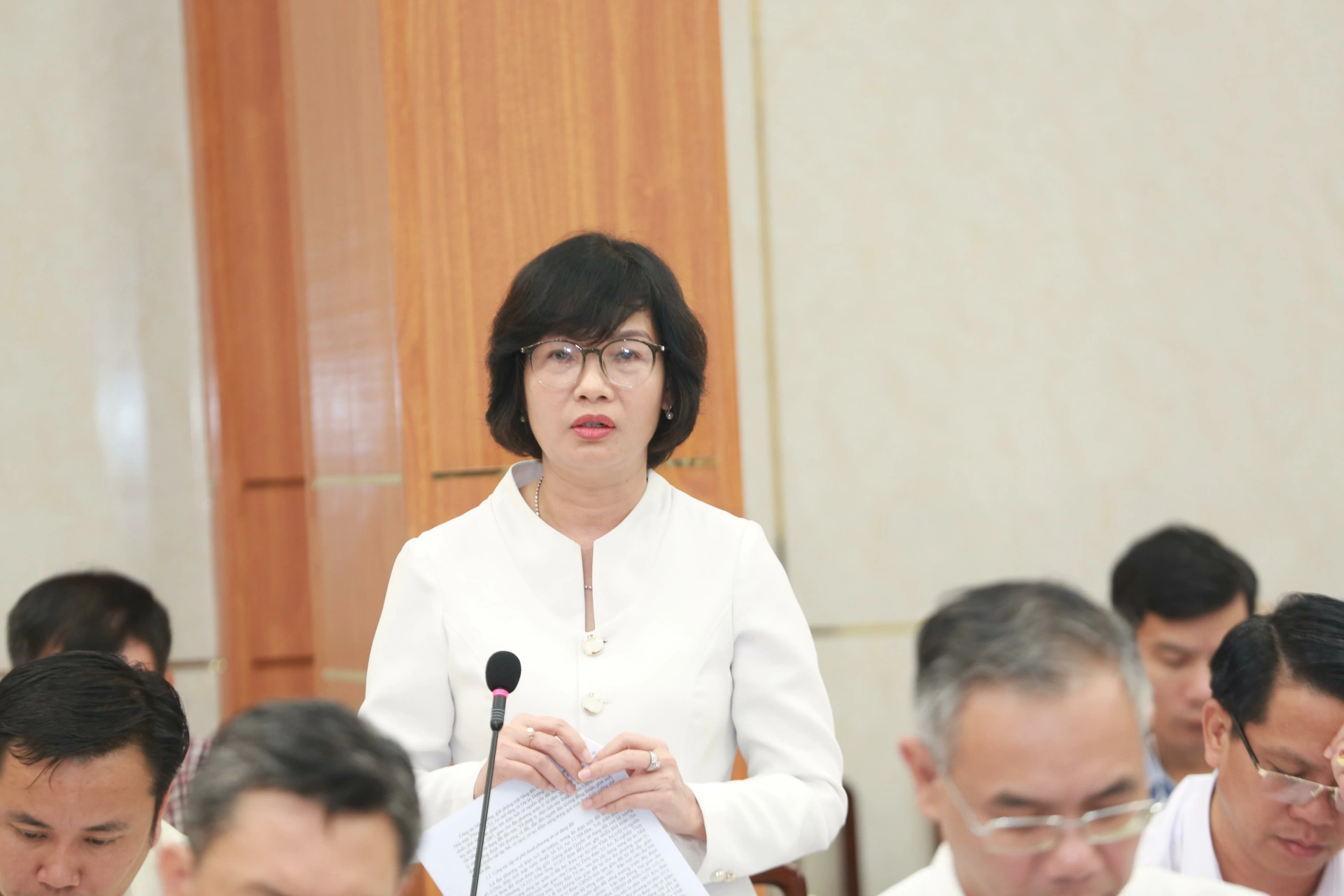 |
| Nguyen Thi Dung, Deputy Secretary of the Party Committee and Chairwoman of the People’s Committee of Tri An Commune, speaks at the conference. Photo: Huy Anh |
Nguyen Thi Dung, Deputy Secretary of the Party Committee and Chairwoman of the People’s Committee of Tri An Commune, noted that the commune has a vast forested area and nearly 13,000 hectares of water surface from the Tri An Reservoir. However, many plots remain uncertified for land use rights, causing difficulties in land management.
Hundreds of hectares of land formerly managed by state-owned agriculture farms have not been officially approved for new use plans, leading to long-standing complaints as residents continue to occupy the land.
Tri An Commune proposed that the Provincial People’s Committee direct relevant departments to promptly issue guidance on handling land cases originating from former state farms that were handed over to the commune for management but are still being used by residents. This would provide a legal basis for appropriate compensation and support, prevent complaints, and ensure security and social order during the implementation of key projects.
The commune also requested the allocation of personnel to assist in compensation and land clearance for major projects, particularly the expanded Tri An Hydropower Plant and the access road to Hieu Liem Bridge, to ensure progress of implementation according to plan. The Provincial People’s Committee was asked to issue specific guidance on policies for support, arrangement of resettlement, and livelihood transition for households residing within the core area of the Dong Nai Culture and Nature Reserve, ensuring consistency with local realities.
Leaders of Tri An Commune further proposed that the province introduce special policies to support the livelihoods of residents affected by relocation from the core zone, especially poor households, ethnic minority families, and those lacking production land. They also called for assistance in resolving investment, planning, and infrastructure issues related to tourism development around Tri An Lake, as well as stronger promotion and investment attraction for eco-tourism projects associated with nature conservation.
In addition to the above issues, the communes raised several other concerns, including a shortage and deterioration of office facilities, outdated and inconsistent work equipment, limited funding for targeted development programmes, and serious damage to many transport routes that hinder travel, notably along National Highway 51.
 |
| Vo Tan Duc, Deputy Secretary of the Provincial Party Committee and Chairman of the Dong Nai Provincial People’s Committee, speaks at the conference. Photo: Huy Anh |
In response to the proposals from localities, Vo Tan Duc, Deputy Secretary of the Provincial Party Committee and Chairman of the Dong Nai People’s Committee, requested that departments such as Home Affairs, Finance, Science and Technology, Agriculture, and Environment advise the Provincial Party Committee and the Provincial People’s Committee on the coordinated implementation of measures to ensure the stable and effective operation of the two-tier local government model. He emphasised the need to address existing obstacles at the grassroots level; review and supplement personnel; issue a list of job positions for the 2026–2031 period in association with streamlined staffing; improve the system of regulations on functions and duties; continue to decentralise and delegate responsibilities clearly; allocate investment capital for the repair and upgrading of infrastructure; and organize training courses to enhance the capacity of commune-level officials and civil servants.
Through the thematic conferences with communes and wards, the Standing Board of the Provincial Party Committee acknowledged the recommendations and proposals put forward by localities. It will issue specific directives for each group of communes and wards to ensure joint development. This will contribute to the successful implementation of the resolutions of the commune- and provincial-level Party Congresses for the 2025–2030 tenure.
The communes and wards are encouraged to promote proactivity and innovation in their leadership approaches to address internal challenges. The development of a “digital government, digital citizens” is identified as a fundamental solution to reduce staffing pressure as workloads increase. Localities are urged to focus on resolving long-standing issues, particularly in land and construction management, and to devise strategies that harness their unique potential and advantages for further development.
Ton Ngoc Hanh, Alternate Member of the Party Central Committee, Standing Deputy Secretary of the Provincial Party Committee, and Chairwoman of the Dong Nai Provincial People’s Council, speaks at the conference. Photo: Huy Anh Ton Ngoc Hanh, Alternate Member of the Party Central Committee, Standing Deputy Secretary of the Provincial Party Committee, and Chairwoman of the Dong Nai Provincial People’s Council, stated that the thematic conferences with three groups of localities— including urban wards; border, disadvantaged, and ethnic minority communes; and economically developed communes—have provided a comprehensive overview of the newly-formed Dong Nai with ample room for development. In particular, industrial development represents the largest potential, complemented by fertile agricultural land, and promising tourism resources with distinctive local products. |

Every commune and ward has its own potential for development, and each of them plays a vital role in Dong Nai’s overall progress. Therefore, communes facing greater difficulties compared to others should not feel discouraged but rather be confident. Based on a thorough review and identification of their local economic structures, they need to swiftly develop projects and programmes to promote development.
By Phuong Hang - Translated by My Le, Thu Ha



Thông tin bạn đọc
Đóng Lưu thông tin