
Amid the rhythm of modern life and increasingly socio-economic development, in Hamlet 12 Thong Nhat, Phuoc Son Commune, Dong Nai Province, home to 222 households of the S’tieng ethnic minority group, the image of the “gui” (traditional backpack) is still present in every house. This is an important item associated with each family. More than that, the “gui” is a cultural symbol and a source of pride for the S’tieng people.
 |
|
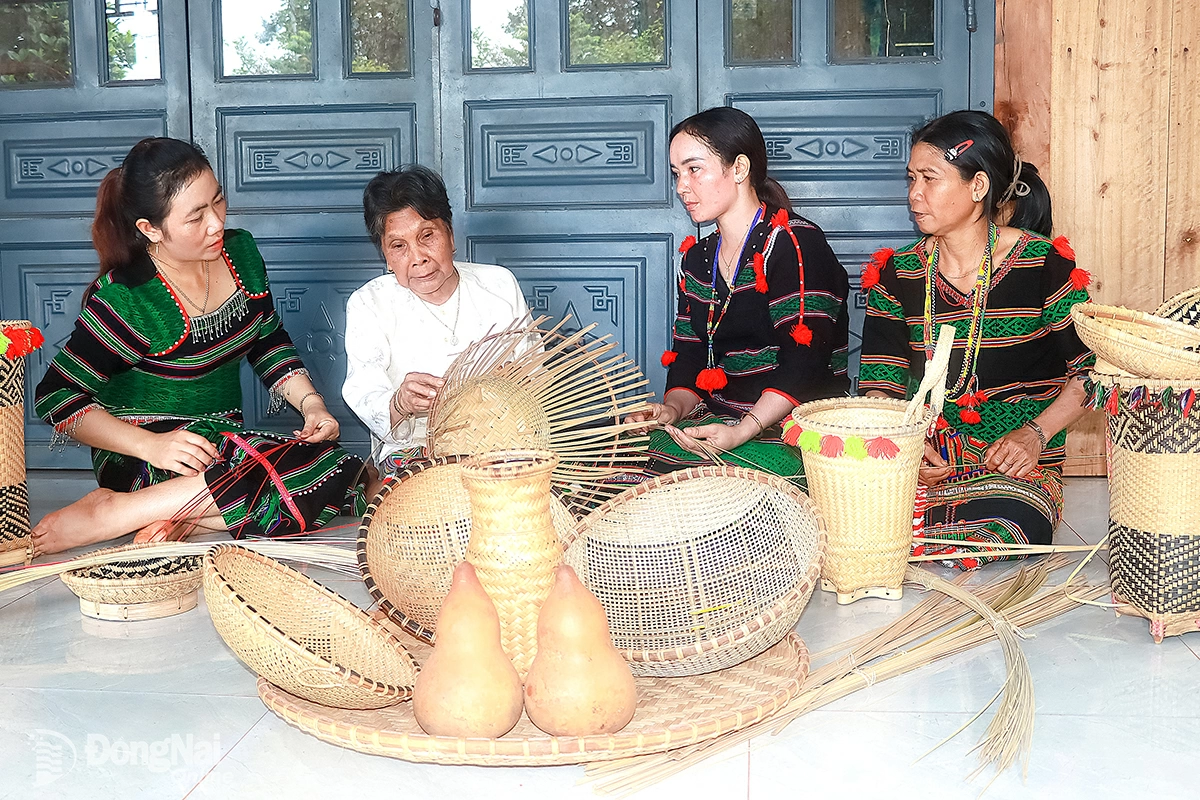
Elderly, experienced gui weavers, in Hamlet 12 Thong Nhat, Phuoc Son Commune, pass their skills on to the next generation. Photo: Quang Minh |
Currently, villagers are establishing a Gui Production Corporate Group. This initiative aims to preserve the traditional weaving craft, safeguard cultural identity, and at the same time create jobs and increase income for the community.
Production organization
Over the last six months, on clear, dry afternoons, people in village 12 Thong Nhat, Phuoc Son commune have gathered at the house of Dieu Mai or at the house of Thi Sen to weave gui together. Sen, the Vice President of the Women's Union of the hamlet, is known for her dedication to preserving cultural identity and improving the livelihoods of her neighbors. Meanwhile, Dieu Mai, a respected community elder, is highly skilled in basket weaving.
“Phuoc Son is a vast commune with a diverse population of ethnic groups and rich cultural traditions. Therefore, in the future, the commune’s authority will pay attention to developing tourism in the direction of experiencing traditional crafts, so that the cultural values of local people will turn into economic value. From there, we can both preserve our heritage and develop the local economy, including the gui weaving craft.”
LUC DUC LAP, Vice Chairman of the People’s Committee of Phuoc Son Commune, Dong Nai Province
Sen shared: “In the past, people mainly wove gui for daily use—to carry rice, firewood, bamboo shoots, or vegetables. However, I realized that producing gui products for the market, especially as souvenirs for tourists, is very promising. I am preparing to propose that the commune establish an official corporate group to produce gui and other items made from bamboo, rattan, and reeds.”
To organize production, Sen has gathered people who know how to weave gui in the village to discuss solutions and assign specific tasks. Accordingly, every day, strong men will go to the fields to harvest bamboo and bring it back to make weaving strips. Skilled artisans both produce gui and teach younger villagers the craft. Organizing gui weaving workshop aims to create a positive and cheerful working atmosphere, thereby attracting community interest, contributing to arousing love for the traditional craft that in danger of fading away.
Dieu Mai explained: “To make a durable and beautiful gui, choosing the right bamboo is essential. We pick stalks about two years old with straight internodes—they’re flexible, strong, and resistant to insects. When cutting bamboo, I have taught others how to select each tree properly; cutting bamboo that’s too young or too old is wasteful, especially since raw materials are limited.”
Traditional gui baskets are usually woven from natural-colored bamboo, rattan. Nowadays, villagers also dye the strips in bright colors—green, red, brown, yellow, or purple to create products with beautiful colors. They also add patterns inspired by daily life, such as rivers, mountains, fields, and villages. Innovation and creativity will make the image of the basket both traditional and modern.
THI SEN, Hamlet 12 Thong Nhat, Phuoc Son Commune, Dong Nai Province
Thị Linh, a knowledgeable, experienced weaver, and a core member of the community, shared: “There are fewer elderly artisans now, so the gui weaving craft is also less popular. I’m glad that around 20 skilled villagers to directly engage in producing the products.”
To weave a complete gui item, besides searching for and preparing materials, the weaving time takes at least one day or more, depending on the size. The traditional backpack can be woven in many designs, single or double strips, sparse or dense, large or small. Depending on the needs of use or the needs of customers, weavers create many different designs. In addition to traditional patterns and colors, weavers are now creating many innovative and modern patterns, making their products more attractive and marketable.
Linking production and consumption
According to Sen, to achieve the goal of bringing the gui to the market, making it a regular and professional production industry, helping households earn a stable income, people are currently proactively focusing on production. Each month, the corporate group sets specific targets for quantity and variety. Thanks to that, there are always products available for display and sale.
Recently, its members have actively promoted their products and introduced the production model at workshops and exhibitions on ethnic cultural goods. On the other hand, each member in the corporate group, especially the young ones who know how to use Zalo, Facebook, and TikTok, is in charge of promoting their gui products to online platforms. In the near future, once the corporate group is officially recognized by the communal authority, villagers plan to cultivate their own bamboo and rattan to ensure an abundant source of raw materials, contributing to the sustainable development of this model and industry.
Luc Duc Lap, Vice Chairman of Phuoc Son Communal People's Committee, said: “The S’tieng people’s gui weaving is not only a traditional cultural feature but also an opportunity for economic development. This issue has received attention from communal leaders for a long time. We are working with villagers to complete the necessary conditions and procedures for establishing the corporate group. The commune will also coordinate with relevant agencies to support people in organizing production that is scientific, efficient, and highly productive. At the same time, we make efforts to connect with businesses inside and outside the province to market the products.”
By Quang Minh, Translated by Thuy Trang, Thu Ha


![[Photo series] Close-up on installation of core equipment for the 'heart' of Long Thanh Airport](/file/e7837c02876411cd0187645a2551379f/112025/anh_1_20251112170811_20251112184142.jpg?width=300&height=-&type=resize)

Thông tin bạn đọc
Đóng Lưu thông tin