
Following an expansion of its administrative boundary and its entry into a new phase of development, Da Kia commune now stands before a significant opportunity for breakthrough growth. With outstanding advantages in land resources, climate, soil quality, and water availability, Da Kia is considered one of the most promising localities for developing large-scale commodity agriculture, high-tech farming, and a diversified rural economy.
Yet in reality, this potential has not been fully unlocked. It is time for Da Kia to adopt clear orientations and decisive steps to truly “awaken” its agricultural sector.
Great potential yet to be unlocked
Da Kia possesses natural conditions ideally suited to the development of large-scale commodity agriculture. Its temperate climate, fertile soil, and abundant water resources create a favourable foundation for high-value crops, including long-term industrial crops, fruit trees, and vegetables, as well as various models of large-scale farming and livestock production.
The commune currently has more than 17,214 hectares of agricultural land, accounting for 87.7 per cent of its natural area, much of which consists of nutritious basalt soil suitable for intensive farming. Importantly, Da Kia is bordered by the Be River and a system of reservoirs, including Can Don, Sok Phu Mieng, Team 7, Team 8, and Binh Ha 1, which provide stable irrigation and support agricultural production.
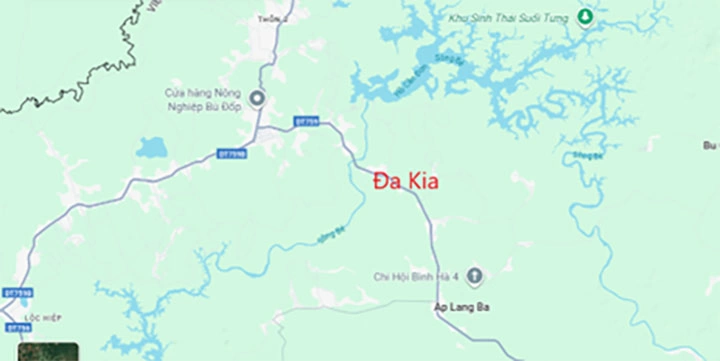 |
| The Be River and the system of reservoirs across Da Kia Commune |
In recent years, local farmers have actively shifted crop varieties, adopted clean-farming practices, accessed new technologies, and formed several efficient production models. However, the commune's agricultural sector still faces structural weaknesses: small-scale production remains common; enterprises investing in processing and consumption are limited and weak; value-chain linkages are unstable; high-tech applications are still at a pilot stage; and rural production and logistics infrastructure remain incomplete.
While agriculture, rural areas and farmers continue to be regarded as the "core of the commune's economy", this is also the area most vulnerable to climate change, market fluctuations, and natural disasters, posing the risk of unsustainable development without bold, strategic solutions.
The challenge for Da Kia lies not only in correctly identifying its potential, but more importantly in transforming this potential into real competitive advantages through strategic planning, production restructuring, and renewed growth models.
Major development orientations
In outlining development priorities for the next tenure, the Provincial Party Committee has identified the restructuring of the provincial development space into four dynamic zones to ensure double-digit economic growth. Among these is the agricultural–ecological–tourism zone in the northeast part of the province, including Da Kia.
 |
| Cam Cu – Hoya Phuc Do garden in Da Kia Commune has been introduced on e-commerce platforms |
The Da Kia commune Party Congress has affirmed: "Focusing on restructuring the agricultural sector towards modernisation and high-tech application…, developing farm-based economies and value-chain-linked production models.” Da Kia will promote production restructuring towards concentration and strong linkages among farmers, new-style cooperatives, and enterprises. The commune plans to encourage the development of new-style cooperatives, expand certified plantation areas, and work towards building a distinct Da Kia agricultural brand.
Livestock production will be oriented towards disease-safe, concentrated models. The commune plans to attract two to three major enterprises to invest in high-tech, closed-loop livestock farms covering breeding, feed supply, care, and consumption. This will serve as a key driver for enhancing the value of the local livestock sector.
Upgrading agricultural and rural infrastructure is considered a “necessary condition” for development. Da Kia aims to prioritise upgrading rural roads and in-field routes, renovating the Binh Ha 1–Binh Ha 2 irrigation canal system, and ensuring electricity, telecommunications, and digital infrastructure for smart agriculture. Another important direction is the development of rural services and e-commerce, supporting product consumption and linking OCOP products with digital transformation to help Da Kia's agricultural goods access wider markets.
Breakthrough solutions required
Based on the commune’s potential and political orientations, five breakthrough groups of solutions have been identified to help “awaken” Da Kia’s agricultural sector:
First, comprehensive planning of agricultural production space is required in alignment with the commune’s overall planning. This serves as the foundation for all subsequent breakthroughs. Sound planning will clarify the advantages of each sub-region, avoid fragmented and spontaneous production, and create conditions for attracting enterprises to invest, develop infrastructure, and build sustainable value chains. On this basis, Da Kia can establish concentrated production zones for key crops and livestock, plan raw-material areas linked to processing enterprises, and apply plantation-code systems and traceability to meet standards and enhance product competitiveness.
 |
| Promoting the young force of rural areas in Da Kia commune to adopt agricultural technology |
Second, Da Kia must boldly invest in high-tech agriculture and digital transformation. This is not only a trend but also an essential requirement for Dakia to improve productivity, reduce costs, and achieve breakthrough income for farmers. Smart-irrigation systems, efficient fertilisation technologies, and IoT-based sensors for soil and water monitoring will help optimise inputs, reduce waste, and minimise risks from increasingly unpredictable weather. Traceability software, digital farm process management, and electronic farm diaries will help agricultural products meet market standards and participate more deeply in value chains. When product value increases, productivity rises, and costs decline, high-tech agriculture becomes the pathway for Da Kia to escape the middle-income trap and advance towards a modern, high-value agricultural system.
Third, the formation of new agricultural-economic models such as digital cooperatives, circular–ecological farms, and experience-based agriculture linked with rural tourism is both a necessary trend and an urgent requirement for adding value. These models enable a shift from simple production to a comprehensive agricultural-economic mindset, where value comes from standards, ecological environments, services, and experiences. This pathway helps overcome constraints in small-scale production, improve competitiveness, and open new development opportunities for rural areas.
Fourth, Da Kia must create stronger conditions to attract enterprises to invest in large-scale agricultural production, processing, and livestock farming, essentially enabling “eagles” to nest locally. Enterprise participation is key to establishing stable raw-material zones, enhancing processing capacity, and ensuring professional consumption channels. Strong linkages between enterprises, cooperatives, and farmers through contractual arrangements will form a modern production ecosystem, reduce risks, and guarantee harmonised benefits for all stakeholders.
Fifth, developing high-quality agricultural human resources is a prerequisite for the effective operation of new models and technologies. Digital-skills training for farmers, guidance on modern management and production technologies, and the formation of a team of “professional farmers” are strategic steps. Only when farmers shift their mindset, master techniques, and meet market demands can Da Kia’s agriculture grow sustainably and transition from traditional production to a modern, high-value agricultural economy.
With its rich agricultural potential and shift towards innovative development thinking, Da Kia is standing before a unique opportunity for breakthrough growth. Once infrastructure is synchronously upgraded, planning is clearly defined, high-tech applications become widespread, and value-chain linkages are firmly established, Da Kia has every prospect of becoming a new agricultural highlight of the region, actively contributing to the province's overall development. Awakening Da Kia’s agriculture means unleashing the locality’s internal strength, building sustainable livelihoods, raising incomes, and shaping a prosperous future for its residents.
By Ly Trong Nhan, Member of the Provincial Party Committee, Secretary of the Party Committee, and Chairman of the People’s Council of Da Kia Commune
Translated by My Le, Thu Ha


Thông tin bạn đọc
Đóng Lưu thông tin