
Dong Nai province currently has 10 ethnic minority boarding schools, comprising six lower secondary schools, two combined lower–and upper–secondary schools, and two upper secondary schools. These specialized institutions receive focused support from the Party and the State to train high-quality human resources for ethnic minority and mountainous areas.
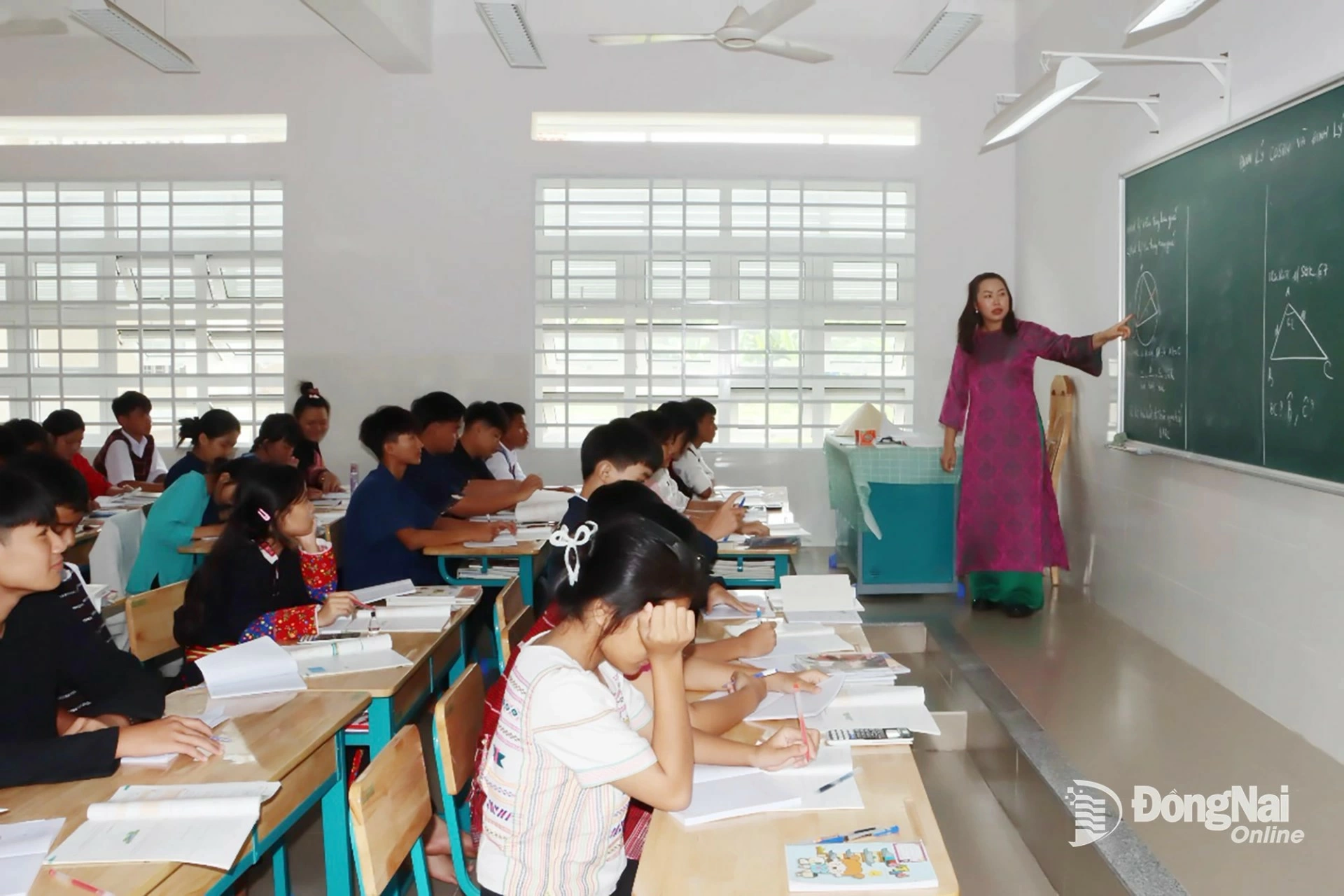 |
| Bui Thi Vi Van during a Math lesson at the Dong Nai Provincial Boarding Upper Secondary School for Ethnic Minorities. Photo: Vu Thuyen |
Recognizing the essential role of these schools, the province and the education sector have consistently invested in infrastructure and equipment to provide optimal conditions for developing young talents and fulfilling the requirements of modern educational reform.
Carrying the dream forward
From a young age, Bui Thi Vi Van, a Muong teacher of mathematics at the Dong Nai Provincial Boarding Upper Secondary School for Ethnic Minorities in Hung Thinh commune, dreamed of becoming an educator, someone who could “sow the seeds of knowledge” among children of her own ethnic community.
That dream grew stronger over the years when she had the honor of being a student in the second intake (1994–1997) of the Dong Nai Provincial Boarding Upper Secondary School for Ethnic Minorities.
Vi Van shared: “With outstanding academic results, I was admitted directly to the University of Economics Ho Chi Minh City (UEH). However, I chose to transfer to the Mathematics Education Department at the Ho Chi Minh City University of Education (HCMUE) to pursue my lifelong dream. After graduation, I returned to the very school where I once studied, to pass on knowledge to new generations of ethnic minority students.”
Vi Van is one of many alumni who have grown and succeeded thanks to the Dong Nai Provincial Boarding Upper Secondary School for Ethnic Minorities. This institution has been a cradle of talent for generations, with many former students now thriving across various sectors of society. For today’s students, enrolling at this school means setting clear academic goals and striving to realize their dreams.
“I’ve learned to be independent and lessen the financial burden on my family. I’m determined to study hard so that one day I can return to show my gratitude to my teachers and the school leadership,” shared Ho Thi Bich Ngoc, a 10th grader.
Similarly, Ly Thu Thao, an 11th-grade student, said: “Thanks to the guidance and inspiration from my teachers, I’m motivated to pursue a degree in education and come back to teach younger students in the future.”
Recognizing the importance of developing high-quality human resources in ethnic minority areas, the Dong Nai Provincial People’s Committee (before administrative restructuring) approved a comprehensive renovation and upgrade project for the Dong Nai Provincial Boarding Upper Secondary School for Ethnic Minorities during the 2024–2025 academic year. The project spans nearly 3.5 hectares, with a total investment exceeding 152 billion VND. Once completed, the school will feature modern facilities, including 15 classrooms, specialized subject rooms, a traditional hall, a kitchen and dining area, dormitories, sports grounds, and a medical room, all designed to meet the learning needs of more than 500 students from ethnic minority backgrounds.
Such comprehensive investment not only offers peace of mind to parents and students but also encourages teachers to pursue their profession with greater enthusiasm and dedication. It opens the door for better digital integration, innovative teaching strategies, and overall improvements in education quality, especially in line with the 2018 General Education Curriculum.
Nguyen Thi Lam Hong, Vice Principal of theDong Nai Provincial Boarding Upper Secondary School for Ethnic Minorities
Preserving the beauty of traditional culture
In addition to innovating and improving educational quality while caring for students’ material and spiritual well-being, ethnic minority boarding schools have also integrated traditional cultural elements into lessons and extracurricular activities. These efforts help students develop a deeper awareness of preserving and promoting their own ethnic identity. Among them, the Loc Ninh Boarding Lower Secondary School for Ethnic Minorities stands out as a shining example in the province.
In 2022, the school was newly constructed at a central, spacious, and modern location, with a total investment of 50 billion VND. The campus includes various facilities that fully meet the needs of teaching, learning, experiential activities, and boarding life.
One notable highlight is the school’s smart classroom, which enables 100% of students to use computers for interactive, engaging lessons and hands-on practice.
According to Nguyen Anh Tu, a Math teacher at the school, the computer-based teaching model has been used for the past four years. He said, “From the 2024–2025 academic year, with the introduction of the smart classroom, lessons have become more visual, easier to understand, and more enjoyable for students. In addition to Mathematics, other subjects, especially those in the natural sciences, are also using this classroom for practical, computer-based learning.”
Alongside efforts to improve educational quality, since the 2015–2016 school year, the school has been equipped with a complete set of Ngũ Âm (five tones) musical instruments, representing the five groups of sounds, including metal, wood, skin, wind, and string. In addition to Khmer folk songs, students also perform songs celebrating the country, homeland, and people of Vietnam. The school also has a lithophone (stone musical instrument set), which enables students to explore and appreciate the cultural values of various ethnic groups.
Chu Hoang Kinh, an eighth-grade student from class 8A1 at Loc Ninh Boarding Lower Secondary School for Ethnic Minorities, shared: “I am of the Nung ethnic group, but through learning and practicing the Ngu Am ensemble and exploring Khmer culture in music lessons, I have gained a deeper understanding of the rich cultural traditions of ethnic communities across our country.”
According to Vu Thi Quynh Anh, a music teacher at the school, thanks to the school’s investment in musical instruments, not only our main performing team but also many other students have developed a strong interest in traditional music. The ensemble often performs during significant events at the school, in the local community, and within the education sector. Maintaining and promoting traditional cultural values, through musical instruments, folk dances, and performances, has become an invisible yet powerful bond that connects different ethnic communities, nurturing pride and unity among students and teachers alike.
By Vu Thuyen – Translated by Hong Van, Minho


Thông tin bạn đọc
Đóng Lưu thông tin