
On October 9, Thai Bao, Deputy Secretary of the Provincial Party Committee, Head of the Provincial Party Committee’s Organization Commission, and Secretary of the Party Committee of Provincial Party Agencies, chaired a working session with the Party Committee and Board of Rectors of Dong Nai Provincial School of Politics to review the school's operations following its recent merger.
 |
| Thai Bao, Deputy Secretary of the Provincial Party Committee, Head of the Provincial Party Committee’s Organization Commission, and Secretary of the Party Committee of Provincial Party Agencies, delivers directives at the working session. Photo: Phuong Hang |
Also attending the working session were leaders of the Party Committees, the Office of the Provincial Party Committee, as well as representatives from the Department of Home Affairs and the Department of Finance.
According to the leadership of the Provincial School of Politics, the institution currently has 57 staff members, including 53 on the official payroll and 4 under contract. Three months after the merger, the school has organized and delivered training for 25 classes, with nearly 8,200 participants enrolled in advanced and intermediate political theory programs, as well as two additional professional development courses.
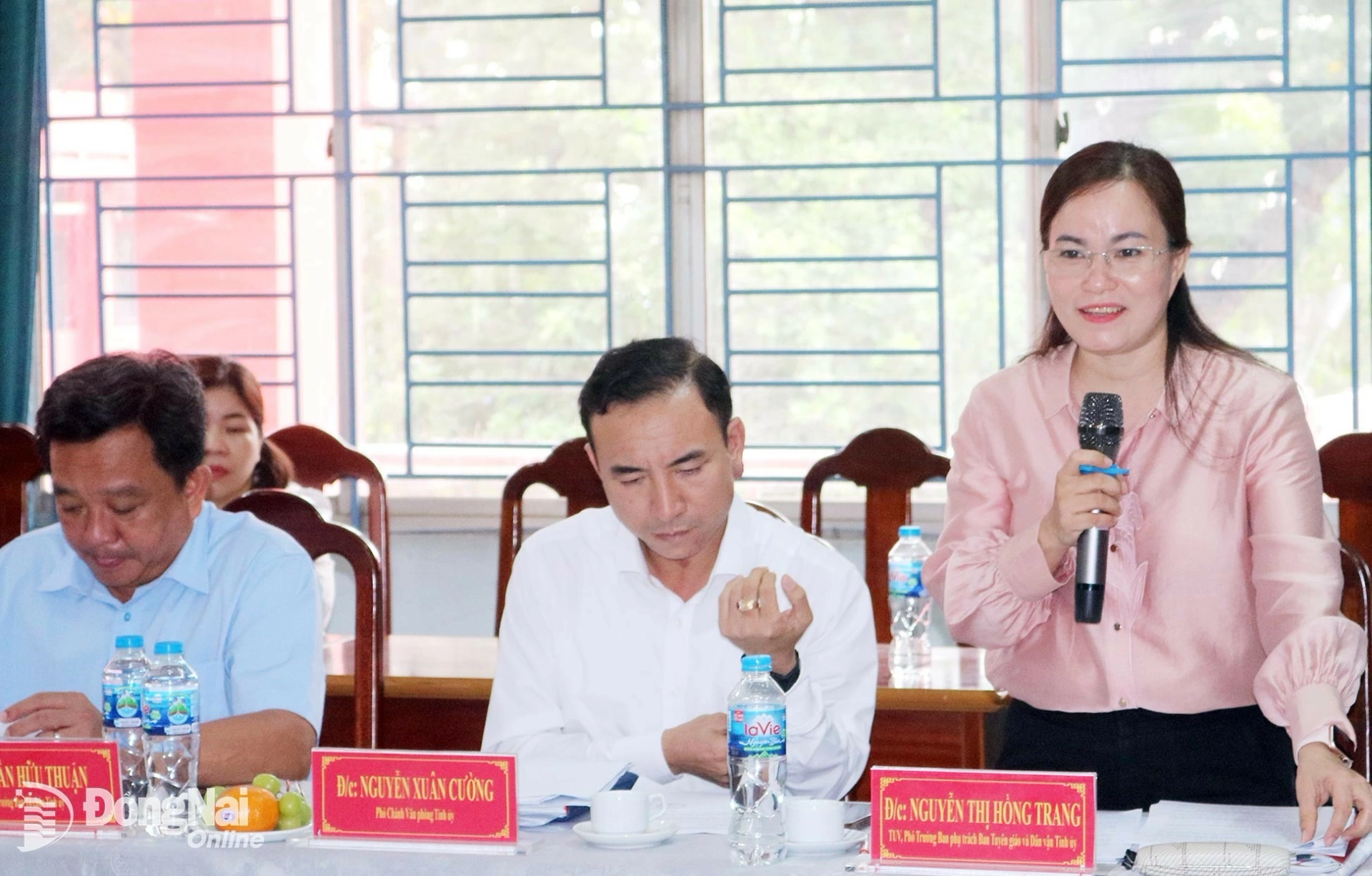 |
|
Nguyen Thi Hong Trang, Member of the Provincial Party Committee and Deputy Head in charge of the Provincial Party Committee’s Commission for Propaganda and Mass Mobilization, delivers remarks at the working session. Photo: Phuong Hang |
In addition to its teaching activities, the school is currently undertaking one provincial-level scientific research project and nine institution-level research projects. It has also collaborated with academic institutions to organize scientific seminars, including a ministerial-level conference with the Institute of Philosophy under the Ho Chi Minh National Academy of Politics, themed: “The current state of digital transformation to promote the development of productive forces in the Southeast region in the New Era.”
The school has organized a delegation of officials to conduct academic exchange and research at the Hongqi Canal Cadre Academy in Henan, China. Additionally, it is in the process of compiling two books: “Promoting the power of great national unity to build a sustainable Dong Nai province” and “Protecting the Party’s ideological foundation through political and ideological education for industrial zone workers in Dong Nai province”, both expected to be completed before October 30, 2025.
The school has set a goal of achieving level 1 standard Political School status by May 19, 2026, and aims to reach level 2 standard by February 3, 2030. Its broader vision is to develop into the sole training center for cadres, civil servants, and public employees within Dong Nai’s political system, as well as a provincial hub for research and the synthesis of practical experiences.
 |
| Nguyen Xuan Cuong, Deputy Chief of the Office of the Dong Nai Provincial Party Committee, delivers remarks at the working session. Photo: Phuong Hang |
After hearing the school's activity report, its proposals, and feedback from participants at the working session, Thai Bao, Deputy Secretary of the Provincial Party Committee, praised the efforts of the Dong Nai Provincial School of Politics following the recent merger. He acknowledged the school’s prompt stabilization of its organizational structure, including the Party Committee, Board of Rectors, departments, and offices. The merger process did not disrupt operations, as the school continued to conduct training programs as scheduled and maintained its scientific research activities uninterrupted.
Thai Bao emphasized that the 1st Congress of the Dong Nai Provincial Party Committee for the 2025-2030 term identified three breakthrough tasks, one of which is improving the quality of the two-tier cadre system, particularly the core leadership personnel. To effectively achieve this objective, enhancing the quality of the cadre team involves multiple components, with training and professional development being a key pillar.
Deputy Secretary Thai Bao urged that, in the time ahead, the Party Committee and Board of Rectors of the Provincial School of Politics must place special emphasis on Party building. The school's Party organization must be comprehensive in its strength in political, ideological, organizational, and ethical aspects. It must serve as a model within the Party organizations of the provincial Party agencies and across the entire Dong Nai Provincial Party Committee. As the institution responsible for training and developing the province’s future leaders, the school bears a significant responsibility to ensure that cadres are well-qualified and capable of meeting the leadership demands of agencies and units. This requirement places high expectations on the school's Party-building efforts.
 |
| Thai Bao, Deputy Secretary of the Provincial Party Committee, Head of the Provincial Party Committee’s Organization Commission, and Secretary of the Party Committee of Provincial Party Agencies, poses for a photo with leaders of provincial departments and agencies alongside the Party Committee and Board of Rectors of the Dong Nai Provincial School of Politics. Photo: Phuong Hang |
To build a clean and strong Party organization within the school, the entire institution must uphold unity, democracy, discipline, and order, strictly following the Party's regulations and the State's laws. Emphasis should be placed on enhancing the quality of Party cell activities.
The key indicator of the school's quality lies in its ability to train and develop cadres with knowledge, integrity, ethics, skills, and practical competence, with individuals capable of meeting the leadership and management requirements of agencies, units, and localities, particularly in the new context of implementing the two-tier local government model.
Furthermore, the value of the school is also reflected in its scientific research outputs, as well as projects that contribute practically and serve as a basis for policy advice and recommendations to help the province address bottlenecks and foster development.
In addition to meeting professional qualifications, the school's faculty and staff must embody the qualities of educators, scholars, and administrators. They are expected to demonstrate strong political will, regularly update their knowledge, and assist learners in mastering both theoretical foundations and practical problem-solving skills.
Lecturers and staff at the Dong Nai Provincial School of Politics must aim to excel in teaching, policy consultation, and strategic advisory roles for the Provincial Party Committee and local authorities.
Thai Bao tasked the Provincial Party Committee’s Organization Commission and the Dong Nai Provincial School of Politics with urgently coordinating and advising the Provincial Party Standing Committee on developing a cadre training and development plan for the entire 2025-2030 term. This plan will serve as the foundation for formulating annual training and development programs for the province.
By Phuong Hang - Translated by Hong Van, Minho


Thông tin bạn đọc
Đóng Lưu thông tin