
The 2019 Law on Education is being reviewed for amendment and supplementation with the aim of further specifying the Party’s and State’s guidelines and policies on breakthroughs and modernization in education and training. At the same time, it seeks to open up opportunities for lifelong learning, improve qualifications and skills, and fully develop individual potential.
The Draft Law Amending and Supplementing a number of articles of the 2019 Law on Education (abbreviated as the Draft Amendments to the 2025 Education Law) contains many new provisions that have attracted public interest.
Many new provisions on delegated authority
The Law on Education No. 43/2019/QH14 was adopted by the 14th National Assembly on June 14, 2019, and came into effect on July 1, 2020. After five years of implementation, the law has shown a number of shortcomings and limitations. The 2025 Draft Amendments to the Education Law would eliminate the current requirement for a secondary school graduation certificate. Instead, principals of secondary schools or heads of institutions delivering the secondary education program would be authorized to certify completion of the program. Likewise, principals of high schools or heads of institutions offering the high-school education program would be empowered to issue high-school diplomas.
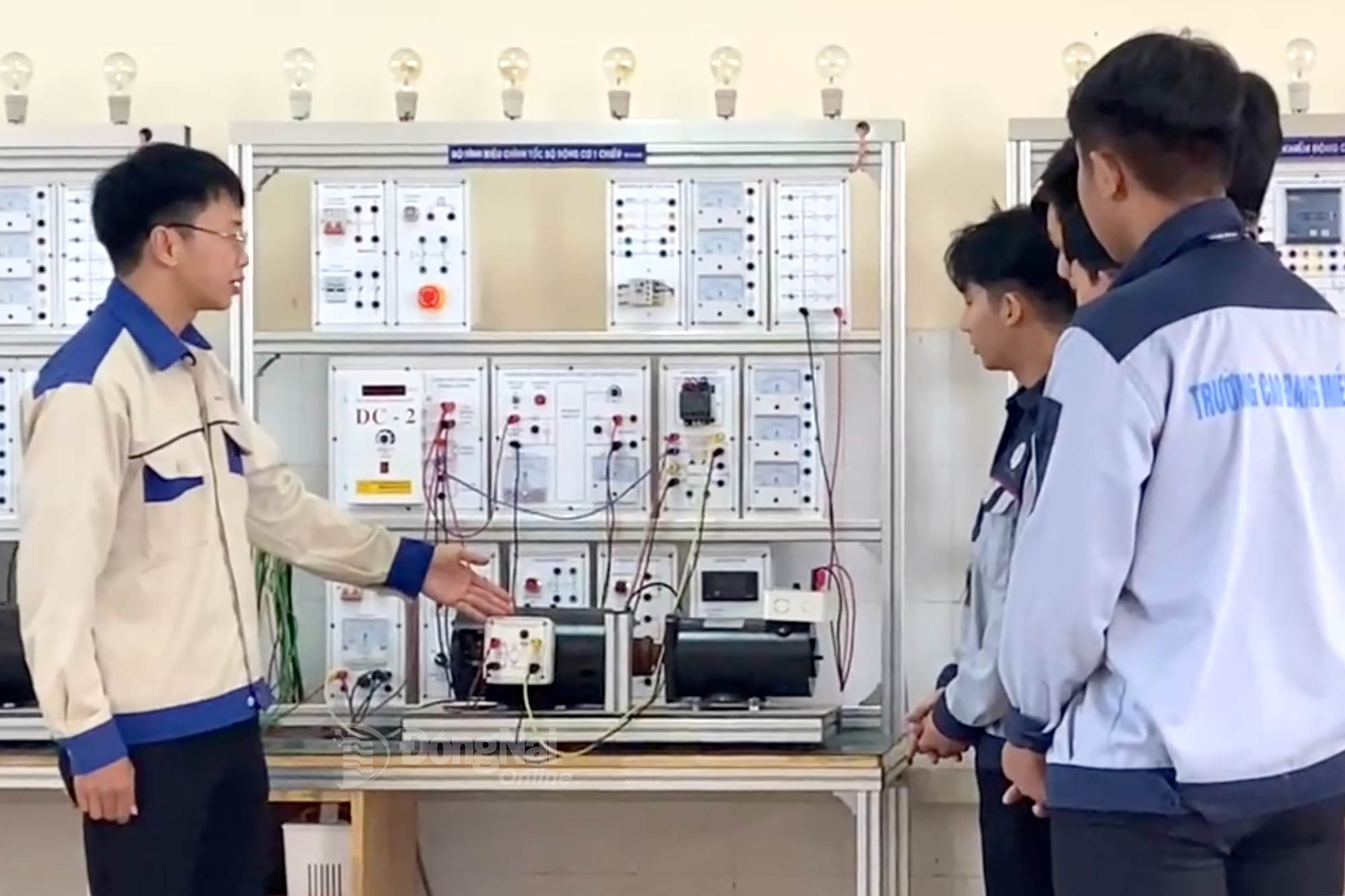 |
| Students of Mien Dong College (Binh Phuoc ward) during a practical session. Photo: Contributor |
Retired educator Nguyen Van Tuan (Dong Xoai ward, Dong Nai province) stated that: the 2025 Draft Amendment to the Law on Education explicitly stipulates that local education materials shall not be classified as textbooks and to revise the regulations on the authority for compiling and appraising local education materials, assigning provincial People’s Committee–affiliated specialized agencies to organize compilation, provincial-level appraisal councils to conduct evaluation, and provincial People’s Committees to grant final approval.
Clause 16, Article 1 of the 2025 Draft Amended Law on Education revises and supplements Article 55 of the 2019 Law on Education as follows: The school council of a public university or public vocational education institution is the school’s governing body, representing the relevant stakeholders. The school council of a public nursery, kindergarten, or community-established preschool is the school’s governing body, nominated by the community that established the school. The school council of a private nursery, kindergarten, preschool, or private general education institution is the school’s governing body, exercising representative rights on behalf of the investors and relevant stakeholders, and is responsible for implementing the investors’ decisions.
The 2025 Draft Amended Law on Education stipulates that: local education materials, compiled by the Departments of Education and Training to meet local needs and suit local characteristics, are appraised by provincial-level appraisal councils and approved by the chairpersons of provincial People’s Committees. The draft does not specify the knowledge volume of local education materials, which could lead to localities including excessive content beyond students’ capacity to absorb. Therefore, it is necessary to add a provision authorizing the Ministry of Education and Training to set specific guidelines on content volume to ensure consistency and alignment with the general education curriculum.
Pham Thi Dung, a teacher at Truong Son Secondary School (Phu Lam commune, Dong Nai province), said that: the school council is the governing body, representing the school community in making decisions on important matters. It is also an organization that embodies democracy and transparency and promotes the autonomy of schools. To avoid being merely formal, the school council must fully exercise its role, school leadership should strengthen its substantive authority for the school council, and council members must actively fulfill their roles and responsibilities.
High consensus
Clause 7, Article 1 of the 2025 Draft Amended Law on Education revises and supplements Article 32 of the 2019 Law on Education as follows: Each subject may have one or several textbooks. The compilation of textbooks is socialized, and their publication is carried out in accordance with the law. The director of the Department of Education and Training decides which textbooks are to be used consistently in general education institutions within their area, in line with the guidelines issued by the Minister of Education and Training.
Le Ngoc Nu (Long Khanh ward, Dong Nai province) expressed: “I support the policy of using a unified set of textbooks to avoid waste. I hope the Government will regulate the provision of free textbooks for students, implement appropriate socialization solutions regarding textbooks, while ensuring sustainability and meeting the requirements for improving education quality.”
The revision and supplementation of certain provisions of the 2019 Law on Education will meet the requirements of international integration and digital transformation, while ensuring consistency and alignment with new legal regulations as well as the policies on organizational restructuring, administrative units at all levels, and the delegation and decentralization of authority.
Chu Van Hien, Deputy Head of the Department for Propaganda, Dissemination, and Law Development, Dong Nai Provincial Lawyers Association, shared: It is necessary to ensure consistency in the compilation, appraisal, printing, and use of textbooks. This helps maintain common standards of educational quality and ensures equal access to knowledge across regions, particularly in remote areas and among ethnic minority communities. A unified set of textbooks compiled, provided, and controlled by the State will prevent the formation of vested interests, curb malpractice, and save social costs.
In view of the shortcomings of the 2019 Law on Education, it is necessary to revise and supplement certain provisions. This is a desire shared not only by the education sector and those working within it, but also by a large number of parents across the country.
By Doan Phu – Translated by Thu Hien, Thu Ha


Thông tin bạn đọc
Đóng Lưu thông tin