
To achieve rapid and sustainable development in the coming years, Dong Nai must continue to address the need for high-quality labor, especially in emerging fields such as aviation, logistics, information technology, semiconductor chips, tourism, and more.
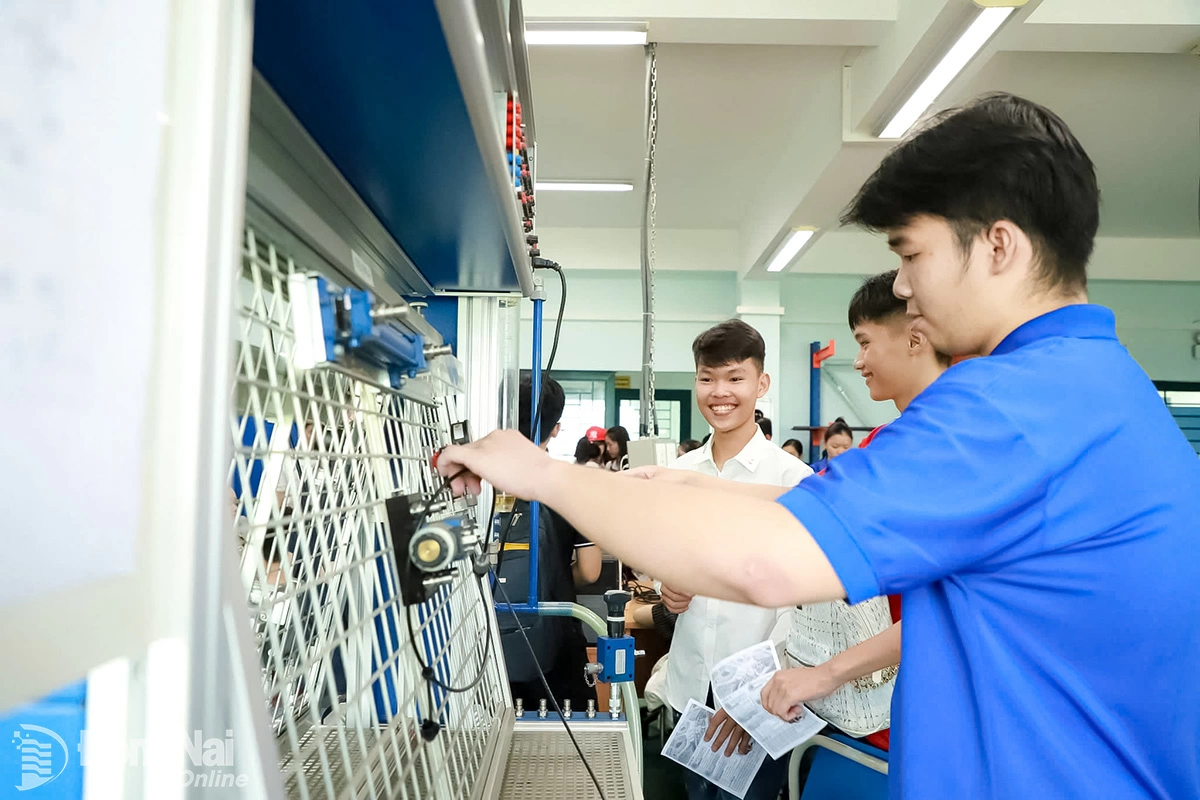 |
| International-level vocational training activities at Lilama 2 International Technology College (Long Phuoc Commune). Photo: Cong Nghia |
According to Prof. Dr. Su Dinh Thanh, Director of the University of Economics Ho Chi Minh City (UEH) – who is very interested in Dong Nai’s development role within the overall growth of the Southeast region and the entire country, in order to effectively solve the issue of high-quality labor for development, Dong Nai needs to plan and reorganize its vocational training institutions in alignment with the province’s overall planning.
The advantage of becoming a training hub
Thanks to the strong industrial development since the country’s renewal and international integration, Dong Nai has become a vast and diverse labor market across many sectors. New opportunities for the workforce will be much greater as Dong Nai is completing all major forms of transportation prevalent worldwide. In addition to roads, railways, and waterways, Dong Nai already has Phuoc An Port providing access to the sea, and soon the Long Thanh International Airport will connect the province to countries around the world.
Moreover, Dong Nai is also focusing on developing the North-South high-speed railway and urban railways connecting to the country’s largest economic hub, Ho Chi Minh City. Among these is Ho Chi Minh City Metro Line 1, which will extend to Tran Bien Ward and Long Thanh Airport. There will also be an urban railway connecting Long Thanh Airport with Tan Son Nhat Airport. Recently, experts and scientists proposed a railway line connecting Dong Xoai Ward with Tran Bien Ward to enhance transportation connectivity after the merger of Binh Phuoc Province with Dong Nai.
High-quality human resources will be one of the key foundations for breakthrough development In the term 2025-2030, the province is determined to improve the efficiency of existing training institutions while reorganizing vocational schools to avoid scattered and fragmented investment resource allocation. The province will also study investment in several key training institutions and attract businesses to participate in high-quality vocational training. High-quality human resources will be one of the crucial foundations for the province’s breakthrough development in the new phase.
Comrade VO TAN DUC, Deputy Secretary of the Provincial Party Committee, Chairman of the Dong Nai Provincial People’s Committee
During his working visit to Dong Nai, Professor Ha Hun Koo, former Head of the Logistics Department, Asia-Pacific School of Logistics, Inha University, and member of the Advisory Committee on Transport Infrastructure Investment, Ministry of Land and Transport of South Korea, predicted that Dong Nai will enter a new cycle of strong development thanks to breakthroughs in transportation infrastructure and high-tech industrial zones. New sectors such as aviation services and industry, logistics, information technology, semiconductor chips, biotechnology, and others will serve as a “strong boost” for the province. Investors in these sectors will quickly come to Dong Nai to leverage the province’s new advantages.
As forecasted by experts and scientists, during the 2020-2025 term, Dong Nai has witnessed a boom of major infrastructure projects and a strong increase in domestic and foreign direct investment (FDI), even during times of economic difficulty. Many high-tech investors have entered sectors with high added value such as electronics, semiconductor chips, logistics, and aviation services. In addition, the province has accelerated the expansion and development of new industrial parks to attract next-generation investors in high-tech fields.
A typical example was recorded at the end of 2023, when Coherent Group (USA) proposed investing in 3 high-tech semiconductor projects in the Nhon Trach 1 and 2 Industrial Parks (Nhon Trach Commune), and all three projects received investment certificates in mid-2024. Recently, Coherent inaugurated one project and is continuing to implement the remaining two with a total capital of over 1 billion USD, while expecting to achieve export revenue of up to 1.2 billion USD per year.
A strategy for training high-quality human resources is needed
According to the Department of Education and Training, Dong Nai currently has 4 universities, 2 university branches, 12 colleges, and 7 intermediate schools. The scale of higher education and vocational education in Dong Nai ranks second in the Southeast region, only after Ho Chi Minh City. The province’s vocational education has increasingly met business labor needs. However, the quality of human resource training still does not fully meet the demands of enterprises and society. High-level labor in key industries remains insufficient in both quantity and quality. In particular, some new fields such as semiconductor chips and chip design are still untapped. Therefore, the province should develop a comprehensive plan for the restructuring of public vocational training institutions, followed by breakthrough and long-term effective investment. Weak public training institutions, outdated facilities, and duplicated but ineffective training programs need to be firmly reorganized.
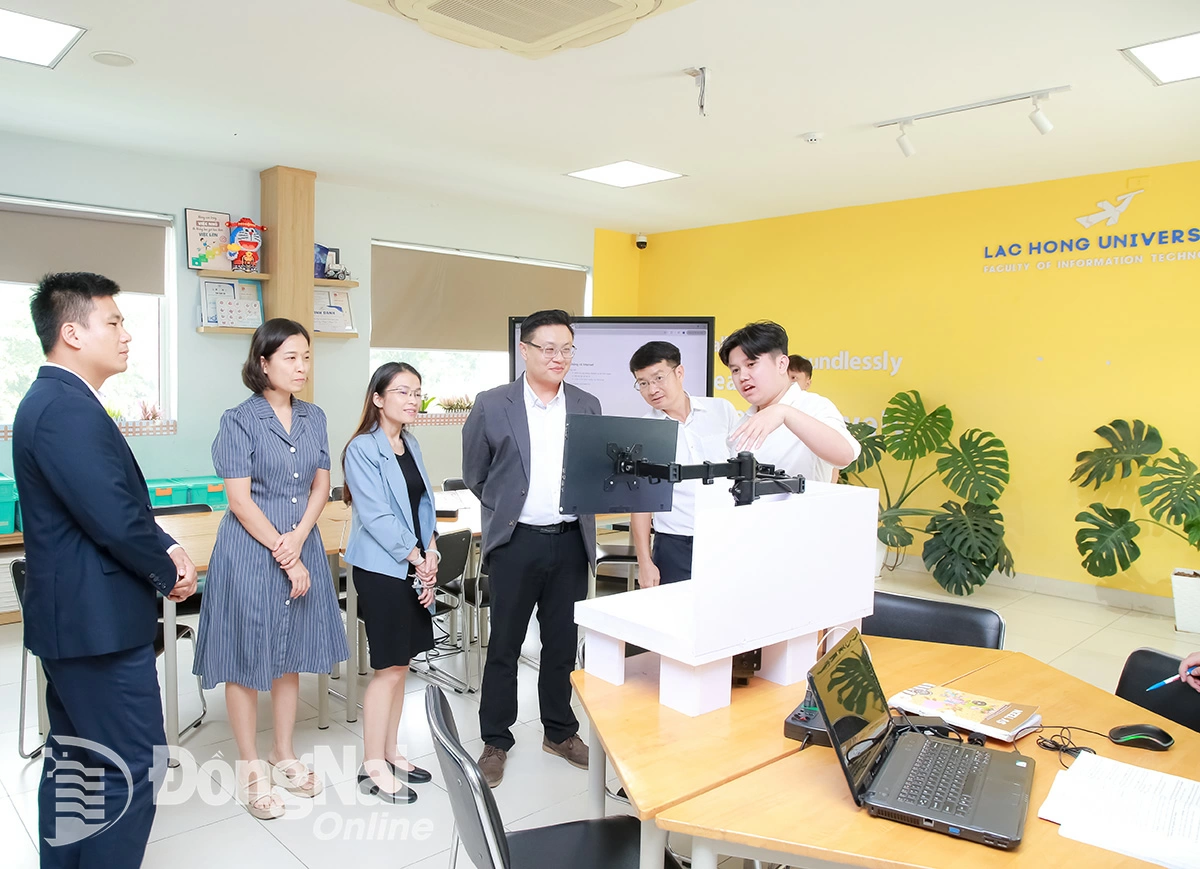 |
| Representatives of Coherent (USA) visit Lac Hong University to learn about its IT human resources training program. Photo: Cong Nghia |
Building a reputable training brand requires significant resources and many years to establish. Therefore, the province needs mechanisms and policies to attract major universities to set up training facilities in Dong Nai. Dr. Lam Thanh Hien, Rector of Lac Hong University, said: Recently, the university was accredited with international standards. In the coming time, the university will continue investing to achieve ABET accreditation from the United States. The school will also strategically invest in new fields, especially semiconductor chips, as very few institutions have enough resources to invest in training in this sector. Therefore, the school hopes the province will continue to support land and policy mechanisms to help it develop into a strong training institution of the province.
Meanwhile, according to the Board of Rectors of Binh Phuoc College, in 2019, the school was established by merging three colleges, including Binh Phuoc Pedagogical College, Binh Phuoc Vocational College, and Binh Phuoc Medical College. After its establishment, the former Binh Phuoc provincial government devoted significant resources to the school, prioritizing investment in new facilities and equipment to support training. The school’s goal in the coming years is for 100% of training programs to meet national and ASEAN regional accreditation standards.
By Cong Nghia – Translated by Quynh Nhu, Thu Ha


Thông tin bạn đọc
Đóng Lưu thông tin