
(ĐN) Entering the 2025-2030 period, Dong Nai province stands before new opportunities, yet also faces significant challenges. Its position as a vital growth pole for the Southern key economic region, coupled with the rollout of national-scale mega-projects such as Long Thanh International Airport, the Ring Road 3, and expressways demands a dynamic, facilitative, and efficient public administration.
Furthermore, the trend of comprehensive digital transformation and the rising expectations of citizens and businesses require the government to constantly innovate, enhance its governance capacity, and truly become a service-oriented government.
A breakthrough to unlock resources
According to Vo Tan Duc, Deputy Secretary of the Provincial Party Committee and Chairman of the Dong Nai People's Committee, during the 2020-2025 term, administrative reform, civil service development, and improvement of local governance effectiveness have been identified by the provincial leadership as a core political task and a strategic breakthrough to unlock resources and fuel socio-economic development.
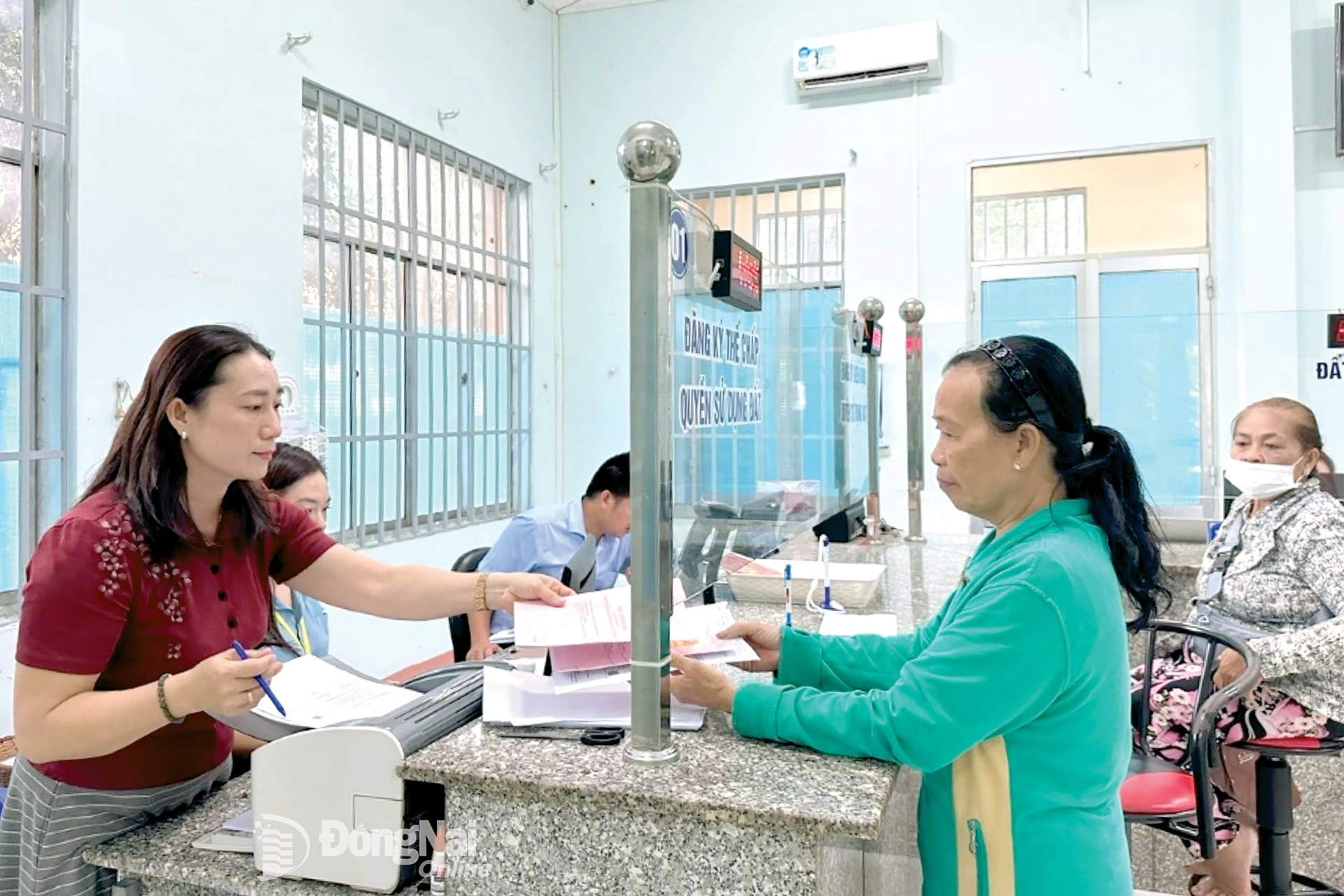 |
| A resident receives guidance while completing administrative procedures at the Thien Hung Commune Public Administration Service Center. Photo: Thanh Nga |
Driven by high political resolve and concerted action across the political system, the province's administrative reform has seen vigorous progress in the past 5 years. The most notable success has been a dramatic leap in its PAR Index (Public Administration Performance Index). From a ranking of 32nd out of 63 provinces and cities in 2023, Dong Nai made a staggering 24-place jump to 8th nationwide in 2024, with a score of 90.69. This is its highest achievement since 2018, placing it for the first time in Group A – the cohort of top-performing localities in administrative reform.
The provincial Department of Home Affairs attributes this success not to chance, but to sound leadership. The provincial authorities candidly addressed shortcomings, issued a dedicated directive for rectification, and mobilized the entire political apparatus. Improvements were recorded across the board: from the drafting and review of legal documents; to administrative procedure reform, with over 96% of applications processed on time; to the steady streamlining of the state administrative apparatus. A parallel push has been the accelerated development of e-government.
This political will is also evident in the province's embrace of the Fourth Industrial Revolution. The provincial Party Executive Committee issued Resolution 05-NQ/TU on digital transformation towards 2025, with a vision to 2030, and established a Steering Committee for digital transformation chaired directly by the Chairman of the Provincial People's Committee. These are critical foundations for Dong Nai's pursuit of a modern, intelligent, and service-oriented administration.
Putting the satisfaction of citizens and businesses first
Building on these results and lessons learned, the overarching goal for administrative reform from 2025-2030 is to build a democratic, professional, modern, streamlined, effective, and constructive Dong Nai administration by 2030 – one that is integrity-based and service-oriented, using the satisfaction of its people and businesses as the ultimate benchmark for performance.
 |
| A civil servant at the Dai Phuoc Commune Public Administration Service Center assists a resident with online procedures. Photo: Ho Thao |
The first Dong Nai provincial Party Congress for the 2025-2030 term identified this as one of eight key tasks requiring focused implementation. They are about promoting administrative reform (with special focus on digitizing administrative procedures) and building a digital and smart government. The province will also continue to refine and effectively operate its streamlined two-tier local government apparatus, foster an enabling, integrity-based administration that serves the people and businesses, and enhance modern local governance capacity. Investment will also be prioritized to complete the provincial political-administrative centre.
The imperative now is a decisive shift in the mindset and operations of the political system from an administrative management state to a service-oriented state, creating a more enabling environment for people and businesses and from "bureaucratic command" to "listening, understanding, and partnering" with citizens and enterprises, under the motto: "The locality decides, executes, and takes responsibility."
PHAN DINH TRAC, Member of the Politburo, Secretary of the Party Central Committee, Head of its Commission for Internal Affairs
The Political Report presented at the first Dong Nai provincial Party Congress laid out key solutions to effectively carry out the above-mentioned tasks. Central to these solutions is the continued refinement of the province's two-tier local government, a process that will be intrinsically linked to streamlining the public sector payroll and enhancing the quality of its cadre, civil servants, and public employees. The province will also finalize a comprehensive list of job positions, complete with detailed descriptions and competency frameworks across the entire political system. Furthermore, the plan mandates a shift in the operational ethos of state administrative agencies towards a more facilitative and developmental model, pushes the adoption of advanced governance methods, and the development of e-government and smart urban infrastructure.
Addressing the inaugural Party Congress of Dong Nai province for the 2025-2030 term, Phan Dinh Trac outlined a clear mandate for governance reform. The Member of the Politburo and Head of the Party Central Committee’s Internal Affairs Commission stressed that the province must ensure its two-tier political system operates with seamless efficiency and authority. He called for an administration that is both integrity-based and accessible, one that elevates the standard of public service delivery. A key directive was the principle of subsidiarity: that citizens' concerns must be addressed at the most local level possible. Trac framed this as a foundational priority for the new term, crucial for establishing a durable framework for the province's future development.
Le Van Chuong, a local party secretary and grassroots leader in Long Binh ward stated that for the resolution of the province's inaugural Congress to be successfully implemented, particularly the goal of building a modern, professional, and effective administration, the calibre of its leadership cadre is paramount. He contends that beyond sound policies and resolute direction, the province's managers and executives at all levels must have innovative mindsets, free from conservatism and inertia, and must have the courage to think boldly, act decisively, and assume full accountability before the Party and the people.
By Ho Thao - Translated by Thien Kim, Thu Ha


Thông tin bạn đọc
Đóng Lưu thông tin