
Following its merger with Binh Phuoc, Dong Nai now possesses outstanding advantages in terms of land area, population, and economy. Particularly, with its central location in the Southern key economic region, the province is regarded as a vital “link” in the regional trade network.
To fully harness this potential, fostering regional linkages is considered the key to driving breakthroughs. Strengthening cooperation and inter-regional and intra-regional linkages towards building Dong Nai into a prosperous, civilised, modern, and green locality is the direction set by the provincial Party organization for the period to 2030.
New advantages after the merger
With a total area of over 12,700 square kilometers, a population of nearly 4.5 million, and a projected GRDP in 2025 of VND 655 trillion, Dong Nai, after the merger, has become one of the two pillars of the region and one of the most developed localities in southern Vietnam.
Nguyen Tuan Anh, Member of the provincial Party Committee and Director of the Department of Agriculture and Environment, stated that Dong Nai possesses vast land resources with diverse functions. This is a significant advantage, allowing the province to expand both industrial parks (IPs) and urban areas while maintaining its agricultural and forestry potential to ensure long-term growth.
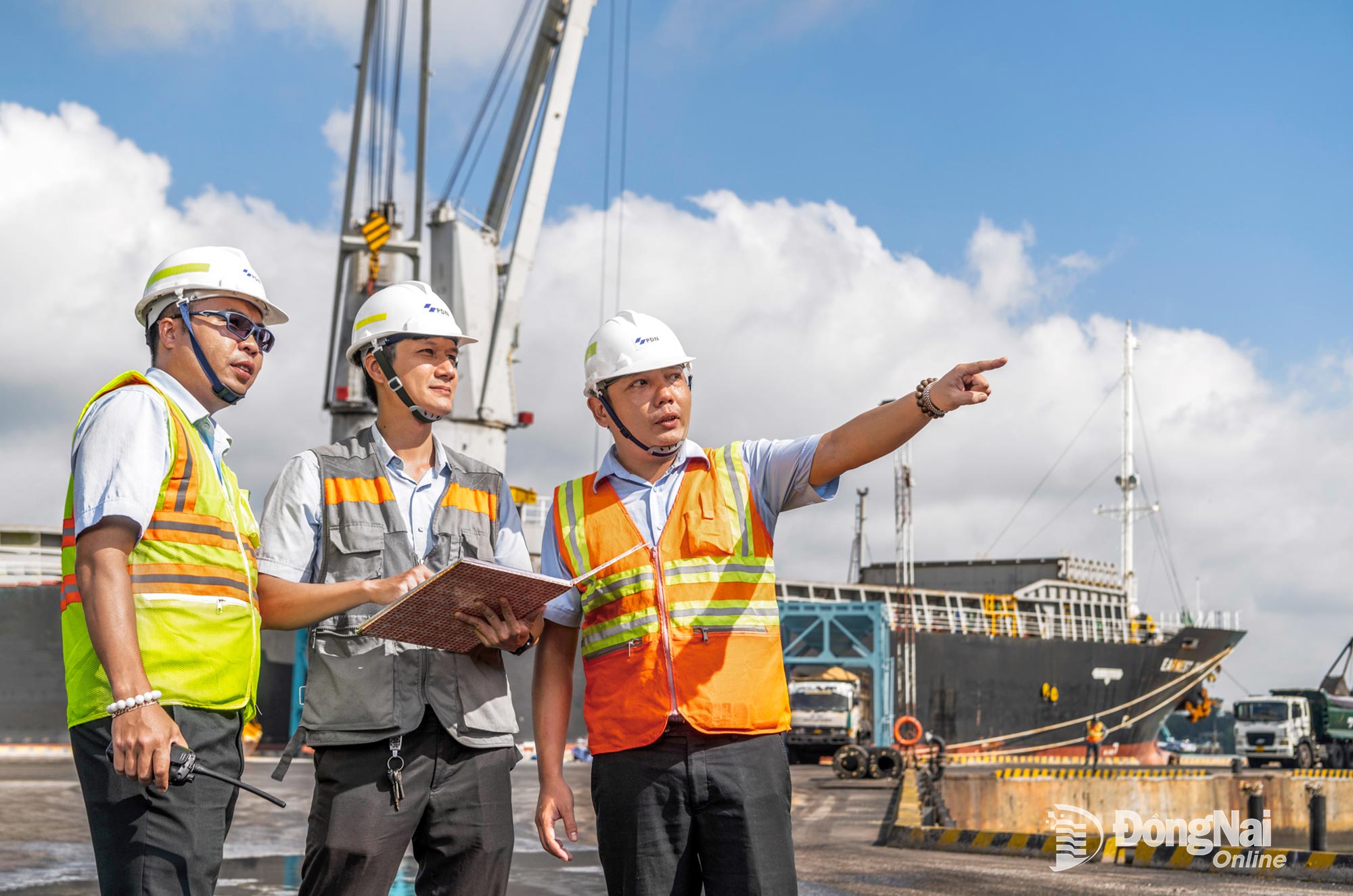 |
| Officials of Dong Nai Port Joint Stock Company inspect operations at the port. Photo: Ban Mai |
Beyond its land, Dong Nai is endowed with abundant natural resources, including bauxite, construction materials, fertile farmland, three types of forests with high biodiversity, as well as a rich system of mountains, rivers, and lakes. These are valuable resources not only for the present but also for driving growth in processing industries, renewable energy, hi-tech agriculture, eco-tourism, and carbon credit markets.
The Dong Nai province has identified four main development zones: a southern urban-industrial zone, a northern industrial-urban zone, an eco-urban zone along rivers and lakes, and a northeastern hi-tech agricultural and tourism zone.
In terms of transport infrastructure, Dong Nai has long been a "traffic hub" of the south, with deep-water seaports, inland ports, national highways, expressways, railways, and particularly Long Thanh International Airport. Following the merger, it also establishes new connections to the Central Highlands and Cambodia, broadening its development space, expanding trade markets, and strengthening its role as a regional connector.
With the fifth-largest population nationwide, Dong Nai has abundant human resources for future industrial and service development. This workforce is not only a labour supply for IPs and economic areas but also a large consumer market attractive to investors. The population scale also generates strong demand for housing, commerce, and services, fuelling the growth of modern urban centres, shopping hubs, and sustainable economic value chains.
Dr. Tran Du Lich, Member of the National Advisory Council on Monetary Policies and the province's Socio-economic Advisory Group, observed that Dong Nai has many advantages for development. Among them, the “trio” of airports, seaports, and international border gates, rarely found together in other provinces and cities, is a crucial feature for developing logistics and service trade in via air, sea, and land routes. However, to maximise this potential, the province needs to promptly adjust its master planning, thereby creating a legal basis for implementing projects in line with the new development space, and ensuring consistency with the national socio-economic development strategy and regional linkage orientation.
In line with the orientation of the provincial Party Committee, the People’s Committee is currently revising the Dong Nai master planning for the 2021-2030 period with a vision to 2050. Based on its advantages in industry, logistics, trade, services, tourism, agriculture, forestry and mineral resources, the province has identified four key development zones: the southern urban–industrial zone associated with Long Thanh International Airport, Phuoc An Port, and the urban areas of Tran Bien, Long Thanh, and Nhon Trach; the northern industrial–urban zone linked with the Hoa Lu Border Gate Economic Zone, Hoang Dieu Border Gate, and the urban centres of Binh Phuoc, Chon Thanh, and Binh Long; the river economy and eco-urban zone along rivers and lakes; and the northeastern hi-tech agriculture, large-scale modern livestock farming, and green eco-tourism zone connected with Bu Gia Map, Phuoc Long, Bu Dang, Ta Lai, and Nam Cat Tien.
In addition to the above-mentioned advantages, the province also possesses the potential for balanced development – a long-term strategy that many localities and countries are pursuing. Accordingly, the combination of Dong Nai's previous strengths in industry and rapid urbanisation with the former Binh Phuoc's advantages in agriculture, forest land, and natural resources will enable the new province to develop in a balanced and sustainable manner.
Enhancing linkages to turn potential into momentum
Dong Nai is a gateway linking the Southeast region with the Central Highlands, central provinces, and the whole country, while benefiting from regional infrastructure such as expressways, ports, and airports. Its abundant resources and large population provide a strong appeal for investment and market expansion.
 |
| The Long Thanh International Airport project is under construction |
Regional connectivity is identified as a vital solution for balanced and sustainable development. It enables Dong Nai to unlock strengths while avoiding counterbalance; lay the foundation to develop synchronized transport and logistics infrastructure; ensure smooth connections to seaports, airports, and border gates, while also attracting investment, sharing resources, and addressing common issues such as environmental concerns and social welfare. For instance, in seaport development, while Cat Lai Port serves as the "gateway" of Ho Chi Minh City and Cai Mep–Thi Vai functions as an international-class deep-water port cluster, the addition of Phuoc An Port in the province will complete the seaport chain, better meeting the growing demand for cargo transportation. Regarding aviation services, Long Thanh International Airport, set to come into operation soon, will be a crucial driver of the province's socio-economic development, helping to ease the burden on Tan Son Nhat International Airport, enhancing national aviation competitiveness, and meeting the country's long-term development requirements.
To enhance linkages with Ho Chi Minh City and neighbouring provinces, Dong Nai is investing in additional roads, railways, and bridges; expanding existing routes; and prioritising the completion of Long Thanh International Airport to make it an international transshipment hub. The province is also developing a free trade zone directly connected with Long Thanh International Airport, Cai Mep–Thi Vai Port, and deep-water seaports. This aims to establish a dynamic economic corridor for both Dong Nai and the entire Southern key economic region that supports Ho Chi Minh City’s aspiration to become an Asian economic and financial hub, while also generating significant revenue for the national budget.
Connections through national highways and expressways to the Central Highlands, a region rich in agricultural and forestry products, and with strengths in hydropower and minerals, will position Dong Nai as a hub for processing, consumption, and export. The province has recently commenced construction on two major expressways that directly link to this region: the Gia Nghia–Chon Thanh and Dau Giay–Tan Phu expressways. For the central and Mekong Delta provinces, the emphasis of connectivity infrastructure development is placed on North–South expressways, roads, railways, and seaports to expand markets and allocate labour resources efficiently.
According to experts, strengthening regional linkages will enable Dong Nai not only to maximise its existing advantages but also to participate more deeply in the production value chain – from raw material supply, processing, and manufacturing to logistics, distribution, and exports. This participation will help enterprises increase added value, reduce costs, expand markets, thereby building a foundation for sustainable and long-term economic growth.
A Southern industrial and service hub
With a solid economic foundation and new advantages gained after the merger, Dong Nai is well-positioned to become an industrial, service and logistics hub in Southern Vietnam. Regional linkages are the key to unlocking internal strengths and spreading growth momentum across neighbouring localities. The province expects to make strong breakthroughs in the coming period, contributing to maintaining the Southern key economic region’s role and position as the growth engine and the largest contributor to the nation’s GDP.
Currently, the province's regional linkages are primarily focused on infrastructure investment. These include projects that are underway or about to be implemented, such as the Bien Hoa–Vung Tau Expressway, Dau Giay–Tan Phu Expressway, Gia Nghia–Chon Thanh Expressway, Ring Roads 3 and 4, and new railway lines. Priority is being given to links with Long Thanh International Airport. Once completed, these projects will not only resolve long-standing bottlenecks and improve urban infrastructure but also open new development space for the province and the region.
The Southern key economic region makes a significant contribution to the national economy and budget revenue, accounting for approximately 40-45 percent of GDP, 50 percent of industrial output, and more than 40 percent of state budget revenues annually.
Dong Nai is also strengthening regional linkages in trade and services, particularly in logistics. With its advantage of being located on a strategic transport axis, adjacent to Ho Chi Minh City, and equipped with seaports, border gates, and an international airport, the province has favourable conditions to form a large-scale logistics hub, serving both domestic and international cargo flows. This will help Dong Nai expand markets, improve competitiveness, and reinforce its role as a key regional gateway for cargo transshipment.
Human resources play a decisive role in the province’s competitiveness and sustainable development. This forms the foundation to meet the requirements of industrialisation and modernisation, enabling the province to attract high-quality investment while also formulating concrete strategies, plans, and actions for the future. In line with the province’s orientation, many universities and colleges have expanded enrolment, updated training disciplines, and partnered with institutions in Ho Chi Minh City and overseas to train engineers, experts, and workers for IPs, seaports, and particularly Long Thanh International Airport. This human resource base will not only meet immediate needs but also provide a foundation for long-term sustainable growth.
In urban development, the province is collaborating with Ho Chi Minh City to survey and plan the utilisation of the Dong Nai riverfront and the development of modern satellite urban areas. This will attract major investors to implement projects that meet housing and service needs for residents, while also expanding urban space, thereby helping to “ease the burden” on central wards and reducing pressure on healthcare, education, housing, and the environment caused by rapid urbanization.
By Ban Mai – Translated by My Le, Thu Ha


Thông tin bạn đọc
Đóng Lưu thông tin