
On the morning of September 13, at the conference on the preliminary review of administrative reform over the first nine months of 2025 and the signing of commitments to fulfilling the targets and tasks for 2025, various departments, agencies, and localities presented reports highlighting achievements, challenges, and, notably concrete solutions to improve administrative reform in the coming period.
*Director of the Department of Science and Technology of Dong Nai Province, Pham Van Trinh: Launching the implementation of e-government and digital government
In recent times, the Department of Science and Technology has made significant efforts to implement key tasks aimed at promoting e-government and digital government development, online public services, and the application of information technology to support citizens and businesses in administrative procedure resolution.
The department has prioritized several initiatives to accelerate the development of digital platforms and databases; enhance internal applications and services within state agencies; and expand digital applications and services for the public and organizations.
Regarding Dong Nai Province’s Digital Government Architecture Framework (version 4.0), the Department finalized and approved the outline in August 2025. Once approved by the Provincial People’s Committee, the framework will be developed and is expected to be completed by December 2025 for official issuance.
As for the data center dedicated to digital transformation, the province currently operates two integrated data centers located in Tran Bien ward and Binh Phuoc ward. The Department has coordinated with technology enterprises to provide adequate infrastructure and equipment. Ongoing efforts are being made to upgrade and maintain these facilities, ensuring the province's IT systems remain stable, seamless, and secure.
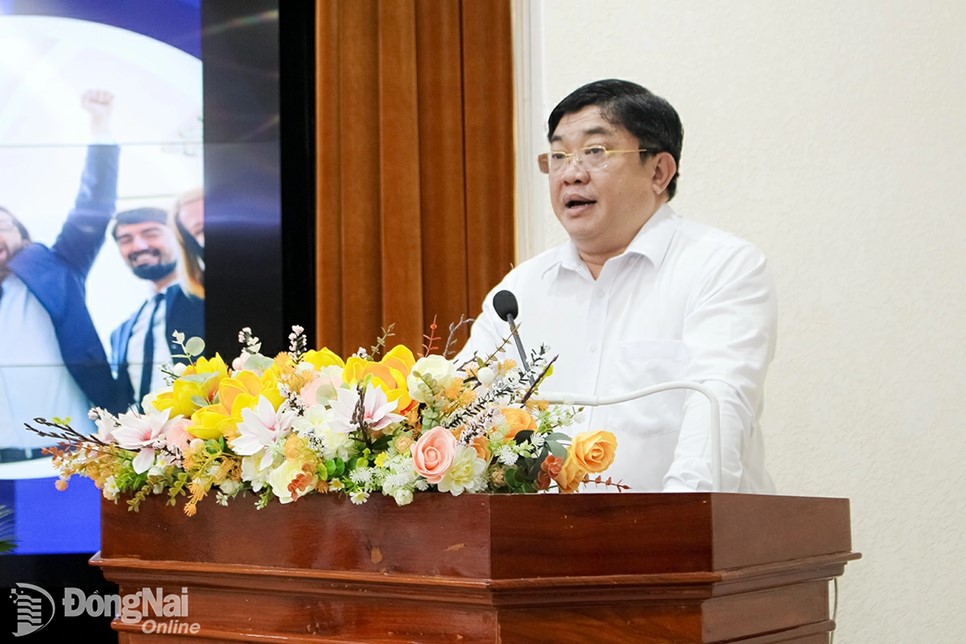 |
| Pham Van Trinh, Director of the Department of Science and Technology of Dong Nai province, delivers a report at the conference. Photo: Ho Thao |
As of now, all 95 communes and wards across the province have met 16 out of 16 infrastructure criteria, achieving province-wide coverage of administrative facilities and ensuring adequate physical conditions to serve citizens and businesses in the reception and processing of administrative procedures. The province’s Local Government Service Platform (LGSP) currently ensures integration and expansion of data-sharing functions. It connects Dong Nai’s specialized systems with national databases, the National Public Service Portal, and central ministries and agencies via the Ministry of Science and Technology’s National Data Exchange Platform (NDXP) and the Government Office’s Vietnam Data eXchange Platform (VDXP). In addition, the province has completed the issuance of electronic identification codes and configured workflows for incoming and outgoing documents on the DNis system for all specialized units under commune- and ward-level People’s Committees, as well as public service units. This ensures smooth communication and direction from grassroots-level authorities.
Key tasks for the final four months of 2025: The Department will relocate and install the province’s Intelligent Operations Center (IOC) on the second floor of the Provincial Public Administrative Service Center. This center will serve as the hub for direction and management across all levels of government. The Department will also coordinate with relevant departments and agencies to configure report templates on the provincial reporting information system and establish a digital data repository linked to the provincial IOC, thereby supporting electronic governance in line with Decision No. 456/QĐ-UBND dated July 21, 2025, issued by the Provincial People’s Committee.
At the same time, the Department will submit the Dong Nai Digital Government Architecture Framework (Version 4.0) to the Provincial People’s Committee for approval. It will also coordinate with relevant units to complete investment procedures for deploying a fixed video conferencing system for Party and State agencies at the commune and ward levels across the province.
Moreover, the Department will work with the Office of the Provincial People’s Committee and other relevant bodies to review and standardize system system connections, ensuring data synchronization with the National Public Service Portal and the Electronic Measurement and Control (EMC) system. The Department will continue integrating online public services onto the National Public Service Portal, publish services in accordance with regulations, and ensure service provision levels are aligned with Decree No. 42/2022/NĐ-CP, accurately reflecting the province’s actual results in implementing online public services.
*Deputy Director of the Department of Finance of Dong Nai Province, Pham Thi Kim Oanh: Decisive and synchronous implementation of solutions to accelerate public investment disbursement
In recent times, the Department of Finance has actively and synchronously implemented various measures aimed at fulfilling key tasks in budget and public financial management and administration.
Notably, the Department has proactively advised the Provincial People's Council and People's Committee to issue several important resolutions and decisions regarding socio-economic development plans, state budget revenue and expenditure estimates, public investment planning, decentralization of revenue sources and expenditure responsibilities, principles for allocating recurrent expenditure estimates, and procurement and asset maintenance authorizations. Additionally, the Department has advised the Provincial People's Committee on allocating budget estimates following the administrative restructuring of the two-tier local government system; supplementing funds for conducting priority tasks; providing financial support for organizing Party congresses at the commune and ward levels; implementing accounting operations; handing over and receiving assets under the “Gratitude Fund”; and providing feedback on equipment procurement plans for communes and public administrative service units.
While several positive outcomes have been achieved, the Department of Finance has also identified ongoing limitations in the province's public financial reform efforts. Specifically, the disbursement rate of public investment capital has not met expectations, particularly for key projects in the province. The handling of surplus public offices and assets remains slow, mainly due to procedural obstacles and challenges in assessing the actual usage needs of units after consolidation.
 |
| Pham Thi Kim Oanh, Deputy Director of the Department of Finance of Dong Nai province, delivers a report at the conference. Photo: Ho Thao |
The Department of Finance proposed that, in the coming period, the provincial authorities should issue strong and synchronized directives to accelerate the disbursement of public investment capital during the final months of 2025. Efforts should also be intensified in managing, reorganizing, and handling surplus public office buildings in accordance with regulations, ensuring the efficient use of public assets. Moreover, the Department recommends strengthening financial inspection and supervision, and strictly addressing any violations. All conclusions and recommendations from inspections and audits must be thoroughly implemented, with greater enforcement of financial discipline and order. Regarding public financial reform, it is necessary to continue reviewing and adjusting the autonomy mechanism, developing technical and economic norms, and promoting more comprehensive and synchronized reductions in state budget expenditures in the next phase.
*Nguyen Thi Thanh Thao, Deputy Director of the Dong Nai Provincial Public Administrative Service Center: Enhancing the effectiveness of channels for collecting feedback from people and businesses.
Thanks to the drastic leadership of the Provincial People's Committee and the active efforts of departments, sectors, and localities, administrative procedure reform (APR) in Dong Nai has seen positive progress. The province's performance indicators for serving citizens and businesses in handling administrative procedures and delivering online public services have shown strong growth, contributing to improving business and investment environment and reducing social costs related to administrative compliance.
However, alongside these achievements, several limitations and shortcomings remain in the implementation of administrative reform. These include delays in digitalizing records, low rates of online payment adoption, and underperformance in the processing of online public services in certain departments and localities, which have not yet met required targets. In addition, some online public services have not standardized interactive electronic forms, causing difficulties in online submission when citizens are required to repeatedly input the same information; and the advisory work on plans for streamlining and simplifying administrative procedures remains slow.”
These causes of these shortcomings and limitations stem from both objective and subjective factors. On the subjective side, the reform and control of administrative procedures in some departments and localities have not received sufficient attention. Furthermore, the professional capacity of some officials, civil servants, and public employees remains inadequate, and many have not fully demonstrated their roles and responsibilities during the performance of their duties.
 |
| Nguyen Thi Thanh Thao, Deputy Director of the Dong Nai Provincial Public Administrative Service Center, delivers a report at the conference. Photo: Ho Thao |
In the coming period, it is essential to rigorously implement administrative procedure reforms, with a focus on enhancing quality and strictly controlling the set of administrative procedures across all sectors and fields. These procedures must ensure legal compliance, adequate grounds for implementation at the one-stop shop division, and transparency and consistency. The configuration of internal and electronic processes for resolving administrative procedures must strictly follow the decisions published by the Chairman of the Provincial People’s Committee.
There is an urgent need to review and standardize forms and declarations, and to develop interactive electronic forms (e-forms) that facilitate online public services. These forms should leverage existing databases to automatically populate fields, eliminating the need for citizens to repeatedly enter the same information, in accordance with legal regulations. The restructuring of administrative processes must also ensure that procedural implementation is no longer constrained by administrative boundaries within the province. The reception of administrative procedures must comply with Government regulations.
The province should continue to standardize the levels of online public service provision currently integrated with the National Public Service Portal. It must review online public services that remain at the ‘partial’ level, compare them with the list of administrative procedures eligible for end-to-end online public service provision under the decisions of central ministries and agencies; and propose upgrading to the ‘end-to-end’ level for procedures that meet the requirements, ensuring consistency, efficiency, and convenience for people and businesses. Simultaneously, it is necessary to enhance the effectiveness of channels for collecting feedback of citizens and businesses regarding the reception and resolution of administrative procedures by agencies, departments, and localities across the province.
*Truong Dinh Quy, Deputy Director of the Xuan Hoa Commune Public Administrative Service Center: Promoting upgrades to physical facilities and digital infrastructure
Following the administrative restructuring, digital transformation linked with administrative reform has brought about significant improvements in the appearance of the one-stop shop division, service delivery manner, and quality of administrative resolution, contributing to the overall effectiveness of local government operations. The commune has actively upgraded its physical infrastructure and digital platforms, especially at the Public Administrative Service Center, by applying technology and standardizing data. Notably, the commune has enhanced the use of digital tools in meetings and applied artificial intelligence (AI) in routine agency tasks.
In the time ahead, the Xuan Hoa Commune People’s Committee will continue to strengthen its digital infrastructure, train personnel, expand communication efforts, and improve the quality of online public services, progressing toward a digital government that serves the people.
Key initiatives include regularly strengthening and promoting the activities of the community digital technology teams in local hamlets. These teams are identified as the core force in engaging with citizens, guiding them in the use of technology, and supporting digital transformation at the grassroots level. The commune also plans to intensify public awareness campaigns through new communication methods, including social media platforms such as Facebook and Zalo. Furthermore, it aims to establish direct communication channels with citizens via Zalo applications, helping to enhance the state's ability to disseminate official information and improve public access to reliable, accurate data.
 |
| Truong Dinh Quy, Deputy Director of the Xuan Hoa Commune Public Administrative Service Center, delivers a report at the conference. Photo: Ho Thao |
In addition, the commune has upgraded and developed a paperless online meeting system, contributing to improving the quality of meetings and local task handling. Plans are underway to establish an intelligent operations center (IOC) at the commune level and develop automated systems for real-time data collection and updates, such as security camera networks, environmental monitoring systems, and local sector-specific databases. These systems will be integrated with AI-powered data analytics system to support decision-making and leadership direction of the Commune People’s Committee.
*Ho Quoc Tan, Chairman of the People’s Committee of Dai Phuoc Commune: Developing innovative models and new practices to better serve the public
In recent times, based on the administrative reform evaluation criteria issued by the Provincial People’s Committee, Dai Phuoc commune has held meetings, developed specific implementation plans, and assigned clear responsibilities for each criterion to relevant units and individuals. Implementation progress and outcomes for each indicator are closely monitored to ensure effective execution. The commune has maintained and efficiently operated its Public Administrative Service Center under the one-door, modern interconnected one-door model, with strong application of information technology. As of now: 99.9% of administrative dossiers are processed ahead of deadline, 99% of administrative procedures are settled with online fee and charge payments, 100% of dossiers utilize citizen data integration. The commune has also prioritized researching and piloting innovative and practical models in administrative reform to better meet the needs of citizens and businesses. Examples include: a “Welcome Refreshment” model, offering free drinking water to residents visiting the Public Administrative Service Center, a “Job Recruitment Point” model, set up right at the Service Center to connect job seekers with employment opportunities. These initiatives aim to enhance the service quality and public satisfaction in administrative procedure resolution.
 |
| Ho Quoc Tan, Chairman of the People’s Committee of Dai Phuoc Commune, shares additional insights on innovative local models following his presentation at the conference. Photo: Ho Thao |
For the time ahead, the commune has proposed a series of solutions to further advance administrative reform. These include continuing to implement administrative reform comprehensively and effectively, with a strong linkage between administrative procedure reform, institutional reform, organizational restructuring, and civil service reforms. These elements are considered foundational to driving more robust progress in simplifying administrative procedures. The commune also plans to enhance public communication and guidance efforts, enabling citizens to better understand the benefits of online public services and encouraging proactive participation. Community digital technology teams will be further empowered and activated as a key force in helping residents transition into digital citizens in a rapidly evolving digital society.
At the same time, Dai Phuoc is committed to building a friendly, citizen-centric local government. Efforts will be focused on improving staff capacity, reinforcing accountability, and upholding public service ethics and discipline, ensuring that each cadre, civil servant, and public employee truly serves the people with sincerity, empathy, and professionalism. The commune also emphasizes the application of science, technology, and digital transformation as a core driving force for administrative reform. Internal oversight mechanisms will be strengthened to monitor the implementation of administrative procedures, promptly detect and rectify shortcomings, and maintain continuous dialogue with citizens and businesses to quickly resolve bottlenecks and improve service delivery.
*Ngo Hong Khang, Chairman of the People’s Committee of Binh Phuoc Ward: Timely guidance and resolution are needed to address local challenges.
To effectively meet public demands related to administrative procedures, the People's Committee of Binh Phuoc Ward has reviewed and upgraded the facilities of the Public Administrative Service Center, ensuring it is fully equipped. The ward has also assigned competent, well-qualified officials and civil servants to receive and process administrative dossiers in a timely, efficient, and compliant manner. Inter-agency coordination has been carried out synchronously, with clear task assignments, contributing to the effective implementation of local political, economic, and social tasks.
However, despite these efforts, during the implementation of the two-tier local government model, several challenges have arisen, particularly in finance, land management, and organizational structure. In many cases, guiding documents or legal regulations from higher-level authorities have not been issued promptly, causing difficulties for local governments in carrying out their duties.
 |
| Ngo Hong Khang, Chairman of the People’s Committee of Binh Phuoc Ward, delivers a report at the conference. Photo: Ho Thao |
To ensure that local administrative apparatus continues to function stably, efficiently, and effectively in line with assigned responsibilities, the ward proposes the Provincial People's Committee direct relevant provincial departments and agencies to provide timely guidance and policy support for addressing local issues. It is also essential to issue clear regulations on the functions, duties, and powers of departments and centers under the commune-level People's Committees; standardize the administrative procedure system for consistent application from provincial to grassroots levels; and eliminate duplicative or overlapping procedures.
In addition, the ward asks for enhancing professional training, especially in areas such as judicial affairs, information technology, public administration reform, and citizen service skills; greater decentralization and delegation of authority based on the principle: "localities decide, implement, and take responsibility on their own"; Clarification of jurisdiction is expected between provincial and local governments in key sectors like economic development, infrastructure, construction, and land management. There’s a need to improve information technology infrastructure and seamless connectivity among government agencies; and establish ward-level IOC integrating population, land, education, and healthcare data to support leadership and governance.
By: Ho Thao
Translated by: Hong Van – Thu Ha


Thông tin bạn đọc
Đóng Lưu thông tin