
On September 20, after a prompt and serious working session, the irregular meeting of the Executive Committee of the Dong Nai Provincial Party Committee successfully completed its agenda items.
 |
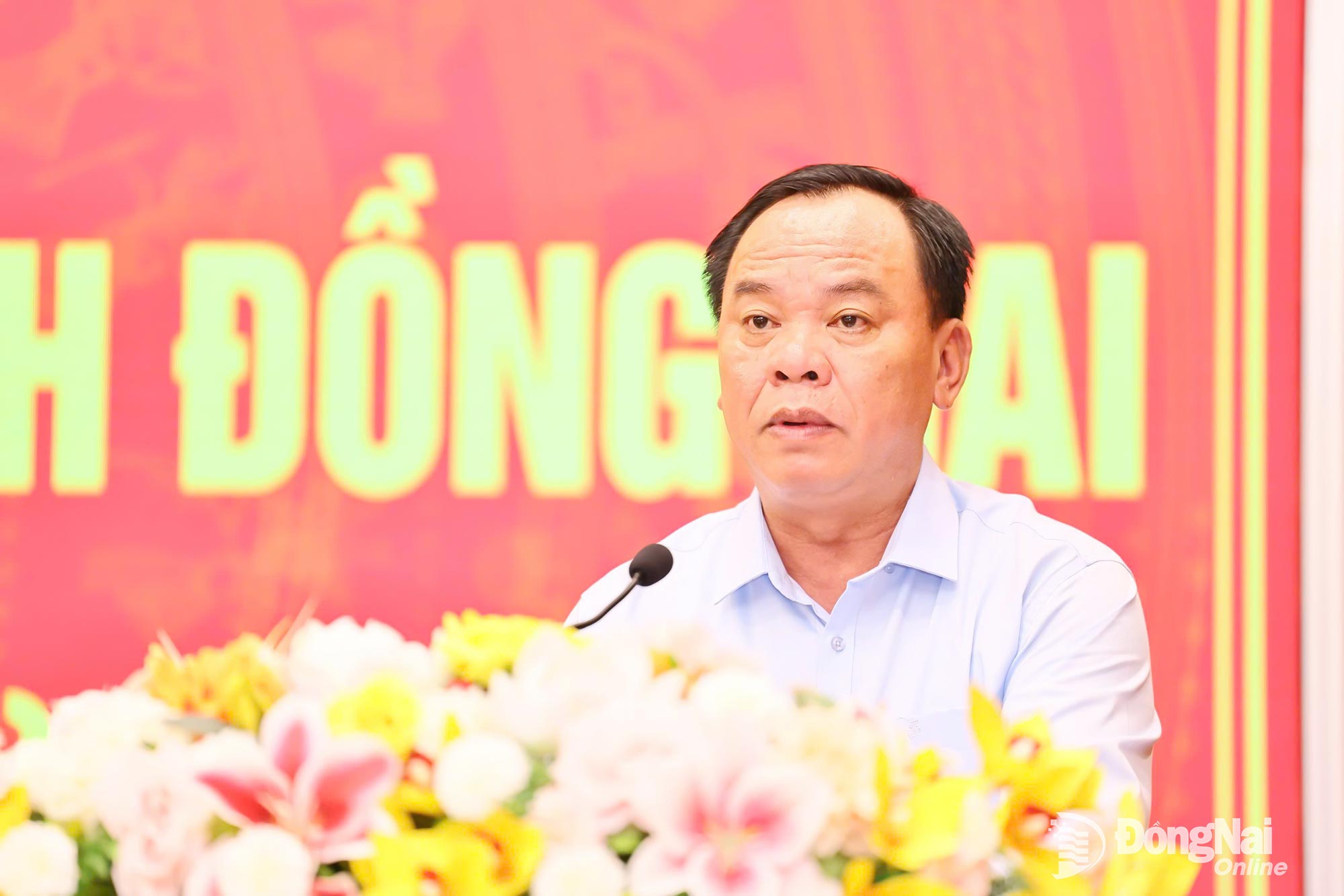 |
| Deputy Secretary of the Provincial Party Committee, Chairman of the People's Committee of Dong Nai province, Vo Tan Duc, provides information on the results of implementing and operating the two-tier local government model in Dong Nai province (from July 1, 2025, to September 18, 2025). Photo: Cong Nghia |
At the conference, Deputy Secretary of the Provincial Party Committee, Chairman of the People's Committee of Dong Nai province Vo Tan Duc reported on the results of implementing and operating the two-tier local government model in the province (from July 1, 2025, to September 18, 2025).
The Chairman of the Provincial People's Committee noted that since the official launch of the two-tier local government model on July 1, 2025, under the strong and synchronous leadership of the Provincial Party Committee and the Party Committee of the Provincial People’s Committee, the new administrative apparatus has quickly stabilized, ensuring smooth operations without disruption, and has achieved initial positive outcomes across various aspects of work.
So far, the Provincial People’s Council has held four sessions and issued 28 key resolutions, providing a legal framework for organizational structure, personnel, finance, budget, and related policies.
13 out of 14 provincial-level specialized agencies have issued regulations on their functions and duties. At the commune level, 86 out of 95 communes and wards have promulgated working regulations for both the People’s Council and the People’s Committee, and 86 out of 95 communes and wards have also issued regulations on the functions and duties of their specialized divisions.
In addition, the province has completed the consolidation of 14 specialized agencies under the Provincial People’s Committee, 34 public service units, and 8 state-owned enterprises. All communes and wards have established Fatherland Front Committees. All key leadership positions at the commune level have been filled. 2,624 cases have been approved for support policies for early retirement or termination of employment. Large-scale training and professional development courses have been organized for thousands of commune-level officials and civil servants across multiple fields, including home affairs, inspection, agriculture, and environment.
 |
| Delegates attend the conference. Photo: Cong Nghia |
The Provincial People’s Committee has also addressed surplus office facilities following the restructuring of the two-tier administrative units and the provincial merger, allocating an additional 178 billion VND for communes and wards to repair headquarters and strengthen facilities. Housing, accommodations, and shuttle services have been arranged for cadres, civil servants, and public employees transferring from the former Binh Phuoc province to work in the new Dong Nai province.
In terms of administrative reform and digital transformation, from July 1 to September 16, 2025, the province received 350,164 dossiers, with an on-time processing rate of 99.12%. To date, all communes and wards have been equipped with online meeting systems. Shared digital platforms such as the Document and Executive Management System (Dnai-S) and the Public Administrative Procedures Information System (iGate) have been operating smoothly.
According to Chairman of the Provincial People's Committee Vo Tan Duc, alongside these achievements, the operation of the two-tier local government model has also revealed certain shortcomings and limitations. Specifically, a large volume of tasks transferred from the district to the commune level has caused an overload for commune-level officials and civil servants. There are localized shortages of personnel in key areas such as land administration–construction, finance–accounting, and information technology. The qualifications and skills of a segment of commune-level officials and civil servants remain limited, falling short of task requirements in the context of digital transformation.
Disparities also remain in allowances between Party and government agencies, while staffing quotas allocated by the central government do not fully match the province’s socio-economic development realities.
The absence of specialized divisions in Phu Ly and Dak Lua communes has led to difficulties: Lack of specialized focal points has caused delays and omissions in task execution; incompatibility with specialized software has affected administrative procedure processing for citizens. Meanwhile, other communes with similar conditions but retaining specialized divisions continue to operate effectively.
Some communes and wards, after restructuring, have had to operate in scattered or downgraded headquarters with insufficient space. In remote areas, many office facilities are outdated and low in capacity, negatively affecting work efficiency.
 |
| Delegates attend the conference. Photo: Cong Nghia |
Network transmission line in some areas remains unstable. Data integration and sharing with national databases and those of ministries and sectors still face numerous shortcomings, with frequent errors occurring. The legal framework from the central government is still incomplete and inconsistent, causing confusion in the application process.
Comrade Vo Tan Duc stated that to overcome these shortcomings and limitations and continue improving the model, the province has identified seven key task groups, including strengthening leadership, direction, and supervision to promptly resolve grassroots-level difficulties and obstacles; effectively carrying out political and ideological work to build social consensus; further consolidating organizational structure and personnel, fully implementing policies, and developing a roadmap for streamlining staffing in the 2026–2031 period; promptly issuing comprehensive regulations and working procedures while promoting decentralization and delegation of authority.
The province will also continue to address policies for cadres, civil servants, public employees, workers, and non-specialized commune-level staff in line with central and government direction; review and assess the personnel organization and operational models of villages and residential groups to promptly propose restructuring plans when directed by the central government; intensify the application of science, technology, and digital transformation; further streamline and improve the efficiency of public service units; and continue pushing forward administrative reform to enhance service quality and public and business satisfaction.
By Phuong Hang, Cong Nghia - Translated by Dang Huyen, Thu Ha


Thông tin bạn đọc
Đóng Lưu thông tin