
The Loc Hoa lithophone, recognised as a national treasure, is not only a testimony to an ancient culture, but is also being given new vitality through the hands of the younger generation.
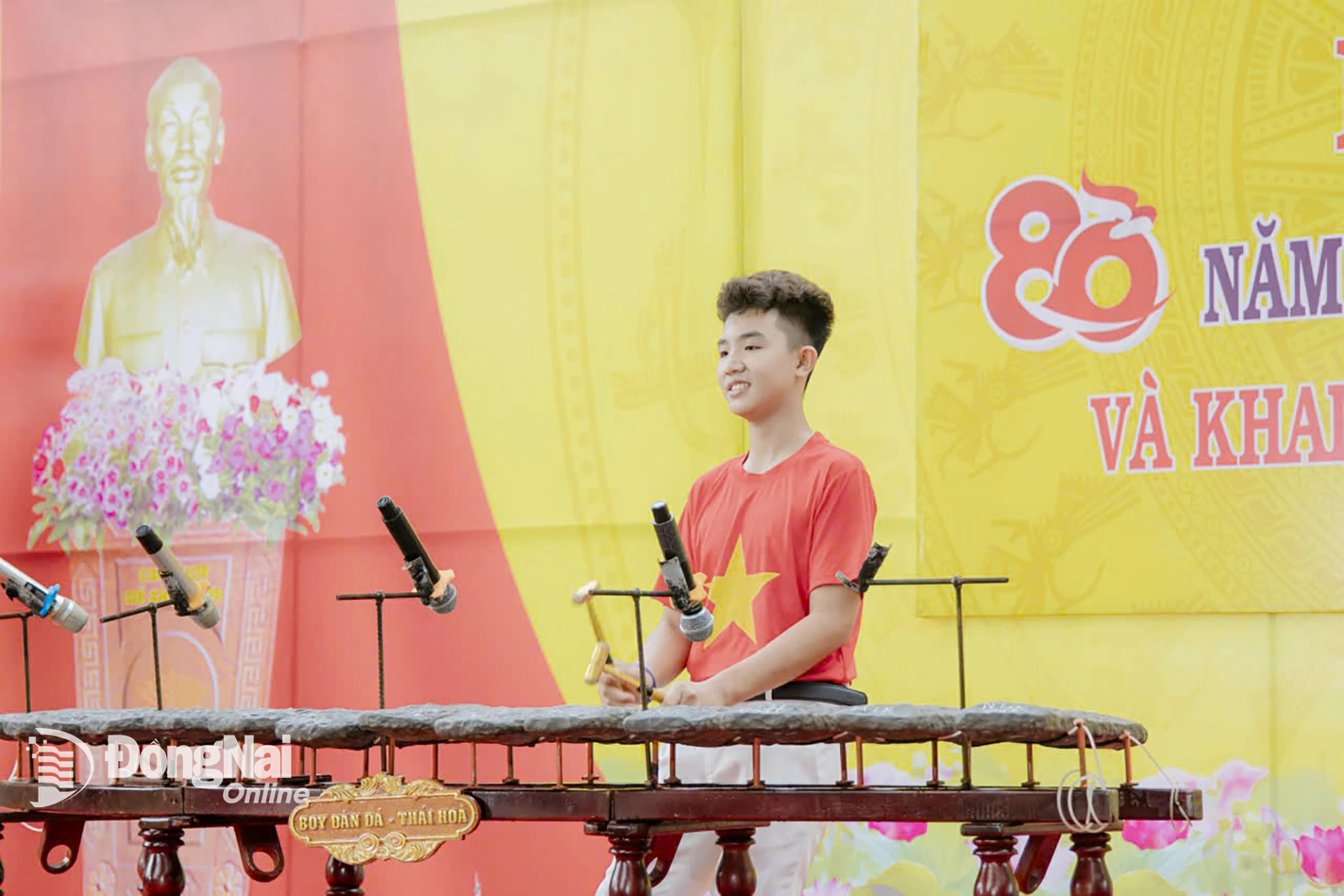 |
| Nguyen Thai Hoa, a student of Loc Ninh Secondary School, dreams of becoming an ambassador, connecting the world with Vietnam through the proud melodies of the nation. |
The story of Nguyen Thai Hoa, a seventh grader at Loc Ninh townlet Secondary School (Loc Ninh Commune, Dong Nai Province), who is passionate about the lithophone and has just won first prize at the Dong Nai Province Pink Melodies Festival 2025, stands as a vivid testament to the journey of preserving and promoting heritage through love and national pride.
Bringing the Loc Hoa lithophone into schools
Discovered in Loc Hoa commune (now Loc Thanh, Dong Nai province), the Loc Hoa lithophone has become a unique cultural symbol of the borderland. The lithophone set, consisting of 14 stone slabs and dating back more than 3,000 years, is considered among the oldest percussion instruments of humankind, demonstrating the refined craftsmanship of prehistoric communities. It serves as compelling evidence of the rich history and long-standing human presence in the region. The lithophone has been listed by the United Nations Educational, Scientific and Cultural Organization (UNESCO) among the instruments of the Central Highlands gong cultural space.
Beyond its archaeological significance, the lithophone today is being preserved and widely promoted. Recently, Dong Nai province invested in the production of 50 lithophone sets for schools, agencies, and communities, and organised training courses, competitions, and festivals. These activities have turned the lithophone into a “bridge” between the past and the present.
Nguyen Thi Kim Chi, Principal of Loc Ninh Secondary School, said: “The policy on introducing the Loc Hoa lithophone into schools has created a meaningful platform, enabling students to discover and develop the values of traditional instruments from an early age. This is not only a way to nurture young talents but also to instill the love for national culture and pride in local heritage.”
The lithophone is one of the oldest percussion instruments of Vietnam and also one of the world’s most primitive musical instruments. It is crafted from stone slabs of varying length, thickness, and size. Larger and thicker slabs produce deeper tones, while smaller and thinner slabs generate brighter ones. Ancient people utilised natural stone types from the mountains of the South Central and Southeast regions to create these instruments.
Associate Professor and archaeologist Bui Chi Hoang, Deputy Director of the Southern Institute of Social Sciences and Head of the appraisal team for the Loc Hoa lithophone
A seventh grader’s dream to bring the lithophone to the world
In fact, the lithophone is not only confined to exhibition halls, but it also resonates on school stages, in cultural contests, and at community festivals. Its appeal is amplified when placed in the right hands, such as those of Nguyen Thai Hoa. At the age of 12, he discovered his passion for the lithophone and won first prize in the solo category at the 2025 Dong Nai “Pink age Melody” contest.
Hoa recalled: “The first time I learned about the lithophone was in May 2024, when I began practicing it from then on. For me, practicing the lithophone is the most relaxing part of the day, when I can fully immerse myself in the sound I love. On stage, I simply tried my best, and the moment I heard the announcement of the first prize, I was truly happy, because my hard work had finally been recognised.”
For Hoa, each note is more than just sound; it embodies a part of national culture. He aspires to “renew” the lithophone, making it closer to his peers. He has experimented with integrating the lithophone into children’s music, contemporary tunes, and even revolutionary songs, producing surprising and captivating results.
Behind his success is the devoted support of his parents. His mother carefully prepared costumes and performance ideas, while his father quietly accompanied him to contests, adjusted each stone slab, and even built a wooden frame so that Hoa could practise comfortably.
Nguyen Linh, Hoa’s father, shared: “We always stand by our son. The lithophone is part of our cultural heritage, so we are even more supportive. Whether he pursues art in the future or not, we will always be there for him.”
Hoa’s passion has also inspired his younger sister, Nguyen Kieu Mai Phuong, a primary school student, who recently won first prize in the solo category at the same contest. Admiring her brother as a role model, she dreams of one day performing alongside him on a grand stage.
Coming from modest backgrounds, both children have discovered a profound passion for contributing to the preservation of the nation's cultural traditions. Their story affirms that traditional music can shine brightly in today’s life when nurtured with youthful creativity and love. The journey of Thai Hoa and Mai Phuong is not only a personal joy but also shows the right direction in bringing cultural heritage into schools, inspiring national pride in the younger generation. When the youth learn to love, innovate, and cherish traditional instruments, the nation’s cultural legacy will never be forgotten. Instead, it will remain deeply rooted in every Vietnamese heart and resonate further across new horizons.
By Dao Bang - Translated by Thuc Oanh, Thu Ha


Thông tin bạn đọc
Đóng Lưu thông tin