
Grand Lord Hung Dao, real name Tran Quoc Tuan, was a talented military leader who, together with the Tran dynasty’s army and people, achieved three great victories over the Mongol-Yuan invaders. In February 1984, Tran Hung Dao was honored by the Royal British Scientific Society as one of the ten greatest military generals in the world.
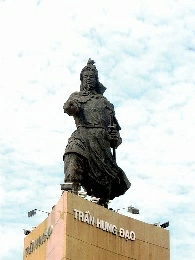 |
Above all, in the hearts of the people, Lord Hung Dao is remembered as a great general, a noble personality, and a revered saint.
Three great victories over the Mongol-Yuan invaders
According to Dai Viet su ky toan thu (The Complete Annals of Dai Viet): “In the ninth lunar month (1257 - editor’s note), an imperial edict was issued ordering the generals to lead naval and infantry troops to guard the border under the command of Quoc Tuan” (1), upon receiving news that the Mongol-Yuan forces were preparing their first invasion of our country (“In the twelfth lunar month, Yuan general Uriyangkhadai invaded Binh Le plain”). This shows that Lord Hung Dao took part in the very first battle against the Mongol-Yuan invaders, although “the king and crown prince boarded the dragon boat, advanced to East wharf, engaged the enemy, and defeated their forces.”
When the Mongol-Yuan forces returned to invade our country for the second time, our troops were defeated at Kha Li and Ngoc Chau, then withdrew to Chi Lang Pass and later Van Kiep. Concerned about the situation, King Tran Nhan Tong consulted Tran Quoc Tuan, saying: “We should surrender to save the people.” Tran Quoc Tuan replied: “Your Majesty may cut off my head first, then surrender to the enemy.” In the tenth lunar month of the year of the Goat (1283), “King Nhan Tong appointed Lord Hung Dao as National Duke and Commander-in-Chief of all naval and land forces, numbering 200,000, to fight the enemy” (2).
At the beginning of the year of the Rooster (1285), Lord Hung Dao launched a counteroffensive, and our army won a decisive victory. The battle of Chuong Duong port paved the way for our forces to advance toward Thang Long. The Mongolian commander-in-chief Thoat Hoan fled back to his country. Within six months (from the twelfth lunar month of the year of the Monkey 1284 to June of the year of the Rooster 1285), under the command of Lord Hung Dao, our forces drove 500,000 Mongol troops out of the national territory (3).
In the second lunar month of the year of the Pig (1287), Thoat Hoan led his troops to attack to take revenge. Initially, the Mongol-Yuan forces gained victories, forcing our army to retreat to Van Kiep and then withdraw to Thang Long. Thoat Hoan’s assault on Thang Long failed, and he pulled back to Van Kiep, where all his army’s supplies were seized all by our forces. Our army launched a counteroffensive on the Bach Dang river. Pointing to the Hoa river, Lord Hung Dao swore: “If this battle does not end in the defeat of the Yuan enemy, I will not return to this river.” Our forces won a complete victory. Thoat Hoan and his generals fled back to their country (4).
Lord Hung Dao Tran Quoc Tuan left behind many valuable works on military art, such as Du chu ty tuong hich van (commonly known as the Exhortation to the Military Generals), Binh thu yeu luoc (Essentials of Military Strategy) and Van Kiep tong bi truyen thu (Secret Transmission of Military Tactics), among others.
A noble personality
According to legend, shortly before his death, Tran Lieu (father of Tran Quoc Tuan) held his son’s hand and said: “If you do not overthrow the throne, I will not rest in peace” (5). Tran Quoc Tuan kept these words in his heart but did not consider them righteous. Although his father had deep grievances with King Tran Thai Tong, Tran Hung Dao always placed national interests above all else, remaining loyal and wholeheartedly supporting the Tran kings in defending the country against foreign invaders.
Tran Quoc Tuan and Tran Quang Khai had inherited grievances from previous generations, which left lingering suspicions between them. However, Tran Quoc Tuan took the initiative to bathe Tran Quang Khai, after which the two grew close, building mutual trust, and increasingly deepening their bond (6). It can be said that Tran Quoc Tuan set aside his own feud to build solidarity and unity in driving out foreign invaders.
In addition to his talent for employing people and commanding troops with military prowess, Lord Hung Dao also recommended capable individuals to serve the country, such as Da Tuong and Yet Kieu (originally his household servants and slaves) (7) who rendered great service in defeating O Ma Nhi and Toa Do. Other renowned figures included Pham Ngu Lao (who came from a farming background) (8), Tran Thi Kien, Truong Han Sieu, Pham Lam, Trinh Du, Ngo Si Thuong, and Nguyen The Truc, all of whom began as his followers and later distinguished themselves in both literature and statecraft. All of them became well known for their literary and political achievements. Thanks to his strategic brilliance, heroic spirit, and unwavering respect for loyalty and righteousness, he was able to gather and keep many virtuous talents by his side.
Supreme deity - Saint Tran Hung Dao
When “the realm was at peace, tranquility prevailed in all corners of the nation, the harvests were abundant for years, and the people lived in joy, the Retired Emperor recalled the great merits of Grand Lord Hung Dao. He ordered officials to restore his former residence at Van Kiep into a magnificent ancestral shrine, so that Grand Lord Hung Dao would be honored while still alive. The Retired Emperor himself composed an epitaph, recounting his achievements, comparing him to Grand Duke Jiang of the Zhou dynasty. Throughout the year, officials were dispatched with offerings to conduct solemn rites at the temple where he was worshipped during his lifetime.” (9).
After his passing, the people honored him as Saint Tran (also known as Cuu Thien De). Since the temple was established at Van Kiep, both communes of Van An and Duoc Son have been worshiping him day and night.
 |
| Temple of Great General Tran Hung Dao in Long Thanh commune |
In Dong Nai province, there are temples worshiping Tran Hung Dao in Binh Son commune, former Long Thanh district (now Long Thanh commune) and in Tan Tien ward, former Bien Hoa city (now Tam Hiep ward).
In the early days of leaving their northern homeland to work as rubber workers in Binh Son, the poor farmers carried little more than a few sets of clothes and basic household items. However, with the belief that their ancestors and deities from their native land would protect them in the new settlement, they brought along with them a copy of the imperial edict issued by Emperor Tu Duc conferring the title of Supreme Deity Tran Hung Dao at the Bao Loc temple (Nam Ha), and enshrined it in their new home in Binh Son. At the end of 1926, the plantation workers in Binh Son submitted a petition (enclosing the copied imperial edict they had brought from their homeland) to the plantation owner, requesting permission to build a temple to worship Tran Hung Dao.
In response to the legitimate wishes of the rubber plantation workers, the French authorities agreed to allow them to build a small temple made of thatch and bamboo at their settlement. Each year, from the 18th to the 20th day of the eighth lunar month, the death anniversary of Tran Hung Dao was solemnly commemorated in accordance with the nation’s traditional god worship rituals.
Over time, the temple fell into disrepair. In 1930, 1939, and 1997, the temple’s Board of Trustees, together with rubber plantation workers and local residents of Binh Son, contributed funds and efforts to restore and repair the temple. In 1998, temple’s Board of Trustees and Binh Son people built a memorial stele house within the temple grounds to commemorate the heroic martyrs of Binh Son commune who sacrificed their lives in the two resistance wars. Since then, the temple has been constantly restored, embellished, cared for, protected and preserved by the Binh Son people, becoming increasingly spacious and beautiful.
In Tan Tien ward, formerly part of Bien Hoa city (now Tam Hiep ward), the temple of Lord Hung Dao was built in 1954 by Tap Thien Association. The head of the association was Nguyen Xuan Dieu. The original temple was a main hall with wooden plank walls and a corrugated iron roof. In 1960, Tap Thien Association used its own funds to renovate and repair the temple, rebuilding the main hall and expanding it into three sections with brick walls, wooden columns and beams, and a corrugated iron roof. Three additional kitchen sections were constructed at the back, along with ceremonial arrangements and altars to worship the founders and benefactors of the temple.
By Nguyen Son Hung - Translated by Huyen Trang, Thu Ha
(1) Dai Viet su ky toan thu (Complete Annals of Dai Viet), translated by Cao Huy Giu, revised by Dao Duy Anh, Hong Duc Publishing House, 2025, pp. 353-355.
(2) Tri tan nhan vat chi tap chu, Nguyen Phuc An, Ho Chi Minh City General Publishing House, 2023, p. 259. The same book, on p. 263, states that the Retired Emperor feigned asking Lord Hung Dao about surrendering to the enemy.
(3) Tri tan nhan vat chi tap chu (cited book, p. 260).
(4) Tri tan nhan vat chi tap chu (cited book, p. 261).
(5) In the year of Rooster (1237), Grand Chancellor Tran Thu Do forced Tran Lieu (father of Tran Hung Dao) to give up his wife, Princess Thuan Thien (sister of Ly Chieu Hoang), to his younger brother, King Tran Thai Tong (Tran Canh), even though she was already three months pregnant with Tran Lieu’s child, and demoted Ly Chieu Hoang (who was the Empress) to princess. Out of outrage, Tran Lieu gathered troops to rebel. King Tran Thai Tong, disheartened and retreated to Yen Tu. Eventually, realizing he could do nothing, Tran Lieu disguised himself as a fisherman and escaped onto King Tran Thai Tong's boat to ask for forgiveness. When Tran Thu Do found out, he drew his sword intending to execute Tran Lieu, but King Thai Tong shielded him with his own body. Tran Lieu was pardoned, though the soldiers who had followed him were all killed.
(6) Nguyen Thanh Diep, August 28, 2024, Education and Times.
(7) Yet Kieu was later conferred the title of Grand Lord Tinh Muc Hien Minh Chieu Ung, and acted as the tutelary deity of Ha Bi village, Hai Duong, in the book Lord Hung Dao (Phan Ke Binh, Le Van Phuc, p. 204, same reference).
(8) Later, Pham Ngu Lao was assigned to lead campaigns against Ai Lao and Champa. In recognition of his significant achievements, he was appointed as Tien Thuong Tuong Quan. After his death, Phu Ung village established a temple in his honor as a protective deity (Phan Ke Binh, Le Van Phuc, p. 204, same reference).
(9) Phan Ke Binh, Le Van Phuc, p. 191, same reference.


Thông tin bạn đọc
Đóng Lưu thông tin