
(ĐN) - Through strategic planning, energy transition, green industrial development, environmental protection, and improvements in residents' quality of life, Dong Nai Province is undergoing a gradual transformation. The province is not only aiming for high economic growth but is also firmly committed to sustainable development.
 |
|
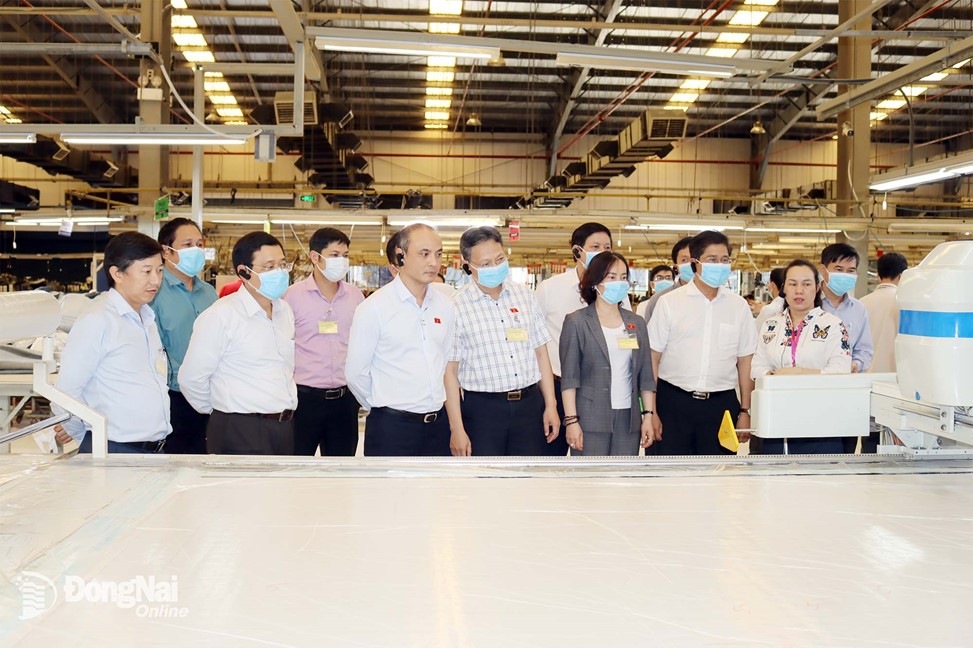
A National Assembly supervisory delegation conducts a field visit to a business in Amata Industrial Park, Long Binh ward, Dong Nai province. Photo: Hoang Loc |
This undertaking represents both a transformation of the economic model and a clear affirmation of the province's strategic vision and political commitment, contributing to the nation's pursuit of prosperity and happiness.
Economic model transformation - An imperative
For years, Dong Nai has affirmed its position as one of Vietnam's major industrial centers, making important contributions to the national budget and export turnover. However, alongside these economic gains, the province is also facing a number of pressing challenges. Urbanization has placed heavy pressure on transportation and water infrastructure, while air and water quality continue to decline. Meanwhile, rapid population growth is straining social welfare systems, particularly in housing, healthcare, and education.
In this context, transforming the growth model from one that relies on resource exploitation and low-cost labor to a green and sustainable approach has become an urgent necessity. This shift not only aligns with international commitments to reducing emissions and mitigating climate change but is also essential for maintaining investment attractiveness, enhancing competitiveness, and ensuring a high quality of life for residents.
Recognizing this imperative, the provincial government has issued several key policies and action plans, such as the Carbon Emissions Reduction Plan for the 2021-2030 period with a vision to 2050, the Sustainable Production and Consumption Action Plan for the industrial sector (2022-2030), and the establishment of a Provincial Green Growth Steering Committee.
Notably, the Dong Nai Provincial Master Plan for 2021-2030, with a vision to 2050, integrates green growth and sustainable development across all sectors and development strategies. Spatial planning is being designed to balance industry, urbanization, agriculture, and natural ecosystems. In addition to expanding high-tech industrial zones, the province is also planning green riverside and suburban urban areas, along with environmentally friendly public transport systems. These elements form the foundation for Dong Nai to drive economic growth while maintaining environmental balance and improving residents' quality of life.
One of the most visible outcomes of this strategy is in the energy sector. On August 19, the expansion project for Tri An Hydropower Plant, the largest of its kind in southern Vietnam, officially commenced. Meanwhile, the Nhon Trach 3 and 4 Power Plants, Vietnam's first projects using liquefied natural gas (LNG), are expected to begin commercial operation in the coming months. These developments mark significant progress in the province's green transition and emissions reduction. Additionally, multiple waste-to-energy plant projects are in the pipeline, and thousands of businesses and households have installed rooftop solar panels to supplement the national grid supply.
Vo Tan Duc, Deputy Secretary of the Provincial Party Committee and Chairman of the Dong Nai People's Committee, emphasized: "The Tri An Hydropower Plant expansion not only adds vital capacity to the national grid and supports Dong Nai's ambition for double-digit growth, but also represents a concrete step toward achieving net-zero emissions by 2050, as committed by Vietnam at COP26."
In the industrial sector, the green shift has become a key strategy for businesses seeking sustainable growth and improved competitiveness. Many companies have proactively upgraded their production lines, adopted modern technologies, and reused waste materials to meet market demands and comply with environmental regulations. Notably, major corporations such as Nestlé, Ajinomoto, Cargill, and Bosch have all announced emission reduction roadmaps and carbon neutrality targets.
Binu Jacob, CEO of Nestlé Vietnam, shared that the circular economy model is being implemented across all Nestlé factories. At the Nestlé Tri An Plant in Dong Nai, all processed coffee grounds are reused as biomass fuel; ashes and residue are recycled into materials for the production of unbaked bricks; and treated wastewater is reused in manufacturing processes. Additionally, Nestlé supports farmers in adopting regenerative agriculture practices for coffee cultivation, which reduces water and fertilizer usage. The company is also transitioning its packaging to recyclable and reusable alternatives.
In the coming years, Dong Nai will continue to innovate its growth model vigorously, promoting industrialization and modernization, while focusing on science and technology, innovation, digital transformation, green transformation, the circular economy, and the sharing economy as the main driving forces. The province will also prioritize environmental protection, climate change adaptation, and the development of cultural, social, health, and educational sectors in line with the economy, continually working to improve people's living standards.
Deputy Secretary of the Provincial Party Committee and Chairman of Dong Nai Provincial People's Committee, Vo Tan Duc
Vision for the new development phase
According to Vo Tan Duc, Deputy Secretary of the Provincial Party Committee and Chairman of the Dong Nai People's Committee, the province aims to become a fully developed, modern, and sustainable area by 2030, with green growth as a strategic focus. Investment attraction will continue to emphasize high-tech, low-emission, labor-efficient industries. Major infrastructure projects, including airports, seaports, and transportation systems, will be developed sustainably to minimize their environmental impact.
With over 84% of its natural land dedicated to agriculture and diverse terrain and soil conditions, Dong Nai has favorable conditions for creating large-scale specialized farming zones for industrial crops, fruit orchards, and livestock. The province plans to incorporate science and technology to increase productivity and reduce emissions. It will also uphold policies to preserve and enhance natural forests, protect groundwater, promote forest-based economies, and work toward establishing a carbon credit market.
A representative from Hyosung Vietnam Co., Ltd., one of the province's leading investors located in Nhon Trach District, noted that due to their products serving as raw materials for many industries, adopting circular economy practices is essential. The company focuses on maximizing resource efficiency, reducing emissions through advanced technologies, utilizing renewable energy, and designing products with long lifespans.
Since 2020, Amata Industrial Park in Long Binh ward has been piloting an eco-industrial park model. Treated wastewater is reused, rooftop solar panels generate on-site energy, and organic waste is composted into fertilizer. Initial forms of industrial symbiosis among enterprises are beginning to take shape. The park aims to obtain official certification as an eco-industrial zone and serve as a model for the transformation of other industrial parks across the province.
Trinh Tien Dung, Chairman of the Board and CEO of Dai Dung Mechanical Construction & Trading Corporation (Ho Chi Minh City), shared that his company is currently developing the province's first green industrial cluster in Gia Kiem Commune. The workshops are pre-designed for solar panel installation and equipped with systems to maximize wastewater reuse, while also encouraging industrial symbiosis. This model offers a competitive edge in attracting investment and securing favorable policies.
In the real estate sector, Dang Van Thanh, Chairman of TTC Group (Ho Chi Minh City), stated that the group is developing a smart eco-urban project along the Dong Nai River in Bien Hoa ward. Designed with low construction density, abundant green space, and a full range of amenities, including international schools, shopping centers, sports and entertainment complexes, and riverside parks, the project aims to create a sustainable and human-centered living environment.
Dong Nai's green growth journey signifies an evolution of economic models, an enhancement of residents' quality of life, and a strong foundation for long-term development.
By: Hoang Loc
Translated by: Hong Van - Minho


Thông tin bạn đọc
Đóng Lưu thông tin