
The first Party Congress for the 2025-2030 tenure of Phu Hoa commune marks a particularly significant milestone in its construction and development process following the administrative merger. The Party organization, authorities, armed forces, and residents in the whole commune are continuing to uphold unity, patriotism, dynamism, and creativity, with a strong determination to fulfill the tasks set out by the commune Party Congress for the new tenure.
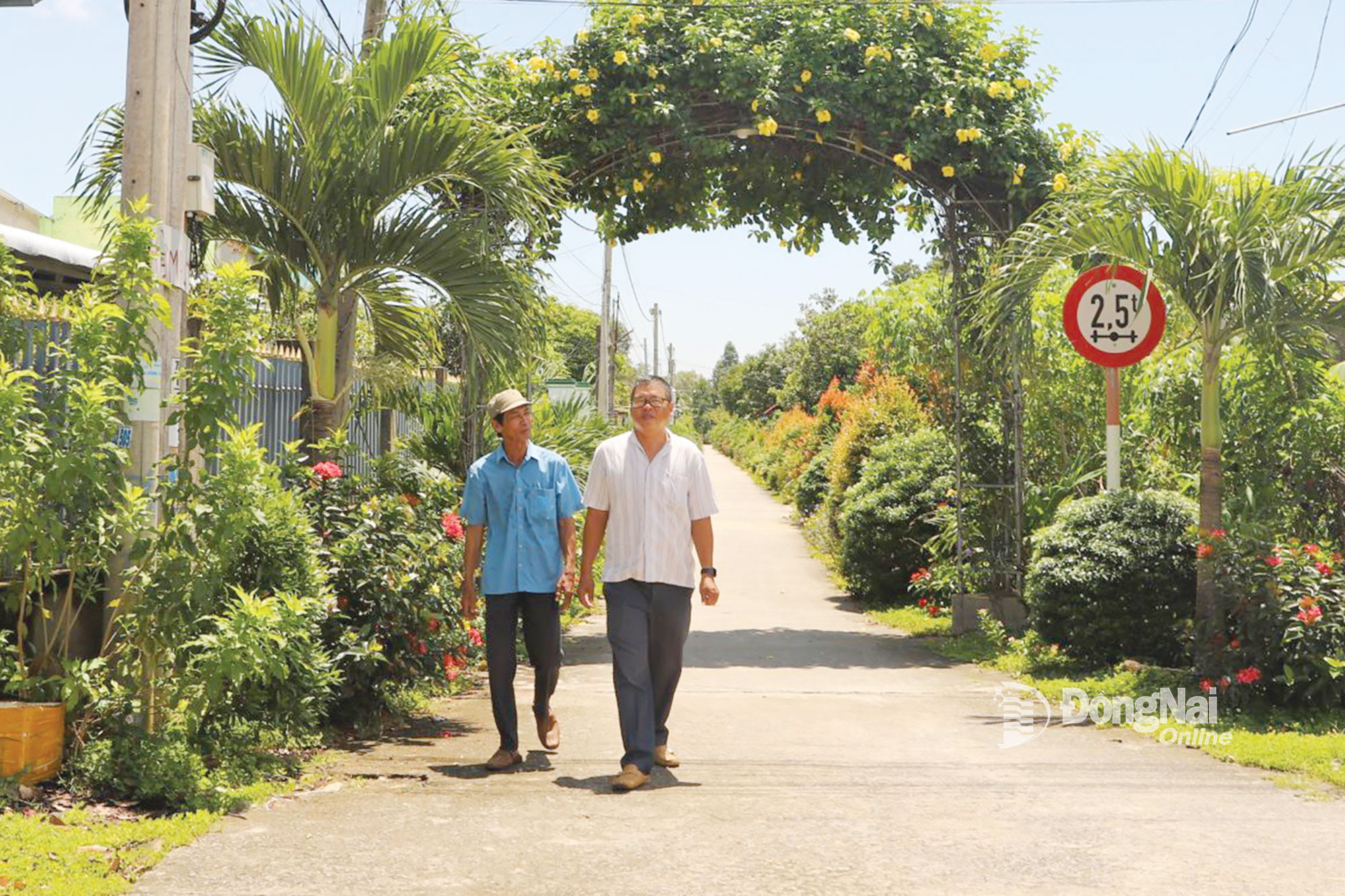 |
| A model road in Phu Dien 4 hamlet is planted with various valuable ornamental trees thanks to contributions from local benefactors. Photo: B. Nguyen |
The commune will focus on three key breakthrough missions: developing agriculture towards green, ecological, and circular production linked to value chains; promoting the tourism potential associated with agriculture; and building a contingent of officials, civil servants, and public employees capable of meeting the requirements of a two-tier local administration and digital transformation.
A livable countryside
During the 2020-2025 tenure, Phu Hoa commune achieved remarkable socio-economic results. The economic structure shifted in the right direction; agricultural production remained stable, people’s incomes increased, and infrastructure was invested in synchronously. Basic construction works were invested in, enabling the commune to meet the standards of an exemplary new-style rural area, with total funding of over 79 billion VND. Rural infrastructure was synchronously developed, with 100% of hamlet roads leading to residential clusters and production zones concreted or asphalted. The systems of electricity, roads, schools, medical stations, and clean water supply were properly invested in. Such comprehensive investment in rural infrastructure has boosted production, facilitated the circulation of goods, and thereby improved incomes as well as the spiritual life of local residents.
Agricultural production recorded stable growth, increasingly shifting towards commercial production with the gradual application of high technology, processing, and market consumption, shifting from traditional, small-scale agricultural production to a specialised agricultural economy with intensive farming. The commune has transformed crop structures in line with soil conditions and market demand, focusing on durian, cocoa, jackfruit and vegetables. The “One Commune – One Product” (OCOP) programme has been promoted, with seven products rated three stars or higher, including two five-star products, which have helped build brands and enhance the market value of local agricultural produce.
Throughout the process of agricultural and rural development, farmers have always been the key actors, playing a central role in applying scientific and technological advances to production, promoting mechanisation, and contributing to the building of new-style rural areas.
Ngo Thi Giup, Head of Residential Cluster 16 in Phu Hoa 4 hamlet, is a respected Party member among the ethnic minority. Despite her age, she actively encourages people to participate in new-style rural development, sharing her farming experience so that others can follow.
She recalled that before the construction of new-style rural areas, people's lives were difficult, roads were undeveloped, and incomes were low, as most farmers grew rice. Thanks to the new-style rural model, the area has become increasingly prosperous and beautiful, with residents’ consensus playing a decisive role.
According to Giup, mobilizing ethnic minority communities is not a matter that can be achieved overnight, nor is it sufficient to simply convene meetings whenever necessary for propaganda purposes. To carry out effective mobilisation, cadres must truly be close to the people. They need to understand the daily lives and work of local residents, and set an example by taking the lead in all movements. Only when the people trust and respect their cadres will they actively participate in local activities. When the entire community comes together, major undertakings such as donating land and contributing funds for road construction, as well as smaller daily tasks like cleaning public spaces, planting flowers, and maintaining model roads, can all be successfully accomplished.
Tran Nam Bien, Secretary of the Party Committee and Chairman of the Phu Hoa commune People's Council, stressed that the commune was established through the merger of Phu Loi, Phu Hoa (former Dinh Quan district) and Phu Dien (former Tan Phu district) – all of which had achieved the model new-style rural standards. The most significant outcome of building the model new-style rural communes is that Phu Hoa has truly become a livable countryside today. Among the most notable achievements is that by 2025, the average income per capita is expected to exceed 90 million VND, representing a 52.7% increase from 2020.
For the 2025-2030 tenure, the commune sets out multiple groups of solutions with the goal of increasing the value of agricultural, forestry and fishery production by an average of 4-4.5% per year. It will encourage the development of industries and handicrafts suitable to local conditions and advantages, such as the processing of agricultural, forestry, and aquatic products, as well as handicrafts, weaving, small-scale mechanics, garment making, and household woodwork. The commune will also study and propose plans for industrial zones that serve the deep processing and preliminary processing of agricultural products, aiming to enhance added value. This will create favourable conditions to attract enterprises to invest in processing and preserving post-harvest products, gradually forming agricultural value chains, reducing post-harvest losses, and stabilising the output of local agricultural products.
Deputy Secretary of the Party Committee, Chairman of Phu Hoa commune People’s Committee NGUYEN VAN VIEN
Developing eco-tourism for the countryside
The Resolution of the first Phu Hoa commune Party Congress, for the 2025-2030 tenure, focuses on comprehensive leadership and direction across all fields, without overlooking any aspect, to ensure the harmonious development of objectives. Alongside economic goals, cultural, artistic, and sports activities are also given due attention for all-round development. In particular, the movement "All people unite to build a cultural life" has been closely linked with the campaign "All people join hands to build new-style rural areas and civilised urban areas," creating a widespread emulation drive. Education and training continue to undergo reforms, with quality gradually improving and facilities and teaching equipment being invested in line with national standards. Healthcare and public health services are also prioritized, with facilities and equipment further upgraded, and the commune's medical staff standardized in both professional qualifications and staffing levels as prescribed by regulations. Social welfare, associated with the implementation of the National target programme on sustainable poverty reduction, continues to receive attention from the Party organization, authorities and the whole society, particularly with a focus on policies to support people with meritorious services.
Tran Nam Bien, Secretary of the Party Committee and Chairman of the People's Council of Phu Hoa commune, added that the orientation of the commune's Party organization is to promote comprehensive development across all fields, with greater emphasis on three breakthrough tasks. Specifically, the first goal is to create a breakthrough in developing agriculture towards green, ecological, and circular production, linked to value chains, with a focus on applying science and technology, as well as digital transformation, in the production, processing, and consumption of farm produce. The second is to mobilise resources to develop tourism potential, considering tourism as a new and important economic sector of the locality. The third is to build a contingent of officials, civil servants, and public employees who meet the requirements of the new period, uphold integrity in serving the people, and satisfy the operational demands of the two-tier local administration and digital transformation.
According to Bien, after the two-tier local administration came into operation, the initial workload was immense. However, with the determination to ensure effective governance, the commune's Party organization and authorities have been focusing on consolidating the apparatus, regulations and legal frameworks. The commune is prioritizing administrative reforms to deliver the best services to its residents. With a strong spirit of great national solidarity and its attainment of model new-style rural status, Phu Hoa commune enjoys important advantages to enter the next stage of development. Agriculture remains its strength, and during the 2025-2030 tenure, the commune plans to link agriculture with tourism, identifying tourism as a new and vital economic sector that will help enhance agricultural efficiency.
Phu Hoa boasts fertile rice fields, the Phu Dien lotus fields and Chu Thap Stone, with a peaceful and picturesque rural landscape that is increasingly attracting visitors.
Nguyen Ngoc Son, Secretary of the Party cell and Head of Phu Dien 4 hamlet, shared that to date the hamlet has developed three model residential areas and six model roads that are bright, green, clean and beautiful. Previously, these model roads were planted with annual flowers, which lasted only a few months before replanting was required. Since 2020, they have been planted with various types of flowers and ornamental trees. Notably, more than 2,000 valuable ornamental trees sponsored by benefactors were planted along the model roads. The model residential area and model road initiatives have been effectively implemented in reality, greatly transforming the landscape and rural environment, and contributing to the formation of clean, green, and picturesque ecological villages.
 |
| A large cocoa field in Phu Hoa commune, operated by Ca Cao Trong Duc Co., Ltd., serves as an effective economic model in the locality. Photo: B. Nguyen |
At present, Phu Hoa is emerging as a tourism destination. Among the highlights is the “Cocoa World” rest stop of Ca Cao Trong Duc Co., Ltd., which attracts up to 30,000 visitors per month during the summer. Here, tourists can visit the gardens, experience the harvesting and preliminary processing, and the production of specialty items made from cocoa pods.
Dang Tuong Khanh, Director of Ca Cao Trong Duc Co., Ltd., stated that the province's support policies have enabled enterprises, cooperatives, and farmers to successfully develop large cocoa fields. With nearly 900 hectares under cultivation and an annual output of over 4,000 tonnes of fresh cocoa pods, Dong Nai now has the largest cocoa area and output in the Southeast region. The province and the locality have also paid great attention to and provided strong support for enterprises participating in the OCOP programme. Notably, the company has had two deep-processed products certified with the national five-star OCOP rating. The programme has truly contributed to honouring the locality's agricultural products. In the coming period, the company will continue to increase its investment in deep processing, aligning with the circular agricultural model associated with eco-tourism development, thereby contributing to the advancement of green, circular, and high-value agriculture.
Deputy Secretary of the Party Committee and Chairman of the Phu Hoa commune People’s Committee Nguyen Van Vien stated that the commune also prioritises the development of services to meet both production needs and people’s livelihoods. It will focus on tapping the potential for trade and service development in a suitable and rational manner, in line with the realities and demands of agriculture, industry, production, and rural life. Priority will be given to services that support agricultural production, daily life, and eco-tourism as part of the new-style rural experience.
Attention will also be paid to creating favourable conditions for tourism development so that it gradually becomes a key economic sector of the commune. Enterprises will be called upon to invest in exploiting planned tourist sites, while local people will be encouraged to build and expand eco-tourism, garden tourism, and agricultural tourism models. Tourism will be developed in close connection with the preservation and promotion of traditional cultural and historical values, with an emphasis on communication and the promotion of tourism products.
At the same time, comprehensive development will be promoted in other services, including finance, banking, insurance, information and communications, postal services, transportation, and various production-supporting and business services. Conditions will be created to enable services to develop in a modern and diversified manner, thereby contributing to production, improving people’s living standards, and meeting socio-economic development requirements in the context of integration.
By Binh Nguyen - Translated by Thuc Oanh, Thu Ha


![[Photo series] Admiring the most beautiful riverside road in Dong Nai before its technical traffic opening](/file/e7837c02876411cd0187645a2551379f/012026/nen_20260114174655.jpg?width=500&height=-&type=resize)
Thông tin bạn đọc
Đóng Lưu thông tin