
In the context of the entire country entering a new stage of development that demands rapid and sustainable growth, the Politburo issued Resolution No. 57-NQ/TW on December 22, 2024, identifying science and technology, innovation, and digital transformation as one of the four national breakthrough pillars. From Dong Nai's practical context, it is evident that the province is accumulating numerous favorable conditions to transform that pillar into a key driving force, while also confronting substantial challenges that must be addressed.
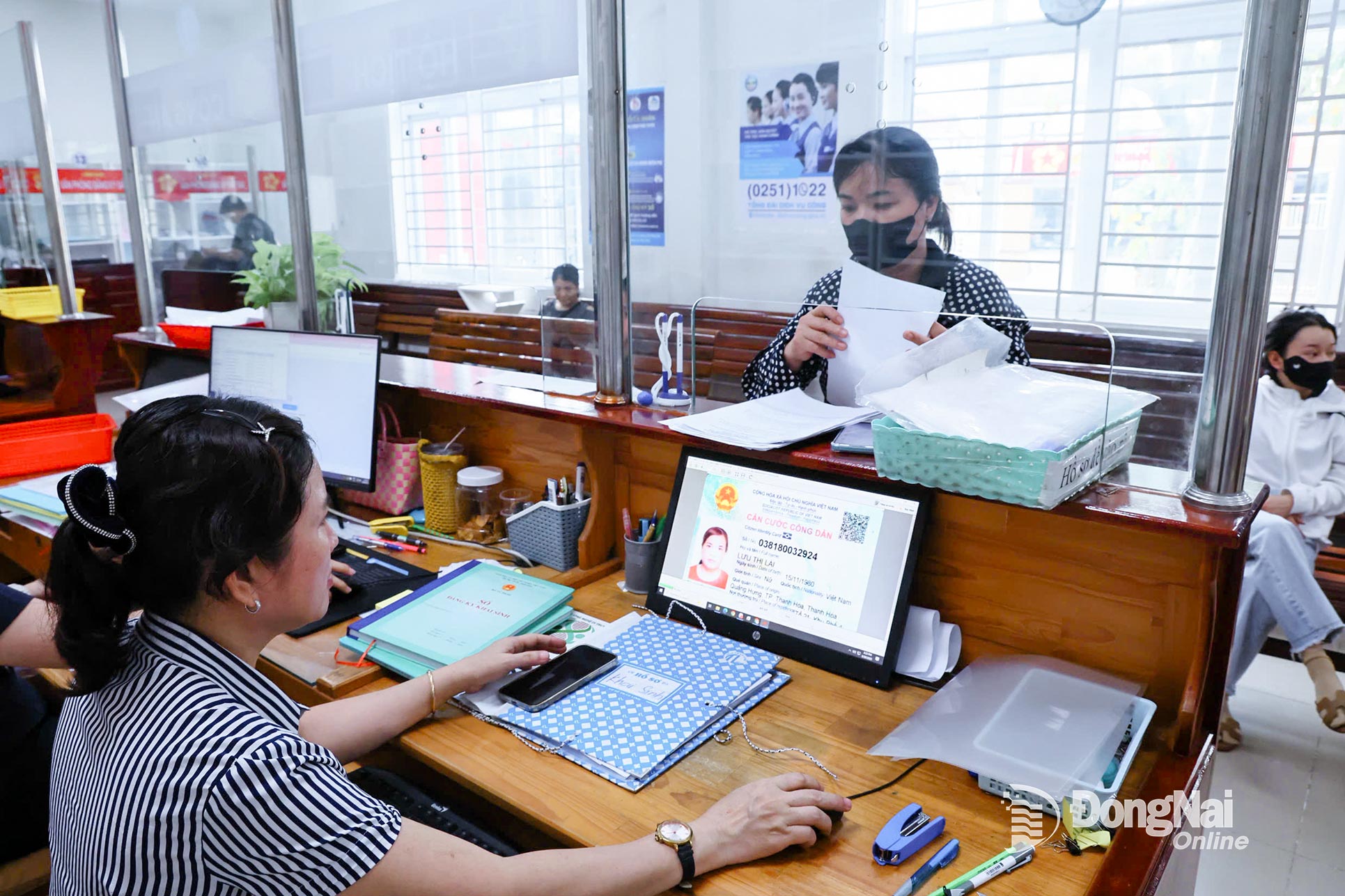 |
| Trang Dai ward officials update data on the National Population Data System to handle administrative procedures. Photo: Cong Nghia |
One of the three strategic breakthroughs outlined in the Draft Political Report of the Dong Nai Provincial Party Committee, set to be presented at the 1st Provincial Party Congress for the 2025-2030 term, is the push to advance science and technology, innovation, and digital transformation. The report also stresses the need to accelerate administrative reform; to build a professional, modern, efficient, and effective administrative system that serves both citizens and businesses, aligned with the development of digital government, digital economy, and digital society. It further underscores the importance of ensuring transparency and openness, fostering a favorable investment and business environment, and enhancing the province's competitiveness.
Practical results
During the 2020-2025 term, Dong Nai has made notable strides in science and technology as well as digital transformation. The province issued a dedicated resolution on digital transformation, integrating it with administrative reform and the development of e-government.
Several foundational databases have been established, laying the groundwork for digital governance. Key digital government initiatives in public security, healthcare, and education have been effectively implemented. The 4G/5G network now covers 100% of central areas, accompanied by the completion of intelligent operation centers at both the provincial and district levels.
Science and technology activities have shown positive progress. Numerous research projects aligned with practical needs have been commissioned; the science and technology market has begun to take shape; and the startup and innovation ecosystem has been initiated. These are the "first building blocks" forming the foundation for Dong Nai's entry into the digital economy era.
According to the draft documents of the 1st Dong Nai Provincial Party Congress, the province aims to increase the digital economy's contribution to GRDP to over 30% by 2030. To realize this goal, Dong Nai will boost investment in research infrastructure and focus on developing high-tech industries, including biotechnology, artificial intelligence (AI), semiconductors, advanced materials, and automation.
The province also plans to implement special policies to attract domestic and international experts and scientists; establish innovation hubs, high-tech zones, and concentrated information technology parks; and foster a dynamic startup and innovation ecosystem. Efforts will be made to promote public-private investment in science and technology and to develop a service market for technological connection and transfer.
In addition to these efforts, Dong Nai views the development of digital infrastructure, digital government, and digital society as a new catalyst for sustainable growth. The aim is not only to enhance administrative efficiency but also to foster an open investment and business environment, thereby boosting the province's competitiveness.
Overcoming challenges, promoting advantages
Dong Nai possesses numerous advantages in executing this breakthrough. Firstly, its strategic location at the gateway to the Southern region positions the province as a significant industrial and service hub. Furthermore, it boasts modern telecommunications infrastructure, featuring 4G/5G coverage and established intelligent operation centers. The province also employs a robust decentralization mechanism based on the principle of "locality decides, locality acts, locality takes responsibility," which fosters flexibility in implementation.
Regarding the foundation of administrative reform, the province has consistently ranked in the upper tier of the Public Administration Reform (PAR) Index for many consecutive years, achieving initial results in the development of e-government. Dong Nai is also an appealing destination for numerous high-tech foreign direct investment (FDI) enterprises, creating opportunities to disseminate new knowledge and technology.
However, Dong Nai is encountering challenges, such as a shortage of high-quality human resources and inadequate scientific and technological capacity to meet demands. Additionally, socio-economic infrastructure remains unfinished, and there is a lack of specific preferential policies to attract high-tech investment. Development disparities continue among regions, with rural, mountainous, and ethnic minority areas still facing limited access to technology, posing a risk of a "digital divide."
Dong Nai is also under pressure regarding capital and technology investments in key industries such as semiconductors, AI, and new materials. The challenges of cybersecurity and high-tech crime are becoming increasingly complex, directly impacting the trust of residents and businesses.
To ensure the successful implementation of this breakthrough task, Dong Nai must complete special policy mechanisms and request that the Central Government permit preferential arrangements regarding capital, land, and taxes for high-tech and innovation projects. It is crucial to make significant investments in digital infrastructure, including enhancing connectivity in rural and mountainous areas and constructing large data centers to support the Southern key economic region. There is a pressing need to robustly develop digital human resources by connecting universities and research institutes with businesses, while incorporating digital transformation and innovative startups into general education and vocational training. At the same time, efforts are being made to strengthen regional and international linkages, deepen participation in global value chains, and collaborate with technology corporations to "leapfrog" in development. It is crucial to integrate administrative reform with digital transformation by streamlining procedures, digitizing public services, and ensuring transparency to combat corruption, waste, and misconduct.
According to the Draft Political Report presented at the 1st Dong Nai Provincial Party Congress (2025-2030 term), the province aims to raise the added value of the digital economy to over 30% of GRDP by 2030. To achieve this goal, Dong Nai emphasizes that digital transformation must go hand in hand with administrative reform. In other words, all technological advancements must contribute to streamlining procedures, enhancing transparency and openness, reducing misconduct, and delivering the highest quality services to both citizens and businesses.
Dong Nai is presented with a significant opportunity for a breakthrough if it effectively harnesses the "dual driving force" of digital transformation and administrative reform. Initial results have shown that the province can truly become a model for digital government and the digital economy for the entire country. However, achieving the goal of becoming a modern industrial and service province, with the aim of meeting the basic standards of a centrally governed city by 2030, necessitates strong determination, coordinated implementation from policy to action, and active participation from residents and businesses. If executed successfully, this breakthrough will not only stimulate growth for Dong Nai but also create a ripple effect in the effort to build a strong and prosperous Vietnam in the digital age.
By: Nguyen Phuong
Translated by: Huyen Trang - Minho



Thông tin bạn đọc
Đóng Lưu thông tin