
Formerly known as Hamlet 4 in Phu Dien commune, Tan Phu district, the area was renamed Phu Dien 4 hamlet, Phu Hoa commune, Dong Nai province, following administrative restructuring of the local political system. This land was once part of the historic Cao Cang village, located in Cao Cang hamlet, Binh Tuy Canton, Long Khanh district, Bien Hoa province (in the past).
 |
| Rice fields in Phu Dien 4 Hamlet, Phu Hoa Commune, are nearing harvest. Photo: D. Phu |
Lotus and rice blend in harmony
In celebration of the 80th anniversary of the August Revolution (August 19, 1945 – 2025), Phu Dien 4 hamlet is awash in the vibrant hues of flags and flowers, blending seamlessly with golden rice fields and blooming lotus ponds. Nguyen Ngoc Son, Secretary of the Party Cell and Head of Phu Dien 4 Hamlet, temporarily set aside his work to help a neighboring hamlet with roadside weeding before taking time to speak with us.
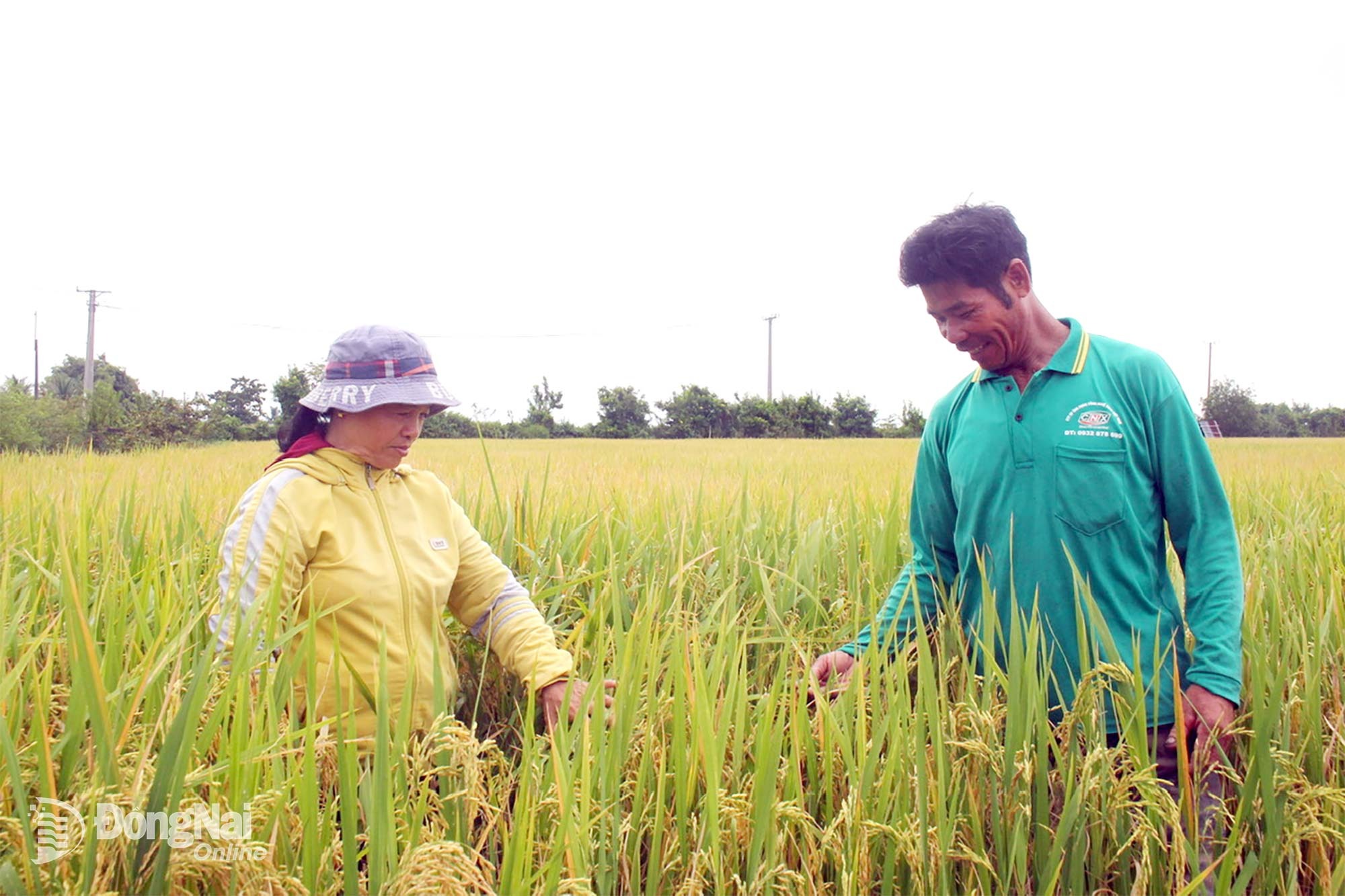
Son shared: “Phu Dien 4 hamlet has maintained the landscape of a model new-style rural area, it comprises 9 residential clusters with 428 households, covering a natural area of 320 hectares, nearly 300 hectares of which are dedicated to rice and lotus cultivation. Most households earn their living mainly from rice farming (three crops a year), lotus cultivation often combined with fish farming and small-scale services. Here, people live in harmony and community bond, amid sprawling golden rice fields and vibrant pink lotus ponds.”
Rice and lotus are signature crops of Phu Dien 4 Hamlet and other hamlets in Phu Hoa commune. This is made possible largely due to the Dong Hiep irrigation dam, which ensures water supply during dry seasons and flood drainage during the rainy season.
“Rice paddies and lotus ponds not only provide a stable income for residents of Phu Dien 4 Hamlet in particular and Phu Hoa commune in general but also help preserve the tranquil and picturesque landscape of the old Cao Cang village.” said NGUYEN HONG PHUC, Head of Culture and Social Affairs of Phu Hoa commune.
Farmer Nguyen Van Hanh from Cluster 5 explained: Local farmers grow lotus primarily for seeds (buds), unlike in other regions where lotus is cultivated for lotus stems, roots or leaves. While lotus cultivation combined with fish farming is more demanding than growing rice, it offers nearly double the profit.
In Phu Dien 4 Hamlet, rice growing area covers about 170 hectares, with average yields of 7 - 8 tons per hectare per crop. When it comes to rice farming, few in this area haven’t heard of the four brothers, namely Nguyen Thanh Hoang, Nguyen Thanh Huy, Nguyen Thanh Cuong, and Nguyen Thanh Do. Not only do they possess large areas of rice, but their fields also yield an average of 10 - 11 tons per hectare thanks to their dense, even sowing and meticulous care through every fertilizer and pesticide cycle. Not a single clump of wild grass or rogue rice plant is left unremoved.
Farmer LUONG VAN LOI said: “People here don’t distinguish between long-time residents and newcomers. Folks from all over the country have settled here as one family, sharing both joy and hardship. This spirit of solidarity is a hallmark of the Vietnamese settlers who once chose the former Cao Cang village for land reclamation and cultivation.
“Densely sowing seeds does increase the cost of seeds, fertilizer, and labor compared to sparse planting. However, that extra cost is minor, and I’m seeing yields 3 tons per hectare higher,” shared Nguyen Thanh Hoang.
A glimpse of old Cao Cang
Beyond the rice paddies and swaying lotus ponds in the sun and breeze by the Dong Hiep irrigation dam, Phu Dien 4 Hamlet still deeply carry the cultural essence of old Cao Cang village with residential areas shaded by lush green trees and blooming flowers.
According to The History of the Phu Dien commune Party Committee (1975–2020), Cao Cang Hamlet was established in 1939 as part of Binh Tuy Canton, Long Khanh district, Bien Hoa province. The present-day Phu Dien was known as Cao Cang Hamlet (Cao Cang Village) back then. As such, locals in Hamlet 4, Phu Hoa commune take pride in their roots as descendants of the old Cao Cang village.
Having lived in Hamlet 4 since 1985, Secretary of the Hamlet Party Cell Nguyen Ngoc Son recalled: In 1956, a group of migrants from the northern provinces arrived, followed by more settlers from provinces and cities between 1961 and 1975. Before 1975, the area was largely wild, with most residents surviving by fishing and not being rely on reclaiming uncultivated land and wild swamps. Only after 1975 did locals begin converting the marshlands into farmland for rice, fish, and lotus.
“To reclaim a single hectare of rice field, I had to spend years clearing weeds and improving the land overgrown with weeds. We used streams to carry away clumps of grass to the river. Since the terrain was uneven, we divided the land into small plots, high ground for broadcasting seeds, lower areas for transplanting them. In waterlogged and muddy areas where the water reached up to our waists and rice couldn’t grow, we planted lotus and raised fish.” recalled Nguyen Ngoc Son.
The breeze from Dong Hiep irrigation dam whispers in the air, blending with birdsong as an encouragement for farmers of Phu Dien 4 Hamlet to continue to produce bumper crops of rice and lotus. After guiding us through his family’s fields, farmer Doan Minh Hoai took us to visit the model residential area of Group 2. “We always strive to preserve the culture of the old Cao Cang village in a way not only to keep it beautiful, but to make it a place worth living, and rich in human warmth.”
Farmer NGUYEN THANH HUY, Phu Dien 4 hamlet said: “Fresh lotus buds here sell for 12,000 to 15,000 VND per kilogram, sometimes even over 30,000. Compared to rice, lotus brings in higher income and better returns. But lotus only thrives in marshy lowlands, which is why the old Cao Cang land has long been distinguished by two signature crops of lotus and rice.”
By: Doan Phu
Translated by: Minh Hanh - Thu Ha


Thông tin bạn đọc
Đóng Lưu thông tin