
On the afternoon of August 22, a national online conference was held in Hanoi to review the 2024–2025 academic year and implement tasks for the 2025–2026 academic year. Attending and chairing the conference was Politburo Member, Prime Minister Pham Minh Chinh. Co-chairing were Member of the Party Central Committee, Deputy Prime Minister Le Thanh Long, and Member of the Party Central Committee, Minister of Education and Training Nguyen Kim Son.
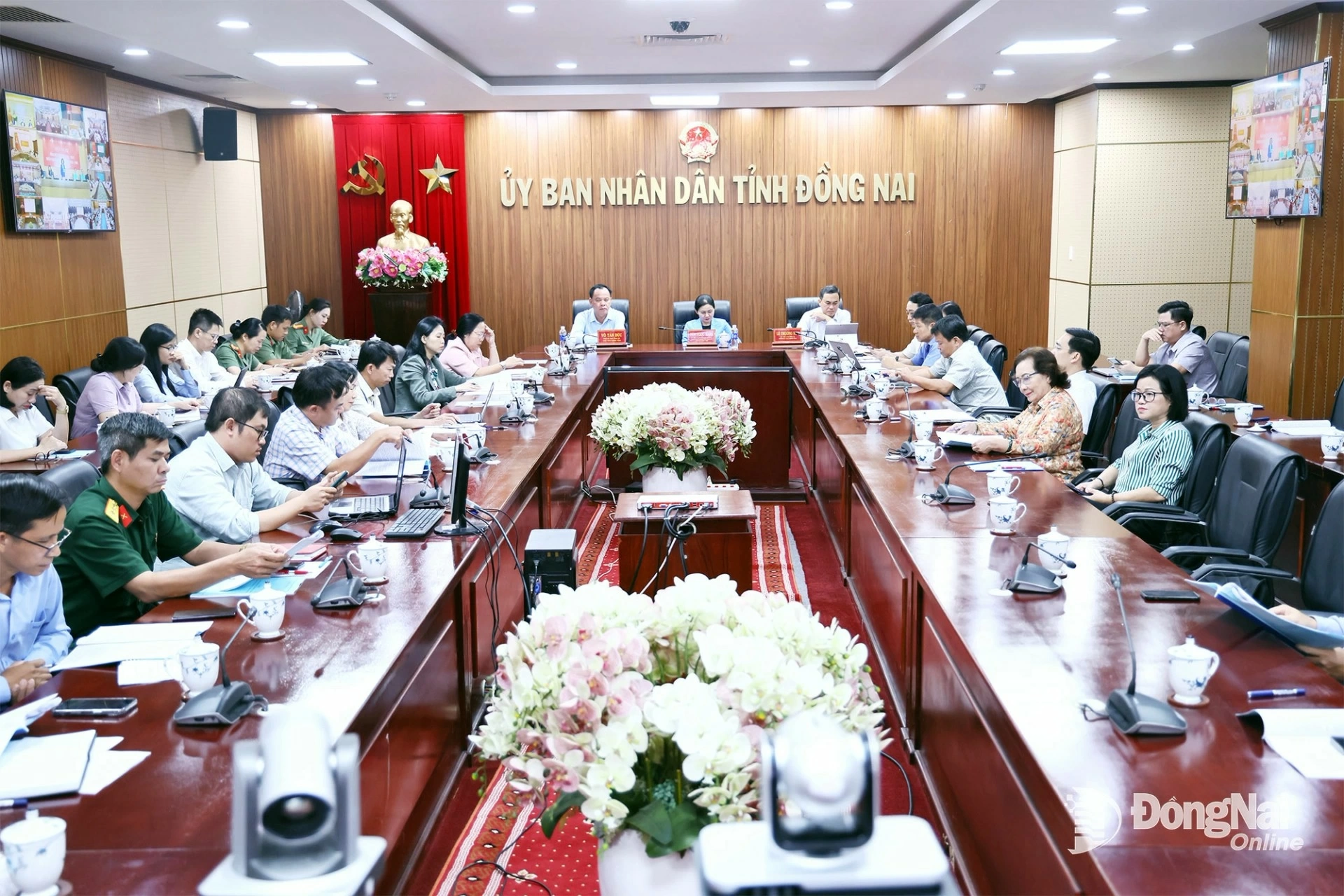 |
| Leaders of Dong Nai province together with provincial departments, sectors, and localities attend the conference. Photo: Cong Nghia |
The conference was connected online with People’s Committees of provinces and cities as well as universities across the country.
At the Dong Nai provincial government hub, participants included: Ton Ngoc Hanh, Alternate Member of the Party Central Committee, Permanent Deputy Secretary of the Provincial Party Committee, Chairwoman of the Provincial People’s Council; Vo Tan Duc, Deputy Secretary of the Provincial Party Committee, Chairman of the Provincial People’s Committee; Le Truong Son, Member of the Provincial Standing Party Committee, Vice Chairman of the Provincial People’s Committee; the Board of Directors of the Department of Education and Training; together with provincial departments, agencies, localities, and universities.
The 2024–2025 academic year took place against a backdrop of positive socio-economic developments nationwide; and the political system was streamlined for greater effectiveness and efficiency. Major policies of the Party and State continued to be refined and implemented synchronously, creating favorable conditions for the education sector to successfully carry out its mission. This was also the time when the education sector implemented the Government’s Action Program to enforce the Politburo’s Conclusion No. 91-KL/TW (August 12, 2024) on continuing Resolution No. 29-NQ/TW regarding the fundamental and comprehensive renovation of education and training. It also marked the final academic year of implementing the Resolution of the 13th Party Congress, paving the way for the 14th Party Congress.
 |
| Board of Directors of the Dong Nai Department of Education and Training attend the conference. Photo: Cong Nghia |
Teaching and learning quality continued to improve, while examinations underwent reforms to better reflect actual teaching and learning outcomes, encouraging teachers and students to adopt more effective methods. Investment in school infrastructure and teaching equipment—especially for schools in remote areas—received significant attention. The sector also accelerated digital transformation in management, teaching, learning, and assessment, while actively promoting training in emerging fields such as Artificial Intelligence (AI), semiconductors, and chips. In particular, during the 2024–2025 academic year, Vietnamese students once again achieved high results in international competitions, consistently ranking among the top 10 countries and territories in participation and performance.
The 2025–2026 academic year will be the first to implement the Resolution of the 14th National Party Congress and the Politburo’s resolution on breakthrough development of education and training. Therefore, the entire sector is determined to act effectively under the theme: “Discipline, Innovation, Breakthrough, Development.”
 |
| Politburo Member, Prime Minister Pham Minh Chinh delivers directive remarks at the conference. Photo: Nhan Dan Newspaper |
In his address, Prime Minister Pham Minh Chinh affirmed the vital role of education and training, especially during a period of national growth. He emphasized that the Party Central Committee, the Politburo, the Secretariat—led by Party General Secretary To Lam—attach great importance to education and training, introducing numerous breakthrough policies, particularly the “four strategic pillars” now being vigorously advanced.
The Prime Minister stressed that the education sector must shift from viewing education and training as the responsibility of the education sector alone to recognizing it as a shared duty of the entire political system, the people, and society. The focus must be shifted from merely imparting knowledge to fostering comprehensive competencies of learners, while reforming thinking, methodology, and approaches so that every citizen—especially the disadvantaged, those in remote areas, and ethnic minorities—can access education on an equal basis.
He instructed the sector to develop advanced, modern, and unified curricula and teaching materials, aligned with national development needs. Education must combine learning with practice, ensure genuine learning, genuine examinations, and genuine effectiveness.
Priority should be given to investing in facilities and equipment for preschools and general education institutions to meet the requirements of the 2018 Preschool and General Education Programs. The sector must build and develop a teaching workforce with the qualities and capabilities needed to meet current demands; resolve teacher shortages and surpluses; and ensure the principle that “where there are students, there must be teachers in the classroom.”
The Prime Minister paid particular attention to education for children and students in economically disadvantaged areas, ethnic minority communities, mountainous regions, border areas, and islands. He directed the implementation of a policy to support lunch meals for primary and lower-secondary students in land-border communes starting from the 2025–2026 school year.
The Government leader requested the entire education sector to thoroughly grasp and decisively implement the Politburo’s resolution on breakthrough development of education and training as soon as it is promulgated; continue reviewing and planning networks of preschools, general education, continuing education, special education, universities, pedagogical colleges, and vocational education institutions. Relevant stakeholders are tasked with building integrated primary–lower secondary boarding schools in 248 land border communes, with an initial pilot of constructing or upgrading 100 schools in 2025.
By: Cong Nghia
Translated by: Trieu Ngan - Thu Ha


Thông tin bạn đọc
Đóng Lưu thông tin