
In the journey of spreading literacy in border areas, Vietnamese is not only a means of communication but also the “key” that opens the door of knowledge for every ethnic minority student. Ahead of the new school year, many schools in Dong Nai Province have organized Vietnamese language enhancement classes for pre-primary students. These classes are not only a preparation in terms of knowledge but also a way to bridge educational gaps, helping the children become more confident and ready for the learning path ahead.
Breaking down language barriers
In the picture of border area education, one of the greatest challenges faced by ethnic minority students is language. Many children grow up speaking only their mother tongue and only start learning Vietnamese once they enter school. This unfamiliarity often makes them shy, hesitant to communicate, and directly affects their learning. For this reason, ahead of each new school year, Vietnamese language enhancement classes for pre-primary students have been organized at many schools across the province, considered it the first important step in addressing the “language bottleneck.”
This year, at Loc Hoa Primary and Secondary School in Loc Thanh commune, 64 ethnic minority students are enrolled in these enhancement classes. In the early days, most of them are timid, even reluctant to talk to friends or teachers.
Teacher Nguyen Thi Hien, Loc Hoa Primary and Secondary School, shared: “Most students, before entering Grade 1, are only familiar with speaking their mother tongue and have never used Vietnamese. As a result, when they come to school and meet teachers and peers, they often feel shy and hesitant to communicate. Thanks to the Vietnamese enhancement classes, the children have shown clear changes. They now know how to greet, how to talk, and are becoming more confident day by day. The most encouraging thing is that they no longer fear coming to school but instead begin to feel excited and eager to learn.”
 |
| Teacher Nguyen Thi Hien – Loc Hoa Primary and Secondary School, Loc Thanh commune – teaches ethnic minority pre-primary students how to tell a fairy tale. Photo: Thanh Thao |
After just 1-2 weeks, clear changes have become evident: shy glances are replaced with smiles, nods give way to greetings and words. This newfound confidence is not only a positive sign of knowledge acquisition but also evidence of the effectiveness of a consistently applied educational approach.
Hoang Thi Anh Hong, Vice Principal of Loc Hoa Primary and Secondary School, affirmed: “Ethnic minority students are often timid and limited in communication. When they enter Grade 1, they can easily feel lost and lag behind their peers in more advantaged areas. Therefore, organizing Vietnamese enhancement classes ahead of the school year is absolutely essential. In just 1-2 weeks, the children become familiar with the primary school environment, meet their teachers, and practice greeting and communicating. This not only helps them become more confident from their very first day at school, but also lays the groundwork for smoothly acquiring knowledge throughout their learning journey.”
 |
| At Loc Hoa Primary and Secondary School, Loc Thanh Commune, alongside teaching, teachers also actively carry out efforts to encourage students to attend class. Photo: Thanh Thao |
Strengthening Vietnamese language skills goes beyond simply teaching literacy, it also helps maintain students’ attendance. Many children who were at risk of dropping out to follow their parents to the fields are now more attached to school, thanks to teachers’ persistent encouragement. Removing language barriers is clearly not just the task of a single classroom, but a strategic solution to “keep students in school” and build a solid foundation for the years ahead.
Starting from the very first lessons in life
If Vietnamese is the key to unlocking the door of knowledge, then enhancement classes are the first step to ensure ethnic minority students can firmly hold that key in their hands.
At Loc Phu Primary and Secondary School (Loc Quang commune), 44 ethnic minority students have been divided among 3 satellite sites to take part in Vietnamese enhancement classes before entering the new school year. Here, lessons go beyond literacy, extending to everyday practices such as greetings, self-introductions, getting used to chalkboards and chalk, and learning basic concepts.
Teacher Truong My Hanh, who directly teaches Vietnamese enhancement to ethnic minority students, shared: “We start with what may seem very small – greetings, how to stand and sit, recognizing tall and short, long and short. Then, the children practice introducing themselves, their families, and their homes. Alongside this, teachers familiarize them with small boards, pieces of chalk, and their very first letters. Most importantly, they are trained in basic communication skills so that when they enter Grade 1, they can speak up with confidence and keep pace with the program.”
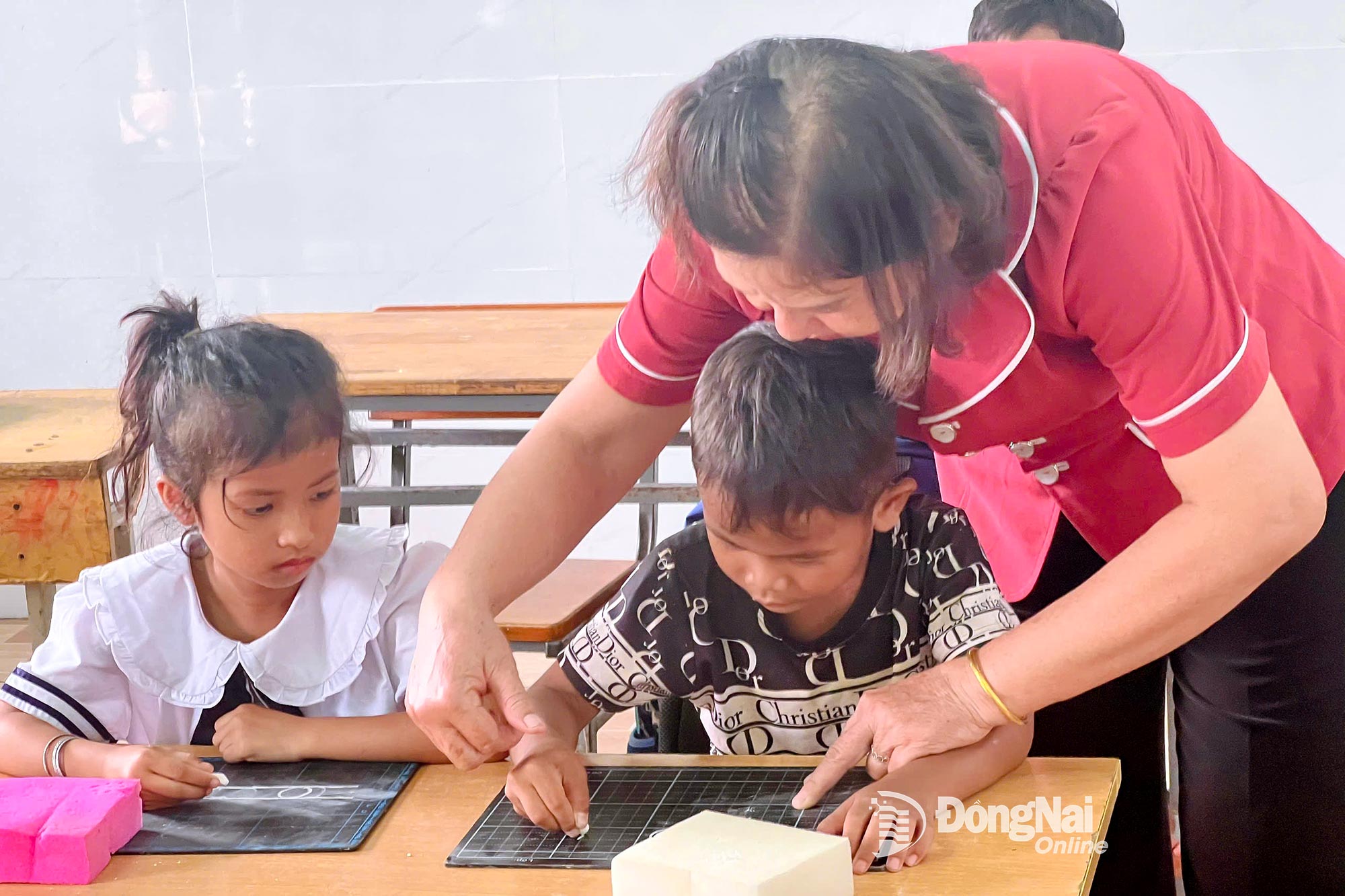 |
| At Bu Linh satellite site of Loc Phu Primary and Secondary School (Loc Quang commune), teacher Truong My Hanh teaches students how to get familiar with small boards and chalk. Photo: Thanh Thao |
Vietnamese enhancement classes go beyond handwriting practice, creating a learning environment where children can “learn through playing and play through learning.” Teachers make use of pictures, stories, folk games, and children’s songs to turn lessons into engaging moments. Each song sung, each group game played not only brings joy but also helps students absorb Vietnamese naturally and in a familiar way.
Mai Thi Phuong, Vice Principal of Loc Phu Primary and Secondary School, shared: “The school takes the initiative in building a pre-primary program that is close to the children’s daily lives, integrating plenty of visual materials, games, and songs so that learning becomes as natural as playing. At the same time, the school assigns teachers who not only have good expertise but also understand local culture and are dedicated to their profession. Thanks to this, teaching Vietnamese is not only more effective but also makes the children feel more familiar, comfortable, and eager to go to school.”
 |
| At Loc Phu Primary and Secondary School (Loc Quang commune), Vietnamese enhancement classes not only focus on handwriting practice but also create a space where children “learn through playing and play through learning,” sparking excitement and the love for school. Photo: Thanh Thao |
Reality has shown that these classes not only provide knowledge but also inspire the passion for learning. Students who were once timid and unfamiliar with Vietnamese now raise their hands to speak, confidently greet their teachers, and chat with friends. Though small, these changes lay a solid foundation to ensure they are not left behind from their very first school year.
At the same time, efforts to encourage school attendance are also carried out in parallel by teachers. Many of them travel long distances, visiting families to persuade parents to send their children to classes on a regular basis. It is this persistence that has helped maintain the students’ attendance, ensuring that the seeds of knowledge are not missed from the very first days.
The Vietnamese enhancement program is a key strategy, helping students practice all 4 skills – listening, speaking, reading, and writing – while getting familiar early with the learning environment. Photo: Thanh Thao
 |
 |
| At Loc Phu Primary and Secondary School (Loc Quang commune), Vietnamese enhancement classes not only focus on handwriting practice but also create a space where children “learn through playing and play through learning,” sparking excitement and the love for school. Photo: Thanh Thao |
Vietnamese enhancement classes in disadvantaged areas may be modest, but they embody a persistent journey of nurturing literacy. Through the dedication of teachers, Vietnamese is not only a language of communication but also a bridge that carries ethnic minority students into the world of knowledge. From those very first lessons, seeds of hope are sown, so that in the future, these children will grow mature, continue their journey of learning, and contribute to enriching and beautifying their homeland.
By Thanh Thao
Translated by Quynh Giao – Thu Ha


Thông tin bạn đọc
Đóng Lưu thông tin