
With the rapid development of technology, digital transformation has been reshaping the way people live, study, work, entertain themselves, and interact with the world around them. To avoid being left behind in the digital era, many officials, members of women’s unions, and women in general have proactively sought out and learned digital knowledge and skills to integrate effectively into the technological age.
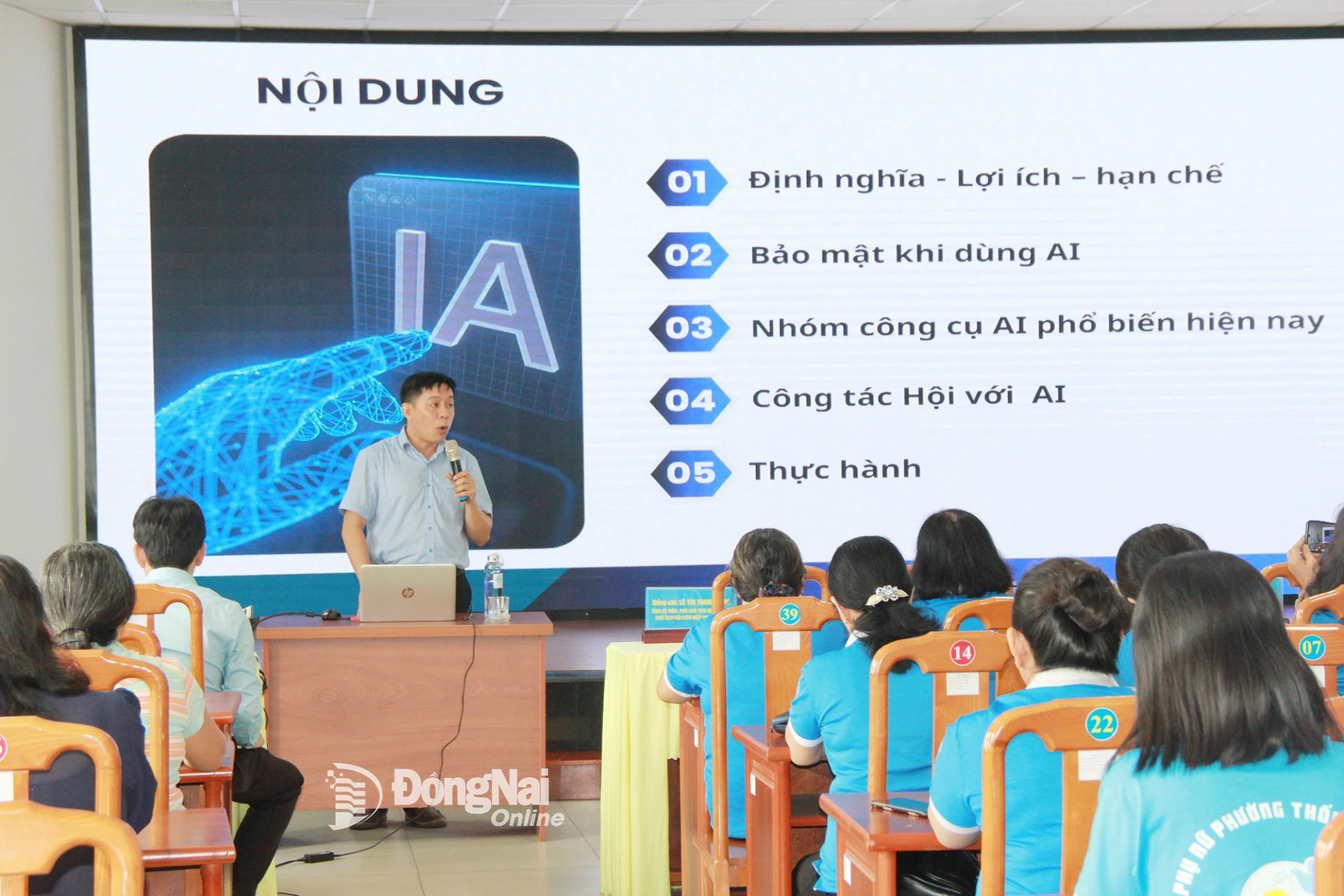 |
| Officials and members of the provincial women’s union receive training on using artificial intelligence in union activities. Photo: Nga Son |
Proactive engagement
Although no longer young and challenged by the use of smart devices and digital applications such as social networks, e-wallets, and online public services, Dao Thi Thanh (a resident from quarter 3, Bien Hoa ward) has taken the initiative to learn so as not to feel left behind in the context of digital transformation.
Thanh said that after acquiring a smartphone, she asked her children and grandchildren to show her how to use its functions, and how to use Facebook and Zalo to follow and share information and connect with relatives and friends. In addition, to avoid depending on her children for paying utility bills, she had them install her bank’s mobile app and teach her to pay bills via bank transfer. She also taught herself to use the benefits provided by an electronic ID account.
According to Thanh, at first she could not manage the operations immediately, but after being shown several times and experimenting by herself, she became familiar with them. Using smart devices and digital applications has helped her resolve many daily matters quickly.
“Previously, whenever I needed to pay a bill, I had to go to a payment point. If I wanted to buy something, I had to go to a shop. Now I can pay all bills and order products online right from home, very convenient,” Thanh said.
Proactively acquiring digital skills not only helps women’s union members and women in general to enjoy a more comfortable life, but also enables them to perform their work more effectively.
As Secretary of the Party cell and Head of quarter 9, former Trung Dung ward, now Tran Bien Ward, Pham Ngoc Ha understands the benefits of technology in handling work. She explained that in the current period, it is essential to constantly update information. Whenever she needs to research a topic, draft documents, or consult materials, she uses ChatGPT selectively. However, she emphasises that this is only a reference tool, and she always cross-checks with official sources. Beyond serving herself, she also promotes and guides others in digital knowledge and skills.
Extensive implementation of the digital literacy campaign
According to Bui Thi Hanh, Vice Chairwoman of the Dong Nai Provincial Women’s Union, digital transformation is taking place strongly and has become an inevitable trend. Popularising digital knowledge for the entire population — including women’s union members, especially those with limited access to technology and enabling them to master digital skills is crucial.
 |
| Officials of local women’s union branches and groups use internet-connected smartphones to follow digital transformation training sessions organised by the provincial Women’s Union. Photo: Nga Son |
With the goal of “leaving no one behind” in the digital era, the Vietnam Women’s Union has launched the “Digital Literacy Campaign” to raise awareness, encourage self-learning, and foster proactive participation in the digital space, contributing to the country’s overall development.
Following the directions of the Vietnam Women’s Union and the Provincial Party Committee, the Dong Nai Women’s Union has recently developed a plan and launched the Digital Literacy Campaign across all levels of the union in the province. The campaign aims to equip officials, members, and women with basic digital skills; teach them to act safely and responsibly online; and help them use digital platforms effectively for life, work, and family activities, thereby narrowing the digital gap among women across regions, educational levels, and age groups.
In addition to defining objectives, requirements, content, annual and 2030 targets, the plan outlines key tasks and solutions for the coming period. It also selects commune- and ward-level women’s unions to pilot models such as: Digital Union Branches, Digital Union Groups, Digital Families, “1+1” Digital Guides, Digital Women, Digital Women’s Clubs for Digital Transformation Assistance, Digital Business Women’s Groups, Digital Markets – Digital Rural Areas, and “Each Citizen – One Digital Identity.”
According to the plan, by 2030 the goal is for 100% of officials, members, and women aged 18 and over in the province to be equipped with basic digital skills, and for 100% of full-time union officials and branch/group leaders to be proficient in using digital applications.
To ensure the Digital Literacy Campaign takes root and attracts broad participation, Bui Thi Hanh stressed that commune- and ward-level women’s unions must proactively develop plans suitable for their specific target groups and local conditions, with clearly defined goals, targets, and solutions for each year and phase. Women and citizens must be placed at the centre, and cooperation with tech-savvy youth should be strengthened to diversify learning formats. Alongside organised activities, each official, member, and woman should be encouraged to self-learn, actively participate in the digital space, must strive to become digital citizens, and contribute positively to the development of their hometowns and the nation.
By: Nga Son
Translated by: Quynh Nhu - Thu Ha


Thông tin bạn đọc
Đóng Lưu thông tin