
In 2025, Dong Nai province set a target to reduce electricity consumption by at least 2.1% of the total commercial electricity output. By the end of July 2025, the province had already surpassed this goal, achieving an electricity savings rate of over 2.2%.
 |
| Electricity saving propaganda activities at Tan Quan Secondary School in Tan Quan commune (Dong Nai province). Photo: Ngoc An |
This result not only surpassed the set target but also contributed to fostering energy-saving habits within the community, while ensuring a safe and stable electricity supply to support socio-economic development.
Communication drives results
In the first quarter of 2025, the provincial People’s Committee issued Plan No. 75/KH-UBND to implement a program on efficient energy use and sustainable production and consumption. The plan set a target to reduce total electricity consumption by at least 2.1 percent. Specific goals included a minimum 5 percent reduction in administrative agencies, 30 percent savings in public lighting, and 2.1 percent savings in the commercial services and industrial production sectors.
To implement the above plan, the Department of Industry and Trade, Dong Nai Power Company, urban infrastructure management units, industrial zones, and local authorities jointly carried out a range of coordinated solutions, with a strong focus on public communication and education.
According to Tran The Du, Deputy Director of Dong Nai Power Company, since early 2025, the company and its affiliates have rolled out various energy-saving measures. In addition to media campaigns via newspapers, social media, and internal communication channels, in the second quarter of 2025, the company collaborated with the education sector to organize 18 extracurricular sessions involving thousands of teachers and students.
Moreover, the company hosted an online contest titled “Customers and Energy Efficiency Solutions” with over 11,700 participants. Nearly 2,000 employees were also encouraged to participate in the national online competition “Understanding Energy Efficiency”, organized by the Ministry of Industry and Trade.
In addition to the general campaign, communication efforts were customized for each customer group. For households, the campaign encouraged the use of LED lighting and high-efficiency energy-saving appliances. In terms of public lighting, the power sector collaborated with infrastructure management units to adjust operational settings, reducing light intensity based on seasons and time of day. For public administrative agencies, departments were required to submit electricity usage data from the previous year and propose plans to cut consumption by at least 5%. Local power companies also advised communes and wards to issue regulations on efficient electricity use and conduct periodic monitoring and evaluation of implementation results.
For commercial and service customers, electricity providers offered tailored consultations, encouraged businesses to reduce lighting for advertisements and signage by 50%, and limited electricity use during peak hours. In the industrial sector, facilities consuming high amounts of energy were required to comply with the Law on Economic and Efficient Use of Energy, conduct energy audits every three years, and schedule production to avoid peak-hour loads. The province also promoted the installation of rooftop solar systems and participation in demand-side management and load adjustment programs.
Thanks to these comprehensive and decisive efforts, in the first seven months of 2025, Dong Nai saved over 268 million kWh of electricity, equivalent to 2.25% of its total commercial electricity output, exceeding the 2.1% target. This endeavor not only eases pressure on the electricity supply but also promotes sustainable consumption habits and contributes to environmental protection.
Fostering habits of energy conservation
According to leaders of Dong Nai Power Company, energy conservation is a regular and ongoing political task. In the coming period, as the new academic year stabilizes, the power sector will continue to coordinate with schools to organize extracurricular activities on electricity saving for teachers and students. At the same time, the company will maintain community-based communication efforts, monitor electricity usage through the online system, and implement incentive programs to recognize individuals and organizations that practice effective and consistent energy-saving behaviors.
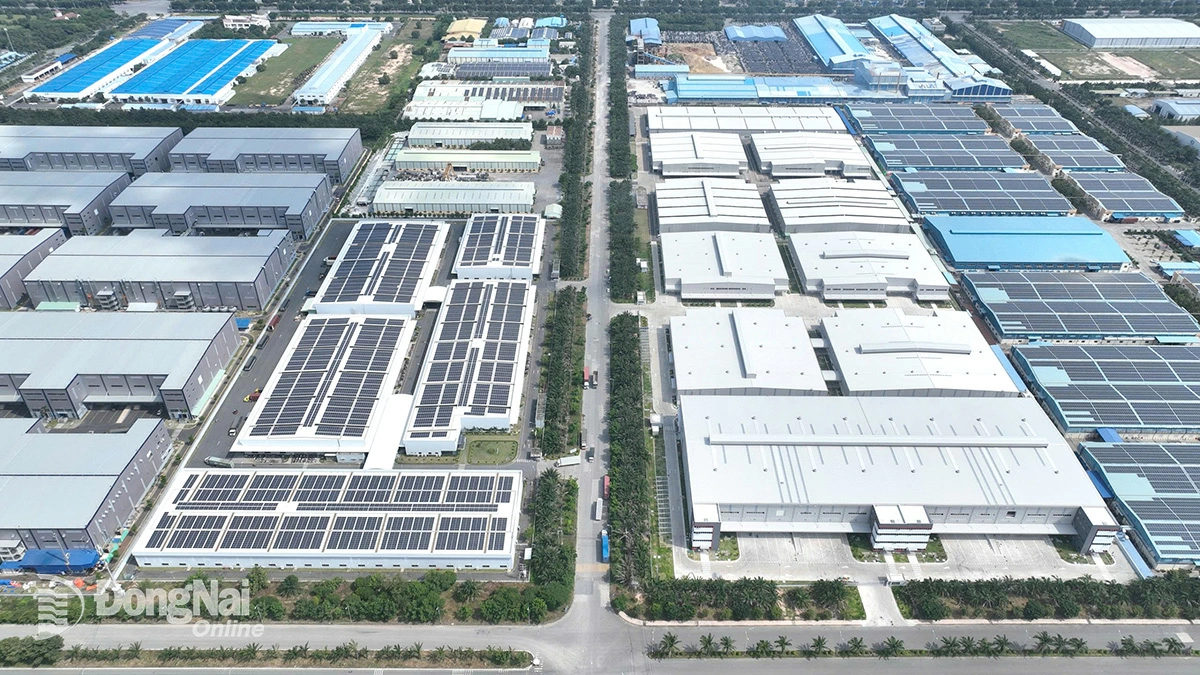 |
| Rooftop solar power system invested by KTG Industrial in Dong Nai. Photo: Provided by the unit |
With results achieved in the first seven months of 2025 and ongoing solutions, Dong Nai Power Company is confident it will meet, and even surpass, its 2025 electricity-saving (power efficiency) target. This accomplishment is not only a milestone in energy management but also a practical contribution to the province’s goals for sustainable development and environmental protection.
From a business perspective, a representative of KTG Industrial Dong Nai Co., Ltd., a member of KTG Industrial, said that “sustainability” is now one of the top three criteria for companies when choosing industrial real estate. Accordingly, KTG Industrial is aligning its growth with ESG (Environmental, Social, and Governance) standards and aims to reach net-zero carbon emissions by 2050.
For example, at Nhon Trach 2 Industrial Park (Nhon Trach District, Dong Nai Province), the company has installed a centralized wastewater treatment system and increased the use of natural daylight panels on roofs, walls, and windows to save energy. Other industrial zones have been equipped with LED lighting systems and EMS (Energy Management Systems) that monitor energy performance and carbon emissions while providing early warnings. These initiatives help reduce operating costs, save energy, cut emissions, and improve maintenance efficiency, ensuring compliance with international standards.
Many enterprises are investing in modern production lines, applying advanced technology, implementing energy management procedures, and engaging employees in energy-saving practices. Notably, several businesses have boldly invested in rooftop solar power systems to harness clean energy and reduce reliance on the national power grid, especially during peak hours.
In the agricultural sector, drip irrigation systems are replacing traditional watering methods and are now being widely adopted by thousands of farmers. This model supports energy-efficient and environmentally friendly farming. Water is delivered directly to plant roots, minimizing losses and significantly reducing pump operation time. Drip irrigation not only saves electricity and water but also helps plants grow better, increasing productivity and producing higher quality.
Provincial Party Committee Member and Vice Chairwoman of the Dong Nai People’s Committee Nguyen Thi Hoang emphasized that electricity saving is no longer merely encouraged, as it has become a mandatory requirement for many stakeholders. This practice not only brings economic benefits to users but also eases pressure on the power supply and helps ensure national energy security. Furthermore, saving electricity is a civilized habit that plays an important role in environmental protection, reducing greenhouse gas emissions, and supporting Dong Nai’s goal of green and sustainable development.
By Ban Mai
Translated by Hong Van - Minho


Thông tin bạn đọc
Đóng Lưu thông tin